AMPLIFIER MOUNTING CONFIGURATION OPTIONS
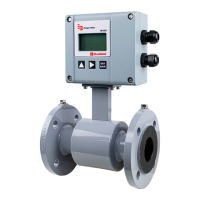
There are two configurations for mounting the amplifier and many options to accommodate a variety of meter placement
and environmental conditions.
Meter Mount Conguration
The meter mount configuration has the amplifier mounted directly on the detector. This compact, self-contained
configuration minimizes installation wiring.
Remote Mount Conguration
The remote mount configuration places the amplifier at a location away from the fluid flow and detector. This is necessary in
situations where process fluid temperature or the environment exceeds amplifier ratings.
The detector and amplifier are connected by wires, run through conduit, between junction boxes on the detector and the
amplifier. The distance between the detector junction box and amplifier junction box can be up to 150 feet (50 meters). A
remote mounting bracket is supplied.
Use a remote mount configuration in the following cases:
• Detector protection class IP 68
• Medium temperature > 212° F (100° C)
• Strong vibrations
DO NOT INSTALL THE SIGNAL CABLE CLOSE TO POWER CABLES, ELECTRIC MACHINES, ETC.
MAKE SURE THAT SIGNAL CABLES ARE SECURELY FASTENED. DUE TO CAPACITY CHANGES, CABLE MOVEMENTS MAY
RESULT IN INCORRECT MEASUREMENTS.
FOR MEDIUM TEMPERATURE HIGHER THAN 158° F 70° C MAKE SURE THAT ANY CABLE IS NOT IN CONTACT WITH THE
HOT SURFACE OF THE DETECTOR.
Submersible Option
If you are installing the meter in a vault, you should order the remote mount, submersible amplifier option. You must not
install the amplifier inside a vault. This will eliminate any potential problems resulting from humidity or temporary flooding in
the vault.
OTE: N National Electronics Manufacturer's Association (NEMA) 6P enclosures are constructed for indoor or outdoor use
to provide protection against access to hazardous parts; to provide a degree of protection against ingress of solid
foreign objects and water (hose directed water and the entry of water during prolonged submersion at a limited
depth); to provide an additional level of protection against corrosion and will be undamaged by the external
formation of ice on the enclosure.
Protection Class
To fulfill requirements of the protection class, follow these guidelines:
• BODY SEALS NEED TO BE UNDAMAGED AND IN PROPER CONDITION.
• ALL OF THE BODY SCREWS NEED TO BE FIRMLY TIGHTENED.
• OUTER DIAMETERS OF THE USED WIRING CABLES MUST CORRESPOND TO CABLE INLETS (FOR M20 DIAMETER 5…13
MM). IN CASES WHERE CABLE INLET IS NOT USED, PUT ON A DUMMY PLUG.
• TIGHTEN CABLE INLETS.
• IF POSSIBLE, LEAD CABLE AWAY DOWNWARDS. HUMIDITY MUST NOT GET INTO CABLE INLET.
ModMAG® M1000 Electromagnetic Flow Meter
Page 14 March 2020MAG-UM-00379-EN-07


 To Next Page