• WE NORMALLY DELIVER THE METER IN ACCORDANCE WITH PROTECTION CLASS IP 67. IF YOU HOWEVER REQUIRE A
HIGHER PROTECTION CLASS, THE AMPLIFIER IS TO BE INSTALLED SEPARATELY FROM THE DETECTOR. IF REQUESTED,
WE CAN ALSO DELIVER THE DETECTOR IN IP 68.
• LES JOINTS DE CORPS NE DOIVENT PAS ÊTRE ENDOMMAGÉS ET ÊTRE EN BON ÉTAT.
• TOUTES LES VIS DE CORPS DOIVENT ÊTRE FERMEMENT SERRÉES.
• LE DIAMÈTRE EXTÉRIEUR DES FILS DE CÂBLAGE UTILISÉS DOIVENT CORRESPONDRE AUX ENTRÉES DE CÂBLE (POUR
M20 DIAMÈTRE 5…13 MM). DANS LES CAS OÙ L'ENTRÉE DE CÂBLE N'EST PAS UTILISÉE, METTEZ UNE FICHE ISOLANTE.
• SERREZ LES ENTRÉES DE CÂBLE.
• SI CELA EST POSSIBLE, DIRIGEZ LE CÂBLE VERS LE BAS. ÉVITEZ QUE DE L'HUMIDITÉ NE PÉNÉTRE DANS L'ENTRÉE DE
CÂBLE.
• LE COMPTEUR OFFERT EST NORMALEMENT CONFORME À LA CLASSE DE PROTECTION IP 67. CEPENDANT, SI
VOUS EXIGEZ UNE CLASSE DE PROTECTION SUPÉRIEURE, L'AMPLIFICATEUR DOIT ÊTRE INSTALLÉ SÉPAREMENT DU
DÉTECTEUR. SUR DEMANDE, LE DÉTECTEUR PEUT ËTRE OFFERT EN IP 68.
METER GASKETS AND GROUNDING
Gasket and grounding requirements must be considered when determining the meter location, orientation and application.
Meter/Pipeline Connection Gaskets
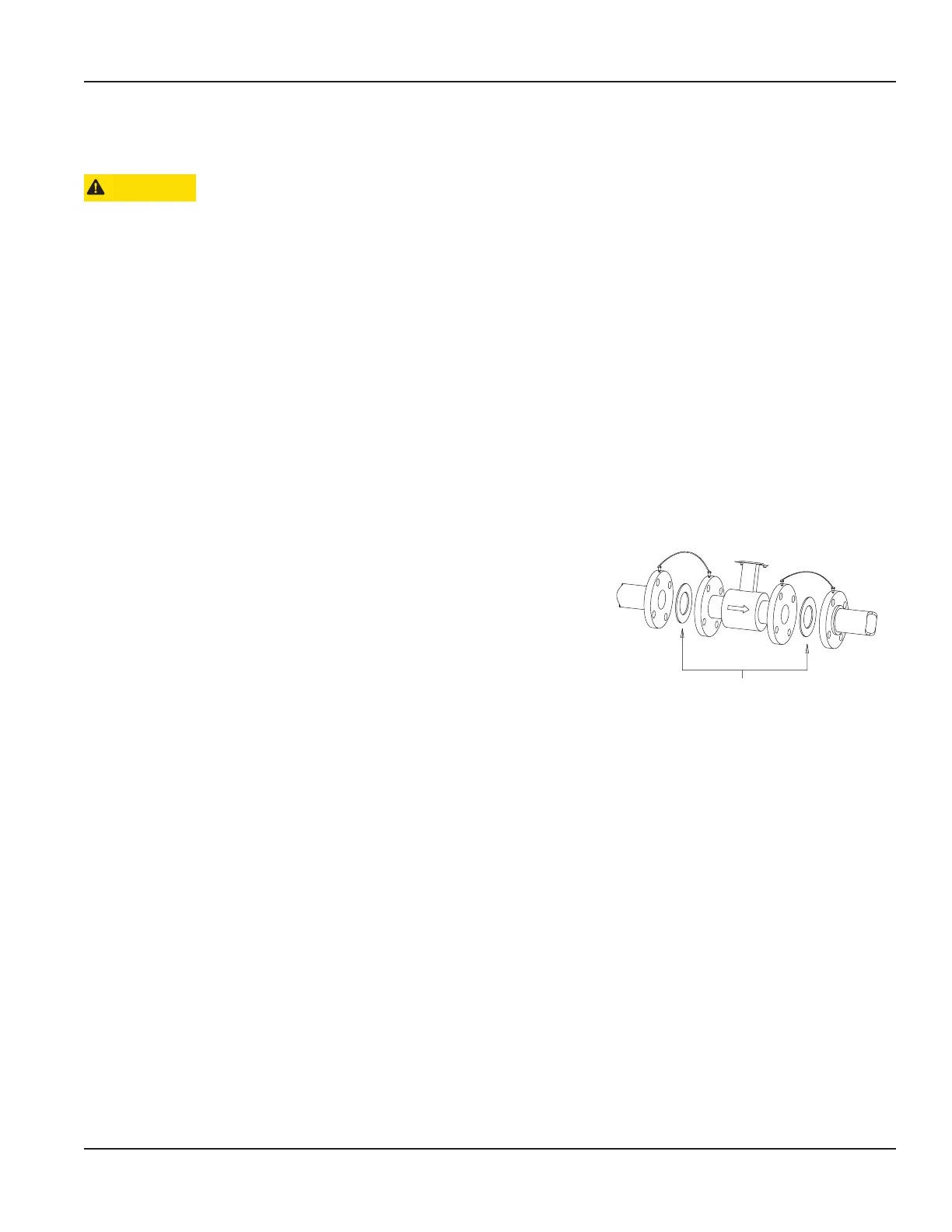
You must install gaskets (not provided) between the detector's isolating liner
and the pipeline flange to ensure a proper and secure hydraulic seal. Use gaskets
that are compatible with the fluid. Center each gasket on the flange to avoid flow
restrictions or turbulence in the line.
During installation, do not use graphite or any electrically conductive sealing
compound to hold the gaskets. This could compromise the accuracy of the
measuring signal.
If you are using a grounding ring in the detector/pipeline connection, place the
ring between two gaskets. (See “Pipelines with Cathodic Protection” on page16.)
Figure 20: Meter/pipeline connection gaskets
Meter Grounding
Process pipeline material can be either electrically conductive (metal) or not electrically conductive (made of or lined with
PVC, fiberglass or concrete).
IMPORTANT
It is essential that the meter amplifier’s input ground (zero voltage reference) be electrically connected to the liquid media and to a
good, solid earth ground reference.
Conductive Pipe Grounding
To achieve an adequate ground, the meter body MUST be electrically connected to the liquid media. The meter flanges are
provided with grounding bolts for this purpose.
If the pipe material is electrically conductive, simply install grounding straps between these grounding bolts and the
mating flanges.
To provide a good electrical connection at the mating flanges, we recommend that you drill and tap the flanges and install a
grounding screw (not provided).
Grounding straps must be copper wire, at least 12 AWG size. They must be connected on both sides (inlet and outlet) of the
detector and to a local, earth ground.
Meter Gaskets and Grounding
Page 15 March 2020 MAG-UM-00379-EN-07


 To Next Page