The Neoway N723-EA is an industry-grade cellular module designed for IoT communication devices. It supports LTE-FDD, LTE-TDD, WCDMA, and GSM network modes, making it suitable for applications such as wireless meter reading terminals, vehicle/handheld POS systems, and industrial routers.
Function Description
The N723-EA module integrates a baseband unit, power management unit, radio frequency unit, and flash storage unit. It provides a comprehensive set of digital interfaces for various applications, including I2S/PCM, RMII, USIM, USB2.0, UART, SDIO, SD/eMMC, I2C, and SPI.
- Cellular Connectivity: Supports LTE Cat. 4 for high-speed data transmission, as well as WCDMA and GSM for broader network compatibility.
- Data Communication: Facilitates data transmission through various interfaces like USB 2.0, UART, and RMII (Ethernet).
- Peripheral Integration: Allows connection to external devices via SDIO for WLAN, SD/eMMC for storage, I2S/PCM for audio, I2C, and SPI for other peripherals.
- Control and Management: Features control pins like PWRKEY_N and PWRKEY for module startup, shutdown, and reset. A SLEEP pin enables low-power consumption modes.
- Status Indication: Includes a RING pin for incoming call and SMS notifications, and a NET_LIGHT pin to indicate network status.
- Firmware Updates and Debugging: The USB_BOOT pin provides a mechanism to forcibly enter download mode for software upgrades and debugging.
Important Technical Specifications
- Dimensions: (30.00±0.10) mm × (28.00±0.10) mm × (2.95±0.20) mm.
- Package: LGA.
- Weight: Approximately 5.10 g.
- Temperature Ranges:
- Operating: -30°C to +75°C
- Extended: -40°C to +85°C
- Storage: -40°C to +90°C
- Operating Voltage (VBAT): 3.4 V - 4.2 V (typical 3.8 V).
- Operating Current (Typical):
- Sleep: ≤ 4.0 mA
- Idle: ≤ 35 mA
- Operating (LTE mode): ≤ 630 mA
- Application Processor: ARM Cortex-R5, up to 832 MHz main frequency, with 32 kB L1 command cache and 32 kB L1 data cache.
- Memory: RAM: 256 Mb, ROM: 128 Mb.
- Wireless Rate:
- GPRS: Max 85.6 Kbps (DL/UL)
- EDGE: Max 236.8 Kbps (DL/UL)
- WCDMA (HSPA+): Max 21 Mbps (DL)/Max 5.76 Mbps (UL)
- LTE-FDD (Cat4, no-CA): Max 150 Mbps (DL)/Max 50 Mbps (UL)
- LTE-TDD (Cat4, no-CA): Max 130 Mbps (DL)/Max 30 Mbps (UL)
- Transmit Power:
- EGSM900: +33 dBm (Power Class 4)
- DCS1800: +30 dBm (Power Class 1)
- EDGE 900 MHz: +27 dBm (Power Class E2)
- EDGE 1800 MHz: +26 dBm (Power Class E2)
- WCDMA: +23 dBm (Power Class 3)
- LTE: +23 dBm (Power Class 3)
- Antenna: 2G/3G/4G main antenna, 4G diversity RX antenna, all with 50 Ω characteristic impedance.
- Interfaces:
- UART: Three interfaces (one Debug UART), 1.8V/3.0V adaptive USIM.
- USB: One USB 2.0 interface.
- SDIO: One interface for WLAN.
- SD/eMMC: One interface for SD card or eMMC.
- PCM/I2S: One interface.
- RMII: One interface.
- SPI: One interface (host mode only).
- I2C: One interface (master mode only).
- GPIO: Four interfaces.
- AT Commands: 3GPP Release 9, Neoway extended commands.
- SMS: PDU, TXT.
- Data Protocols: PPP, RNDIS, TCP/TCPS, UDP, HTTP/HTTPS, FTP, MQTT.
- Certifications: CE, RoHS.
- ESD Protection: Contact Discharge: ±8 kV (GND, ANT, Cover), Air Discharge: ±15 kV (GND, ANT, Cover).
Usage Features
- Power Supply Design: Critical for stable operation, especially in GSM/GPRS burst mode. Recommended designs are provided for 3.4V-4.2V (battery), 4.2V-5.5V (computer internal rectifier), and 5.5V-24V (automotive industry) inputs. Low impedance power traces and large-capacity capacitors are essential to prevent voltage drops during current peaks.
- Startup and Shutdown:
- PWRKEY_N: Controls power-on/off and reset via low-level pulses. A pulse > 0.5s powers on, > 4s resets, and > 18s shuts down.
- PWRKEY: High-level control startup. Pulling to VBAT enables automatic startup upon power-on.
- Automatic Start: Can be configured to start automatically when powered up.
- Sleep Mode: The SLEEP pin, in conjunction with AT commands, controls entry and exit from low-power sleep mode, while maintaining RF functionality for incoming calls or SMS.
- USB Download Mode: The USB_BOOT pin allows forced entry into download mode for software updates and debugging, by pulling it to GND.
- UART Communication: Three UART interfaces are available: one for debugging (DEBUG_UART1), one for AT commands and hardware flow control (CP_UART), and one for general data communication (UART2). Level shifting circuits are recommended when the MCU's logic voltage differs from the module's 1.8V UART level.
- USIM Card Interface: Supports 1.8V/3.0V adaptive USIM cards. External pull-up resistors are required for USIM_DATA and USIM_DET. ESD protection diodes are recommended for signal cables in complex electromagnetic environments.
- SD/eMMC Interface: Supports 1.8V/3.0V dual voltages and various clock frequencies for SD card or eMMC chip connections.
- RF Interface: Requires 50 Ω impedance matching for antenna connections. L-type, T-type, or Pi-type matching networks are recommended, with Pi-network being preferred. Layout guidelines emphasize keeping RF signals and components away from high-speed circuits and power supplies.
- Antenna Assembling: The module supports GSC RF connectors (MM9329-2700RA1 from Murata is recommended) and PCB printing/SMT antennas (recommended for 2.4 GHz Wi-Fi or BT/BLE). The antenna standing wave ratio should be between 1.1 and 1.5, with 50 Ω input impedance.
- GPIO Interfaces: Four GPIOs with interrupt function, controllable via AT commands.
Maintenance Features
- ESD Protection: The module incorporates ESD protection on its main pins. When designing related products, additional ESD protection should be added according to industry standards to ensure product quality.
- Moisture Sensitivity: N723-EA is a level 3 moisture-sensitive electronic element. If exposed to air for extended periods after unpacking, it may get damp and require baking at >90°C for >12 hours before mounting to prevent damage during reflow soldering.
- SMT Guidelines: Recommended stencil thickness is 0.15 mm to 0.20 mm. Specific reflow oven temperature profiles are provided for leaded solder paste, emphasizing peak temperature and time above 220°C. Loading tools are recommended during SMT and reflow soldering to prevent PCB bending and poor solder joints.
- Troubleshooting: The USB_BOOT pin serves as a last resort for handling startup or running failures, facilitating software upgrades and debugging.
- Warranty: Neoway's warranty may be void if the module is disassembled without permission or if heat-responsive element abnormalities are caused by improper temperature control during SMT.

 Need help?
 General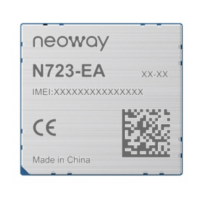

 To Next Page