NIRStar 14.1 - User Manual
Page 93 of 124
17.2.2 Channels Distance
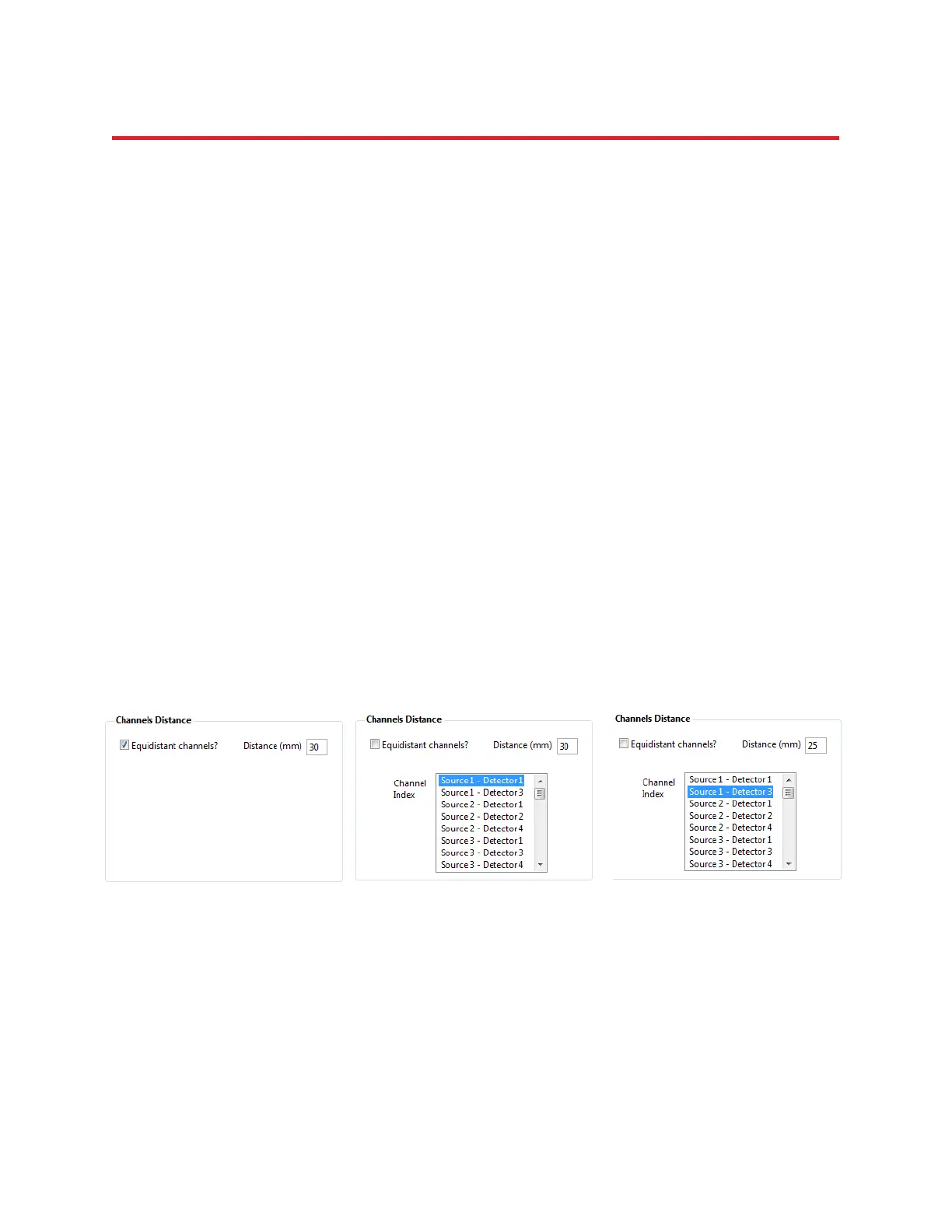
NIRStar 14 allows the user to enter individual source-detector pair distances for the channels enabled in
the Channel Masking tab (Figure 71) in the case that non-equidistant source-detector separation values
should be considered. These values will be considered in the calculation of the Hb/HbO concentration
changes performed by NIRStar. These values will affect only the display, NOT any saved data.
By default, all source-detector separations are considered equidistant (30mm). Unchecking the
‘Equidistant channels?’ box allows editing source-detector separation distances for individual channels
(Figure 71).
NIRStar uses an implementation of the modified Beer-Lambert Law to estimate the Hb and HbO changes
for the trace plots, topographic displays, and block average plots. The estimated concentration changes
scale linearly with the presumed source-detector distance. Therefore, specifying too short a distance will
underestimate, and specifying to long a distance will overestimate the displayed amplitude. In cases
where non-equal-distances are employed (e.g., 10-10 system positions) this may cause imprecise
amplitude estimates if the actual channel distances are not entered in the Channels Distance feature. For
qualitative real-time display purposes these uncertainties are usually uncritical.
Please note, however, that any off-line or real-time analysis relying on quantitative amplitude estimates
should take into account channel-distance variation.
Figure 71. specification of the channel distance.



 To Next Page