Basic Concepts
Basic Concepts
24 25
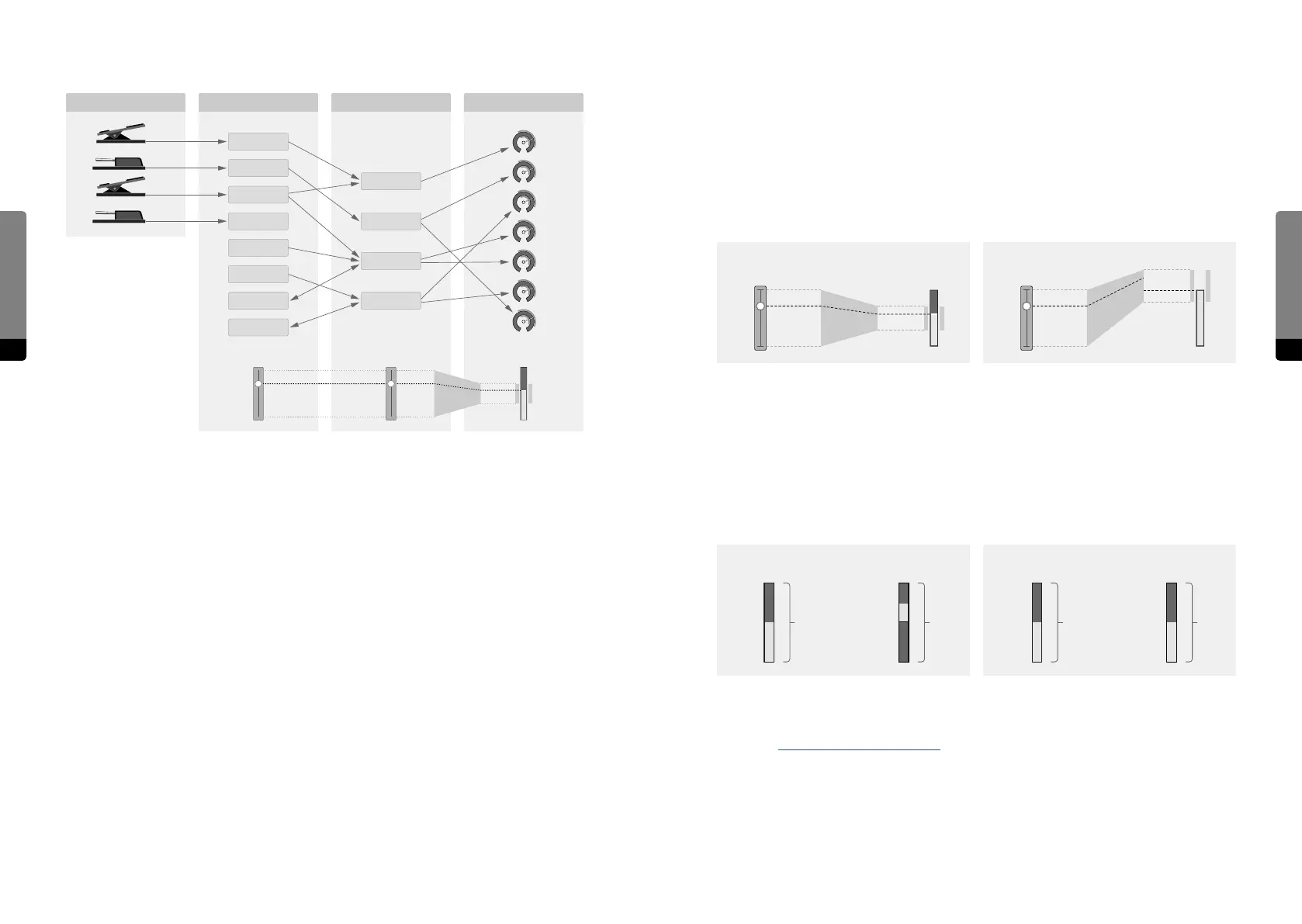
Modulation amounts define the range for target parameters in which to move according
to the corresponding Macro Control. As neither Macro Control nor the target parameter
change in position, the amount will always reflect the Macro Control position within the
modulation range (fig. 1)
There can be cases where the modulation range exceeds the parameter range, also called
virtual overdrive. When a modulation moves a parameter out of its operational range, it
will remain at the corresponding edge (clipped) until the modulation went back far
enough to fit the parameter range again (fig. 2).
When comparing unipolar and bipolar target parameters (fig. 3), it becomes obvious that
the full modulation range (-100% ... 100%) for bipolar parameters is eectively twice the
unipolar parameter modulation range (0% ... 100%).
When a target parameter has a linear scaling, the modulation amount can be displayed in
the same format, sharing the parameter’s unit. Nonlinear scalings of target parameters
require the modulation amount to be in percent (fig. 4).
More information about Hardware Sources and the modulation mechanism can be found
in chapter 5.4 Using Hardware Sources. The section „Modulation Aspects“ explains the
current standard setting, which is commonly used in the factory presets.
Macro Control Mod Amount ParameterMacro Control Mod Amount Parameter
fig. 1 fig. 2
unipolar bipolar
100 % 200 %
100 %
50 %
50 %
0 %
100 %
0 %
–100 %
150 ST 100 %
linear exponential
130 ST
55 ST
-20 ST
16000 ms
40 ms
0 ms
fig. 4fig. 3
3.4 Modulation Scheme
The modulation mechanism translates movements of the user performance (on the
Hardware Sources) into parameter movements, increasing the variation and expressivity
of a preset.
There is no automatic modulation (like an LFO - except for the Flanger) within the C15
instrument, only the user has an influence on movements.
In the sound engine, almost all parameters operate as smoothers. The smoothing time
depends on the instrument settings and operational context. (There is a smoothing time
for parameter edits, a transition time for preset recall and a smoothing time for modula-
tion as well, defined for each Macro Control, which is currently in development).
In a preset, the flow of movements is defined by several amount parameters, weighting
the amount and direction of movements. Each Hardware Source features a separate
amount for each Macro Control. Multiple Hardware Sources can aect one specific Macro
Control. Any target parameter features an MC selector and modulation amount, complet-
ing the routing of modulations. A target parameter can only follow one Macro Control.
The eect of Hardware Sources on Macro Controls is essentially dependant on the type
and settings of the source, so it is hard to generalize.
The eect of Macro Controls on target parameters on the other hand can be generalized.
Defining modulation aspects of a parameter happens in relative context to both the Macro
Control and the parameter as neither of them changes when editing modulation amounts.
External Devices Hardware Sources
Hardware Source
Macro Controls Target Parameters
Macro Control Mod Amount Parameter
Pedal 1
Pedal 2
Pedal 3
Pedal 4
MC A
MC B
MC C
MC D
Bender
Aertouch
Ribbon 1
Ribbon 2


 To Next Page