Parameter Reference
Parameter Reference
118 119
Scaling Types
linear
Most parameters have a continuous, linear scaling type.
This type is suitable when the displayed value is directly
proportional to the control position and precision remains
constant for the whole value range.
exponential
Envelope times and the Comb Filter Decay time have an
exponential scaling type, covering a wide value range with
decreasing precision. The displayed value doesn’t rise by a
constant value, but rather by a factor (20 per quarter).
parabolic
Some parameters (eect times for example) have a
parabolic scaling type instead of being linear. The displayed
value is proportional to the square of the control position
in this case. The resulting behaviour of the parameter feels
more realistic as if it would use linear scaling.
parabolic (gain)
The Mixer and Main Output levels come with a parabolic
gain scaling type and show their value in decibels (dB). At
minimum, they will mute the signal, at the center position,
they will not aect the signal at all and at maximum, they
will amplify the signal by 12 dB (~400%).
integer
Non-continuous parameters with discrete values (such as
Unison Voices and Scale Base Key) come with the integer
scaling type. This is suitable for suiciently low value ranges
and results in a switch-like behaviour. The fine mode is not
eective in this case.
Unit Reference
%
Amount-like parameters oen use a normalized value range in percent
(%), spanning from zero (or -100, when the parameter is bipolar) to 100
percent.
ms
Time-relevant parameters indicate their values in milliseconds (ms),
meaning that 1000 ms equal one second.
st
Pitch-relevant parameters indicate their values in semitones (st). The
interval of one semitone corresponds to two consecutive keys (at
default key tracking). 12 semitones equal one octave.
ct
The Scale Oset parameters are also pitch-relevant, but show their
values in cents (ct), oering more precision. 100 cents correspond to one
semitone.
dB
Gain-relevant parameters show their values in decibel (dB), the common
format of representing signal levels. Zero decibel correspond to 100 %
signal, and a dierence of 6 dB approaches a doubling of the signal.
dB_T
Attack and Release Velocity parameters come with a custom time-re-
lated format in decibel (dB_T). A full velocity will decrease the
corresponding Envelope segment time by the indicated value in dB (6
dB approaching 50 % of the given time).
dB/st
Envelope Level Key Track parameters come with a custom gain-related
format in decibel per semitone (dB/st). The corresponding gain will
change according to the played key by the given amount of decibel per
semitone.
Hz
The Flanger Rate parameter indicates its values in Hertz (Hz), the
number of oscillations per second.
deg
Phase-related parameters indicate their values in degrees (deg), mean-
ing that 360 degrees correspond to a full circle.
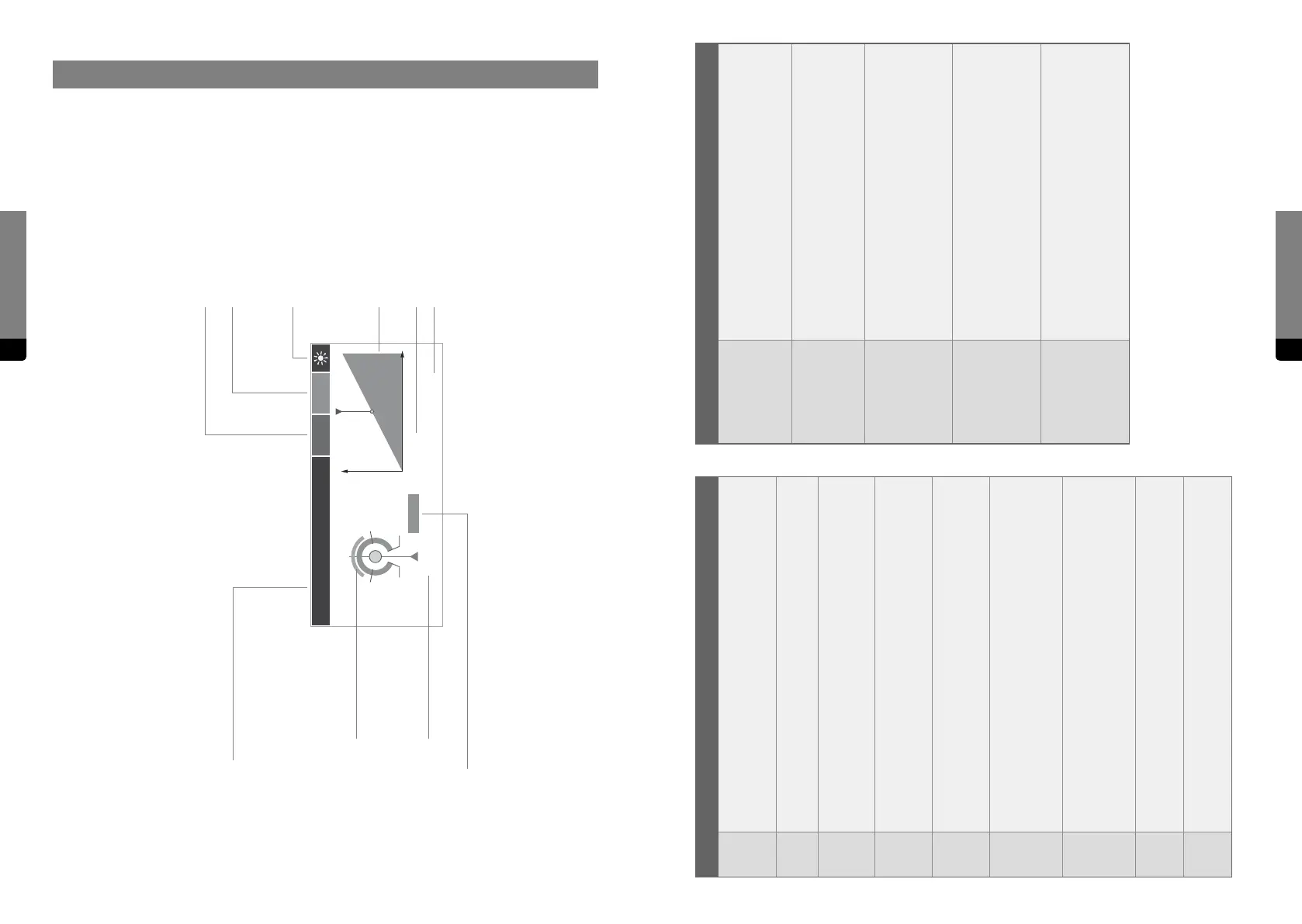
50.0
Parameter
% %
inf
50.0
75.025.0
100.0
linear
100 (1000) steps
Parameter Name
“inf” Indicator
Parameter Unit (see table below)
Modulation Indicator
Factory Default Value
Active Indicator
Modulation Unit
Value Graph, min to max
Scaling Type, see table below
Resolution, coarse (fine)
For some parameters at the lower or upper end
of their range the value will get infinite and will
be replaced by “-inf” or “inf”.
This symbol indicates if a parameter is
influencing the signal flow of the synth, as
indicated by its LED.
A modulation segment is shown, if a
parameter can be modulated.
The background color indicates if a parameter
is directly selectable on the Hardware User
Interface, being on top of the corresponding
parameter stack (dark grey), or if the selection
of this parameter takes more than one push of
a button (light grey).
If a parameter is a modulation target for
Macro Controls, the unit of the modulation
amount will be indicated.
0.0
9. Parameter Reference
Legend to signs and symbols


 To Next Page