Introduction
12
Introduction
13
1. Introduction
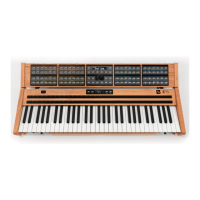
The C15 is an instrument for the performing musician, designed for playability and
detailed sound editing. Its unique sound character spans from crisp and organic to com-
plex and experimental. The top-quality semi-weighted keybed drives a digital synthesis
engine responding with a wide spectrum of sound colors and intensities.
As a dedicated real-time instrument, the C15 is built for human control. There are no
modulation sources or sequencing modules to create rhythmic patterns — we leave this
to the musician. Instead, the C15 is a decidedly responsive instrument which combines
high-resolution keys, Ribbons, and Pedal inputs.
Every parameter on the C15 can be directly selected by a button. In other words, all
functions are soware-defined but have a dedicated haptic control surface. In addition,
a Graphical User Interface can be displayed and edited on any device that has a browser
and Wi-Fi. Like many classical instrument builders, we have chosen wood for most parts
of the housing. All other parts are made of steel or aluminum. Along with the excellent
keyboard, there is a specially-designed ergonomic (pitch) Bender, two very long touch-
strips (Ribbons), and inputs for up to four Pedals.
Marks and Formats used in this Manual
Important notes begin with an exclamation mark and have a grey background:
߱ Ensure that the power supply is not interrupted when using the C15 …
A hint or a background information starts with an “i” symbol:
߰ If you encounter problems navigating the Setup menu intuitively, please refer to …
A section, explaining a user interaction or task has a heading on dark grey background:
Interaction
Typically, it will be first explained for the Panel Unit. If available (most times), it is followed
by an explanation for the Graphical UI and/or the Base Unit. This type of heading starts
with an arrow and has a lighter background:
→ Graphical UI
→ Base Unit
About the Manual Content
The following chapters refer to dierent important aspects of working with the C15 instru-
ment. Each chapter tries to exclude the „broader picture“ by focussing only on the crucial
related aspects. Nevertheless, this manual attempts to cover as many details as possible.
When using this manual, it may be helpful to first be certain about your aspect of interest,
before actually looking something up. The following overview may help clarifying:
2. Setting up the C15
At least for the first attempt of putting all components together, consider reading this
chapter describing the whole process.
3. Basic Concepts
This chapter outlines a general approach to the C15 instrument, explaining how to per-
form, how the modulation mechanism works and how everything is organized.
4. User Interfaces
This chapter explains how to actually work with the instrument. Methods of navigation,
editing and preset access are described in detail for each available interface.
5. The Synthesis Engine
All signal- or DSP- related aspects are subject of this chapter, including details on signal
synthesis and flow, tutorials as well as details on the integration of Hardware Sources.
6. Setup (C15 System Settings)
When already familiar with the instrument, the setup chapter provides insight into the
advanced system settings of the C15.


 To Next Page