134
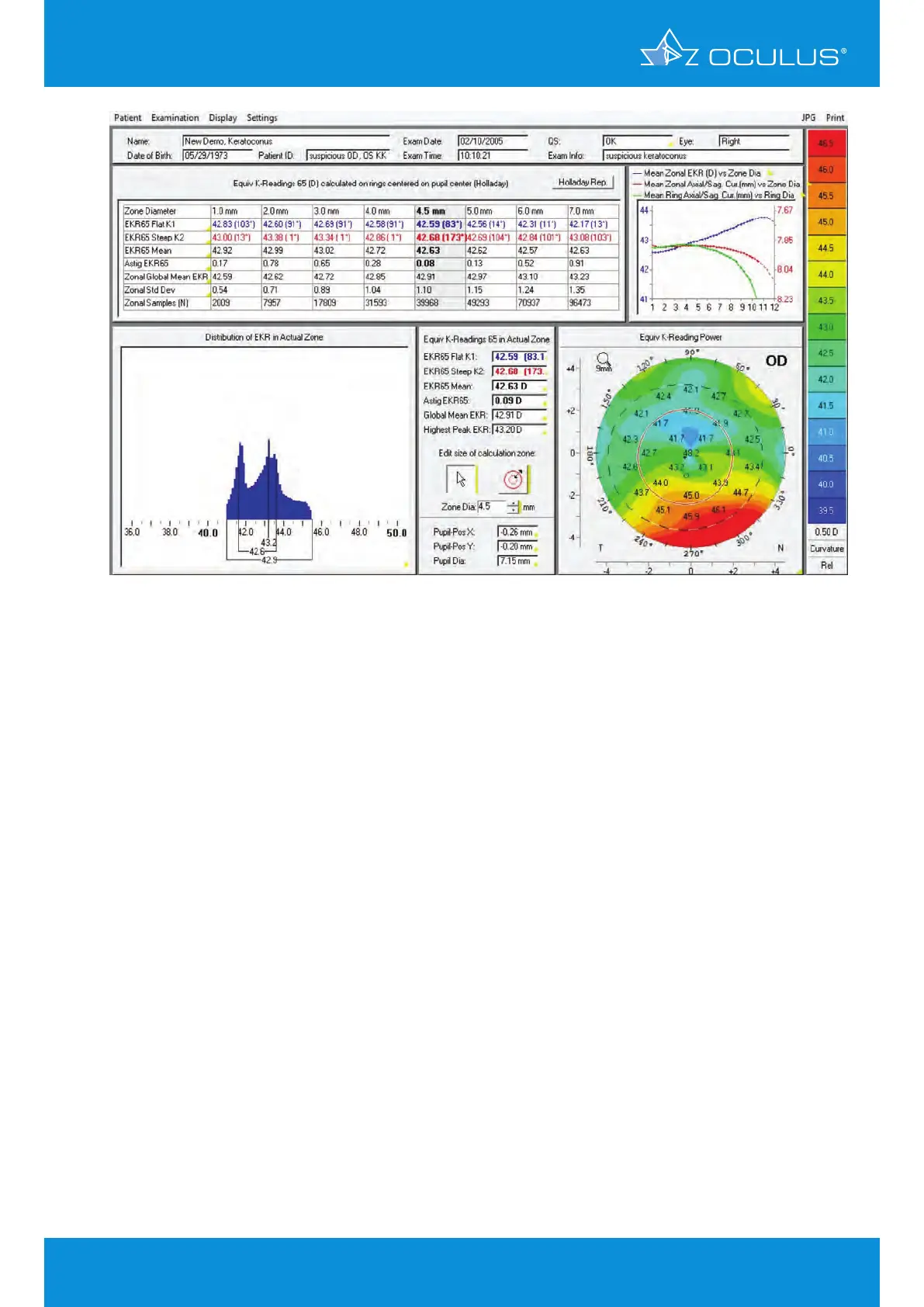
The distribution of EKR is a bimodal (2 peaks) (Figure 162) distribution, and the EKR65 of 42.63 D
is 0.57 D less than the 43.20 D peak. Standard keratometry usually measures nearer the peak and
will over-estimate the power in keratoconus, leaving the patient with a hyperopic surprise. In severe
cases, this difference may be up to 3 or 4 D. The K values that should be used for this case are the
EKR65 flat K1 = 42.59 A 83° and EKR65 steep K2 = 42.68 A 173°. In the EKR65 table the EKR65
mean varies very little, from 43.02 to 42.63 (0.39 D), from the 3 to 4.5 mm zone. The EKR65 power
increases SA as the pupillary diameter increases. This visual performance is also affected by KC and
is limited by the irregular astigmatism in the cornea. Regular astigmatism is also often present, but
determining the ideal toricity is ambiguous at best, and stability of the astigmatism is also a problem.
In our experience, determining the optimal toric IOL power almost always involves an intra-operative
refraction or postoperative refraction and a secondary procedure to achieve the optimal toric IOL.
Figure 162: Holladay EKR65 Detail Report from a keratoconus exam
17 Holladay Report & Holladay EKR65 Detail Report


 To Next Page