80
12 Belin/Ambrósio Enhanced Ectasia Display
12 Belin/Ambrósio Enhanced Ectasia Display
12.1 Why elevation is displayed
by Prof. Michael W. Belin
Before we can talk about how we display elevation tomographic data, we should take a step back
and understand why I am a proponent of elevation based tomography. To do that we need to have an
understanding of how elevation and curvature differ.
Using curvature to describe the cornea dates back to the early 1600s when father Christopher
Scheiner observed how glass spheres of different radii produced reflected images of different sizes.
He produced spheres of different curvature, simulating corneal parameters, and measured the
cornea by matching the size of the image reflected by the cornea with that of the calibrated sphere.
Late in the following century (1796), Ramsden introduced a measuring device that included both
a magnification and a doubling mechanism enabling the examiner to match the corneal reflection
to itself. This technique was popularized by Helmholtz in 1854, who coined the original term
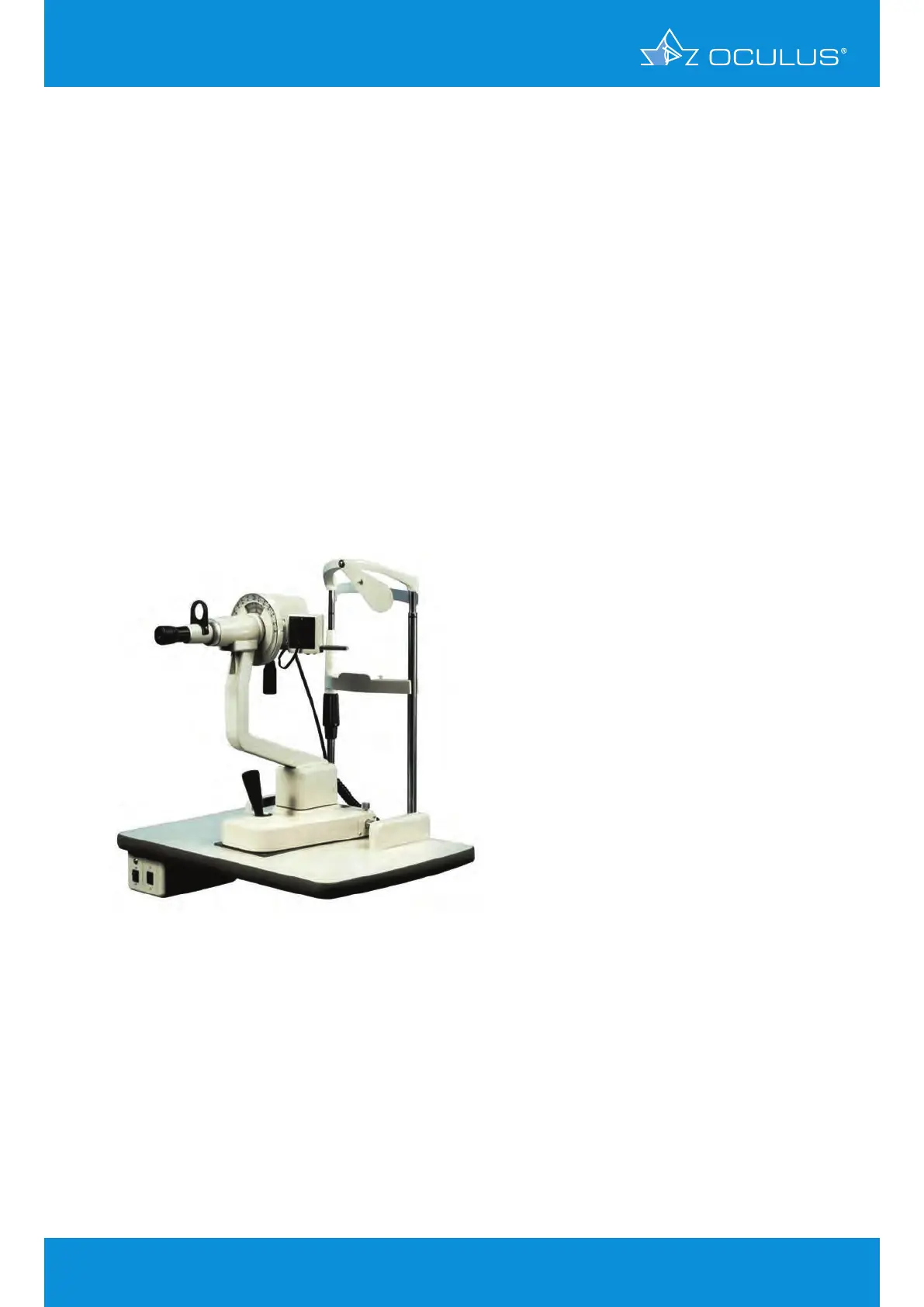
“ophthalmometer”. Javal and Schiotz further improved on its design in 1881 and that instrument
(Javal/Schiotz Ophthalmometer, (Figure 96) has remained essentially unchanged for over 130 years
and is marketed today as the Haag-Streit ophthalmometer.
Figure 96: Javal/Shiotz Ophthalmometer
A variation of the ophthalmometer in which the doubling device was internalized and the image
size fixed was called a keratometer and was further improved upon by Bausch and Lomb in 1932 to
allow simultaneous measurement of both principal meridians. The term keratometer is technically a
trade name for this specific device (Figure 97), but is the term most commonly used for the generic
technique of corneal measurement. Currently this is the most commonly used device for measuring
simple corneal curvature.


 To Next Page