83
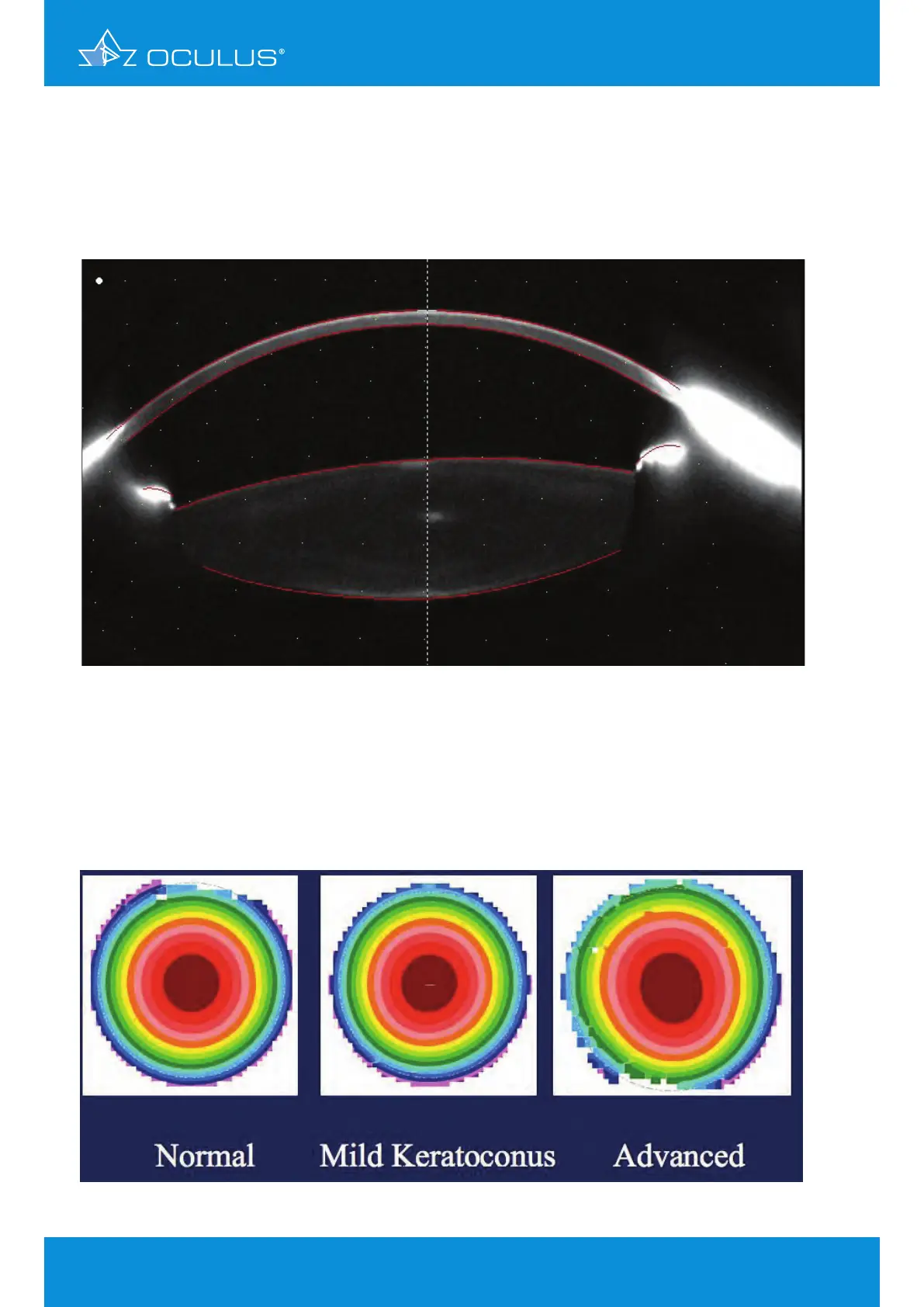
The Pentacam® uses a technique of optical cross-sectioning to identify the anterior and posterior
corneal surface, the anterior iris, and the anterior and posterior surface of the lens (Figure 100). By
measuring these surfaces and their relative position elevation maps of the anterior and posterior
cornea can be produced as well as a full corneal thickness map (additionally lens measurements,
but these will not be discussed here).
Corneal thickness maps are easy to comprehend. Corneal thickness is an absolute measurement
representing the distance between the anterior and posterior surface. Corneal thickness is reference
independent. Elevation is different. Elevation is measured by locating points in space and is
displayed relative to a reference surface. Raw elevation data is displayed (measured) against a
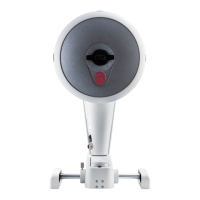
planar reference surface. This represents the “raw” elevation data (Figure 101).
Figure 100: Scheimpflug image
Figure 101: Raw elevation data
12 Belin/Ambrósio Enhanced Ectasia Display


 To Next Page