85
Since the goal of refractive screening is to allow the physician to easily separate normal from
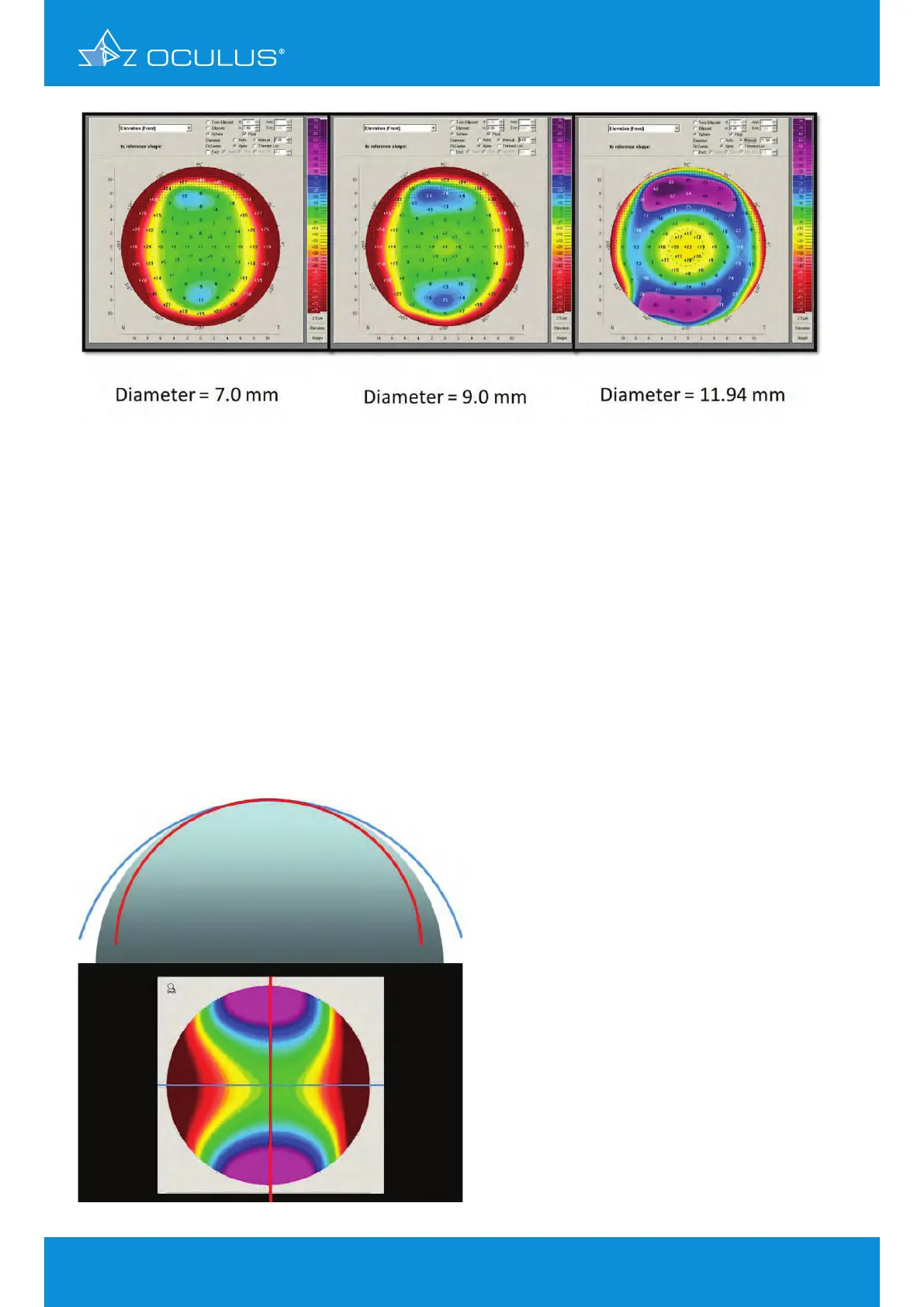
abnormal, it works out that a BFS set at the 8.0 mm optical zone is optimal. A BFS computed from
the central 8.0 mm will mask (i.e. normalize) the normal asphericity and allow easy detection of
pathologic ectatic change. An 8.0 mm optical zone also provides a sufficient number of data points,
while still being in a range where most exams will not include any extrapolated data. For almost all
clinical uses we recommend setting the reference surface to a fixed best fit sphere computed from
the central 8.0 mm optical zone (setting Manual= 8.0 mm). Fixing the area used to compute the
reference surface is also necessary to allow comparisons over time.
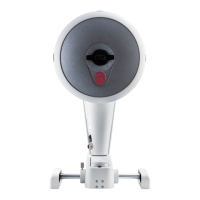
When using a BFS patterns such as astigmatism (Figure 104) and keratoconus (Figure 105) are easily
identified. An astigmatic pattern will have the flat meridian raised above the BFS and the steep
meridian below. The magnitude of the elevation change will increase with increasing distance from
the apex and will increase with greater degrees of astigmatism.
Figure 103: Elevation maps based on different diameters
Figure 104: BFS-based elevation map
of an astigmatic eye
12 Belin/Ambrósio Enhanced Ectasia Display


 To Next Page