Need help?
Do you have a question about the OMA 526 and is the answer not in the manual?
Details about how the lift is shipped and its components.
Instructions for lifting and moving the packed lift safely.
Requirements for storing the packed lift in a protected area.
Guidelines and precautions for stacking packed lifts.
Procedures and precautions for safely opening the lift packaging.
Guidelines for storing and accessing the instruction manual.
Protection against forward/backward movement of the load.
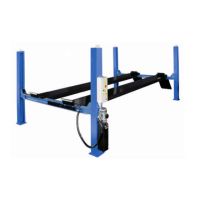
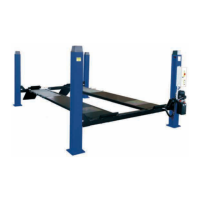
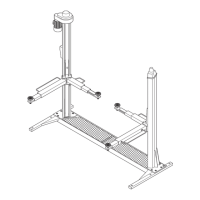
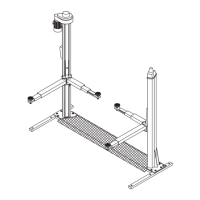
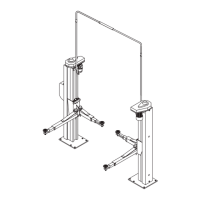
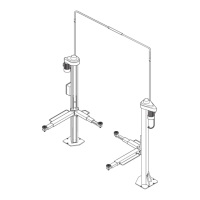
Details of the stationary components of the lift.
Components of the moving parts of the lift.
Components and function of the hydraulic power unit.
Technical data including load capacity and dimensions.
Details of the electric motor powering the lift.
Specifications of the hydraulic pump.
Components and function of the hydraulic power unit.
Diagram showing the layout of electrical components and wiring.
Identification and description of components in the hydraulic circuit.
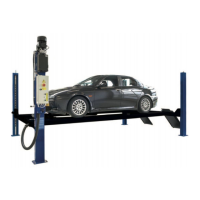
Guidelines on vehicle types and dimensions compatible with the lift.
Limits on vehicle width, wheelbase, and tire spacing.
Information on load distribution and maximum weights.
Operator and fitter responsibilities according to regulations.
Overview of risks and safety measures for lift operation.
Safety measures for forward/backward vehicle movement on the lift.
Safety measures for lateral vehicle movement on the lift.
Key practices for safe vehicle positioning and operation.
Safety devices to prevent damage from excessive weight.
Safety measures against hydraulic hose failure.
Mechanisms to prevent damage from excessive lift travel.
Hazards for the operator due to incorrect positioning.
Hazards for personnel near the lift due to incorrect positioning.
Hazards from striking parts of the lift or vehicle.
Hazards from unintended vehicle movement during operations.
Hazards from improper vehicle positioning or securing.
Hazards from objects interfering with cable movement.
Hazards from slippery floors due to spills or lubricants.
Hazards from contact with electrical wiring or components.
Hazards from improper use or lack of maintenance.
Hazards from using the lift for unintended purposes.
Requirement for qualified technicians for installation.
Ensuring the installation site meets requirements.
Checking space and safety distances for installation.
Ensuring adequate lighting for safe installation and operation.
Specifications for the installation floor and foundation.
Method for securing the lift using expansion anchors.
Steps for marking the floor for post placement.
Prohibition for unauthorized individuals during assembly.
Step-by-step instructions for assembling the lift's platform.
Procedure for removing safety rods from posts.
Steps for preparing the control post for mounting components.
Aligning posts and securing safety rods.
Connecting the hydraulic hoses and components.
Connecting micro-switches and electromagnets as per diagrams.
Connecting the motor and checking rotation direction.
Emphasizing that only skilled personnel should perform setup.
Checks before performing lift operations, including oil level and motor rotation.
Procedure for adjusting lift cables and safety mechanisms.
Aligning and plumbing posts to ensure correct installation.
Drilling and anchoring posts to the floor.
Instructions for fitting vehicle ramps and wheel stops.
Procedure for adjusting lift cables and safety sensors.
Importance of repeating cable adjustment after initial setup.
Verifying alignment, tightness, and free movement of parts.
Checking connections, grounding, and component function.
Verifying oil level, leaks, and cylinder operation.
Ensuring the motor rotates in the correct direction.
Reiterating that only skilled personnel should perform setup.
Testing lift functions without a vehicle.
Testing lift functions with a vehicle on board.
Explanation of the main switch and operation buttons (Lift, Lower, Stop).
Procedure for raising the lift to the desired height.
How to safely stop the lift at a desired height.
Procedure for safely lowering the lift.
Key practices for maintaining the lift's platforms and overall condition.
Emphasizing that maintenance must be done by experienced personnel.
Essential safety and procedural rules for maintenance.
Tasks for the hydraulic unit and circuit performed monthly.
Tasks for anchor bolts, lift cables, and pulleys performed quarterly.
Oil checks and replacement tasks performed every six months.
General, electrical, and hydraulic system checks performed annually.
Guide to identifying and resolving common lift faults.
Table listing common issues and their solutions.
Guidelines for environmentally responsible disposal of used hydraulic oil.
Procedures and safety precautions for decommissioning the lift.
Steps for ordering replacement parts for the lift.
Safety measures when handling or replacing parts.
 General
| Brand | OMA |
|---|---|
| Model | 526 |
| Category | Lifting Systems |
| Language | English |

 To Next Page