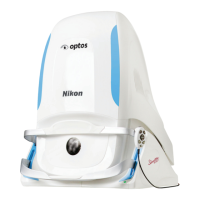
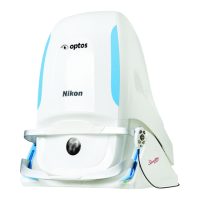
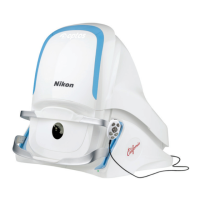
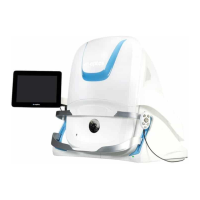
Chapter 3 - Getting to know the device
Warning
The device requires low levels of room light to operate efficiently. Take care to
avoid accidents when working under low light conditions.
Media opacities also absorb or scatter laser light and can block retinal structures.
System response
The device has a laser power of 4mW at the patient's eye and includes a laser safety system that would
prevent the system being used if the lasers were operating at unsafe levels. If the power drops, perhaps
due to a build up of dust, the amount of light returned from the eye will be reduced and will impair image
quality. The accumulation of dust and debris in the return path will also impair image quality.
Detector gains
As the laser power at the eye is a fixed value, the returned retinal information will vary depending on the
amount of light reflected by the pigmentation in the patient's retina. To ensure the greatest amount of
information is detected and that the image quality is optimum, the red and green detectors are set to a
specific gain level. This gain level is initially set when the patient's iris category is entered into the patient
details.
The iris category sets the detectors to expect a certain amount of light back from the patient's retina. You
should assess the patient's hair color, eye color and skin tone to determine the most appropriate iris
category. You can create your own iris categories if you need to.
l
In patients who have high pigmentation levels the "dark" iris category is selected. This sets the
detectors to expect less light back from the patient's retina.
l
In patients who have medium pigmentation levels the "medium" iris category is selected.
l
In patients who have low pigmentation levels the "light" iris category is selected. This sets the
detectors to expect a greater amount of light back from the patient's retina.
The detector gains can be adjusted and used when the next image is captured.
Note
l
Clicking the Optimize button will optimize the current image and sets the detector gains to give a
balanced image of the central pole and periphery in the next image.
l
Review application optimization - maximizes the range of pixel levels displayed on the screen
and adjusts the gamma setting, so that the average intensity of the display matches an ideal
value.
10 of 100



 To Next Page