Concerning Cassette Tapes
Selection of cassette tapes
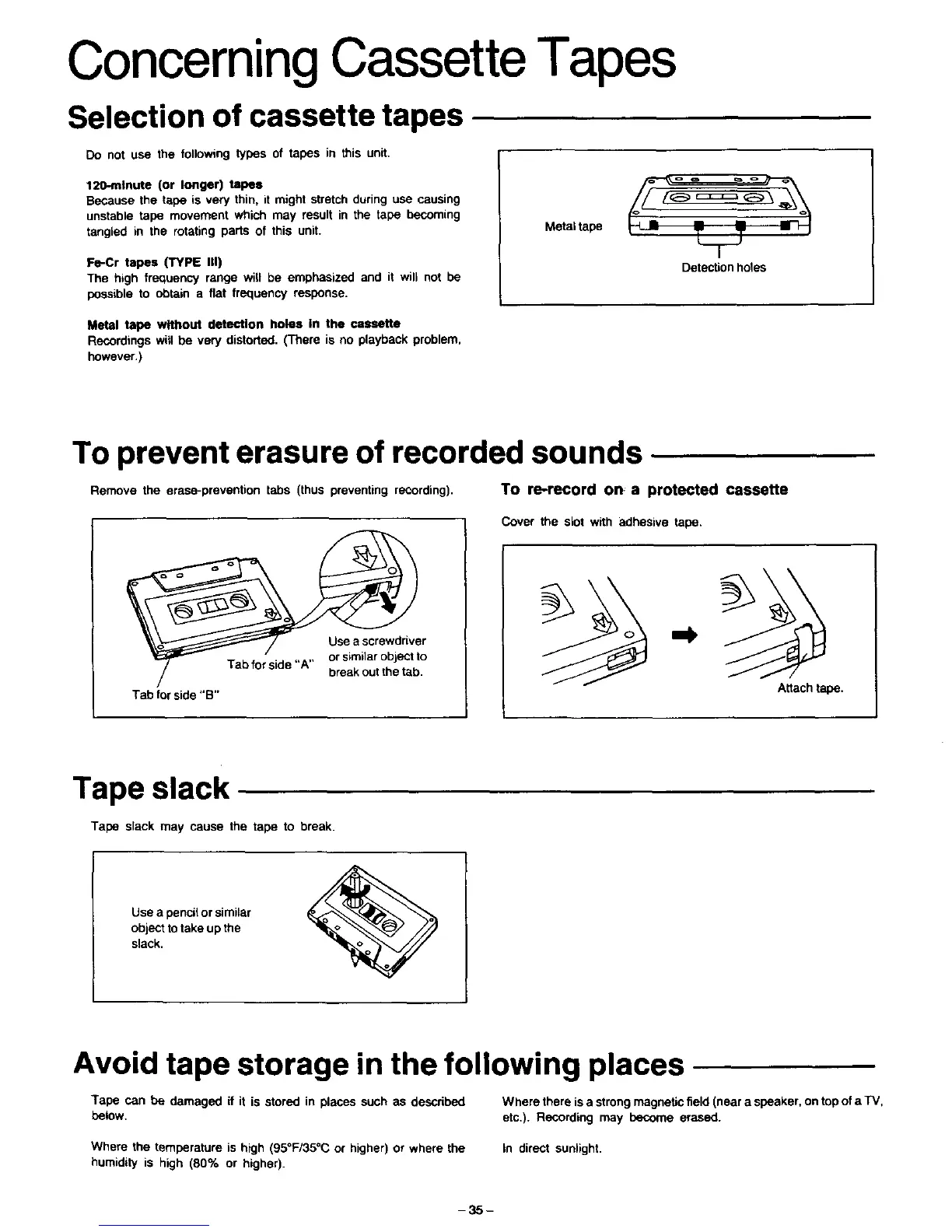
Do not use the following types of tapes in this unit.
120-minute (or longer) tapes
Because the tape is very thin, it might stretch during use causing
unstable tape movement which may result in the tape becoming
tangled in the rotating parts of this unit.
Fe-Cr tapes (TYPE III)
The high frequency range will be emphasized and it will not be
possible to obtain a flat frequency response.
Metaltape
Detection holes
Metal tape without detection holes in the cassette
Recordings will be very distorted. (There is no playback problem,
however,)
To prevent erasure of recorded sounds
Remove the erase-prevention tabs (thus preventing recording). To re-record on a protected cassette
Dover the slot with adhesive tape.
Tab for side "B"
Tab for side "A'"
Use a screwdriver
or similar object to
break out the tab.
Attach tape.
Tape slack
Tape slack may cause the tape to break.
Use a pencil or similar
object to take up the
slack.
Avoid tape storage in the following places
Tape can be damaged if it is stored in places such as descdbed Where there is a str°ng megneticfleld (near aspeaker'°ntop°f aTV'
below, etc.). Recording may become erased.
Where the temperature is high (95°F/35°C or higher) or where the In direct sunlight.
humidity is high (80% or higher).
-35-





 To Next Page