Precautions
Before using this unit please read these operating instructions
carefully. Take special care to follow the warnings indicated on the
unititself as well as the safety suggestions listed below.
Afterwards keep them handy for future reference.
Safety
1. Power Source -- The unit should be connected to power supply
only of the type described in the operating instructions or as
marked on the unit.
2. Polarization -- If the unit is equipped with a polarized AC power
plug (a plug having one blade wider than the other), that plug will
tit into the AC outlet only one way. This is a safety feature. If you
are unable to insert,the plug fully into the outlet, try reversing the
plug. If the plug should still fail to fit, contact your electrician to
replace your obsolete outlet. Do not defeat the safety purpose of
the polarized p}ug.
Installation
Environment
3. Power Cord Protection -- AC power supply cords should be
routed so that they are not likely to he walked on or pinched by
items placed upon o_against them. Never take hold of the plug or
cord if your hand is wet, and always grasp the plug body when
connecting or disconnecting it.
4. Nonuse Periods -- When the unit is not used, turn the power off.
When left unused for a long period of time, the unit should he
unplugged from the household AC outlet.
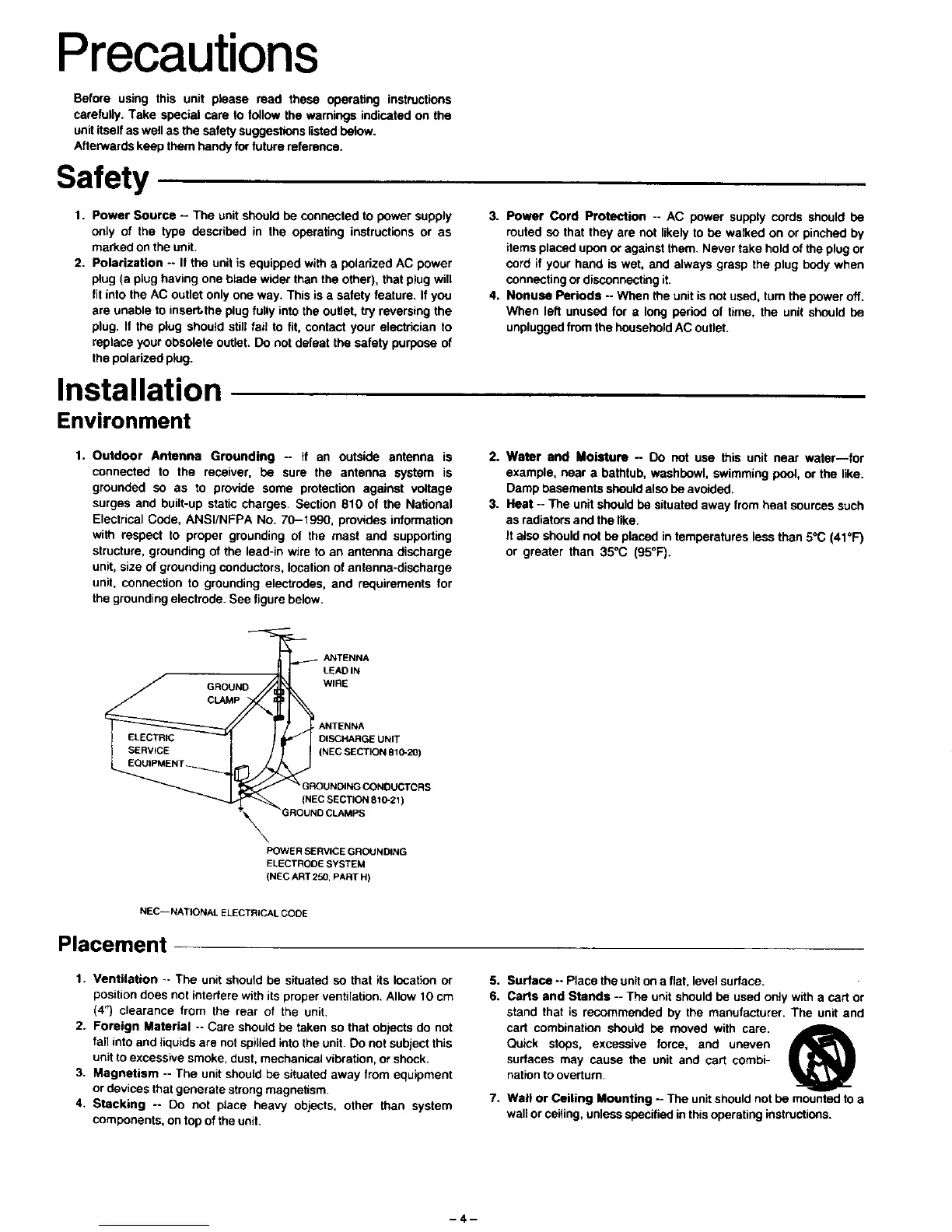
1. Outdoor Antenna Grounding - if an outside antenna is
connected to the receiver, be sure the antenna system is
grounded so as to provide some protection against voltage
surges and built-up static charges. Section 810 of the National
Electrical Code, ANSI/NFPA No. 70-1990, provides information
with respect to proper grounding of the mast and supporting
structure, grounding of the lee@in wire to an antenna discharge
unit, size of grounding conductors, location of antenna-discharge
unit, connection to grounding electrodes, and requirements for
the grounding electrode. See figure below.
CLAMP
2. Water and Moisture -- Do not use this unit near water--for
example, near a bathtub, washbowl, swimming pool, or the like.
Damp basements should also he avoided,
3. Heat -- The unit should be situated away from heat sources such
as radiators and the like.
It also should not be placed in temperatures less than 5°C (41°F)
or greater than 35°C (950F).
ANTENNA
LEAD IN
WIRE
ANTENNA
OISCHARGE UNIT
(NEC SECTION 810-20)
_ONDUCTORS
(NEC SECTION 810-21 )
"_ GROUND CLAMPS
POWER SERVICE GROUNDING
ELECTRODE SYSTEM
(NEC ART 250, PART H)
NEC-- NATIONAL ELECTRICAL COOE
Placement
1. Ventilation -- The unit should be situated so that its location or
position does not interfere with its proper ventilation. Allow 10 cm
(4") clearance from the rear of the unit,
2. Foreign Material -- Care should he taken so that objects do not
fall into and liquids are notspilled into the unit. Do not subject this
unit to excessive smoke, dust, mechanical vibration, or shock.
3. Magnetism -- The unit should he situated away from equipment
or devices that generate strong magnetism.
4, Stacking -- Do not place heavy objects, other than system
components, on top of the unit.
5. Surface -- Place the unit on a flat, level surface.
6. Carts and Stands -- The unit should be used only with a cart or
stand that is recommended by the manufacturer. The unit and
cart combination should be moved with care. i
Quick stops, excessive force, and uneven
surfaces may cause the unit and cart combi-
nation to overturn.
7. Wait or Ceiling Mounting -- The unit should not he mounted to a
wall or ceiling, unless specified in this operating instructions.
-4-



 To Next Page