Note: Generally, cylinder heads wear out at different
rates. Sometimes, servicing the cylinder heads at
different times may be the most economic decision.
This action depends on the valve stem projection of
the individual cylinders. However, this decision must
include the costs of additional downtime that is
caused by this procedure. Perform an economic
analysis to determine if cylinder heads should be
serviced as a group or divided into smaller groups.
Top End Overhaul Information
A top end overhaul involves servicing the cylinder
heads. During a top end overhaul, one piston should
be removed. Inspect the piston, piston rings, and the
cylinder liner. The condition of these components will
determine the period of the major overhaul. Refer to
Service Manual for more information.
Monitoring Valve Seat Wear
Record the engine valve lash, for more information
refer to the Operation and Maintenance Manual,
“Maintenance Interval Schedule”. The monitoring of
the valve seat wear should be carried out before any
adjustment of the valve lash.
1. Remove the rocker covers.
2. Refer to Systems Operation, Testing and
Adjusting, “Valve Lash - Adjust”.
3. On all engine cylinders, record the clearance
before any adjustments are made.
4. Set the valve bridges.
5. Adjust the valve lash to 0.4 mm (0.016 inch).
The recorded values can be used to identify any
excessive valve seat wear on individual valves. The
recorded values can be used to schedule a top end
overhaul.
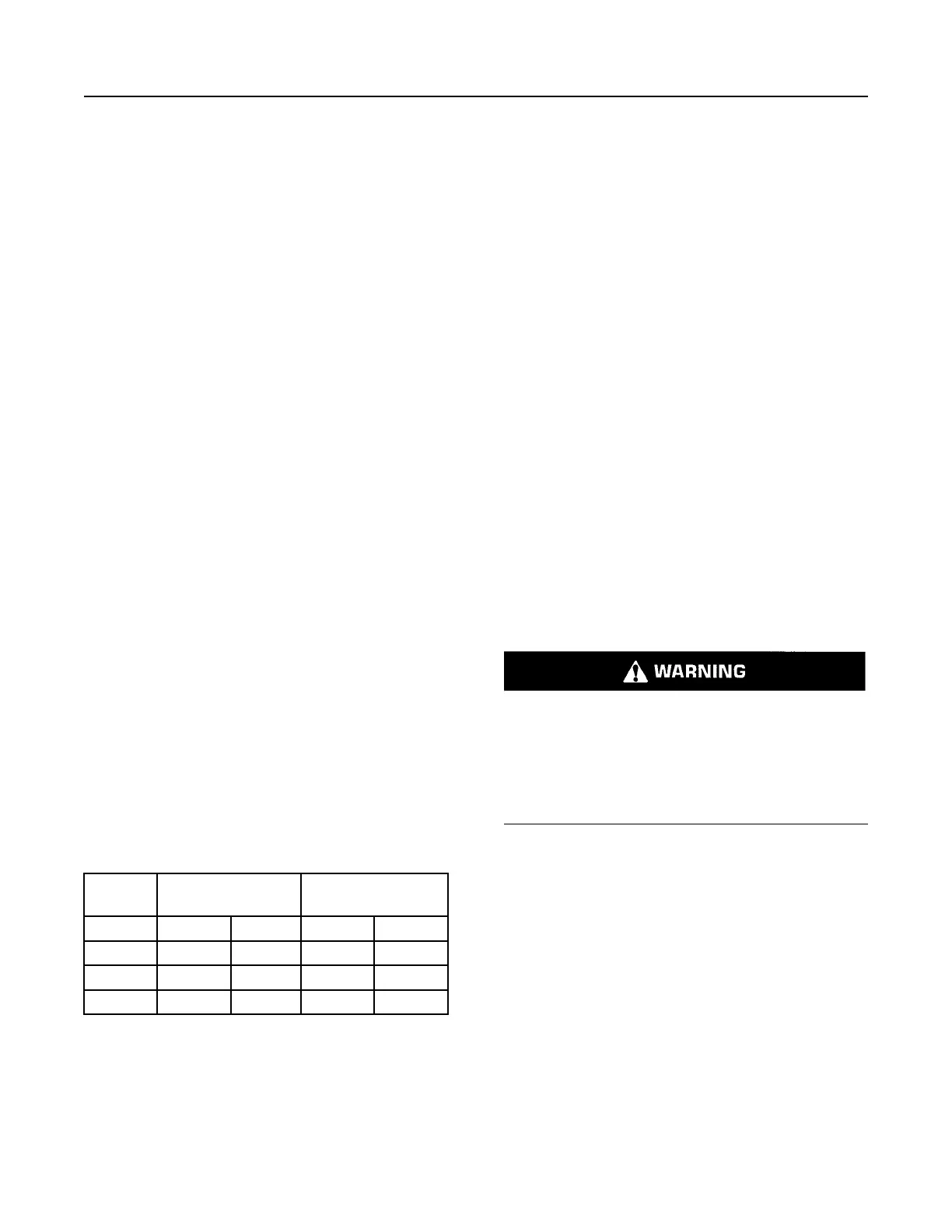
An example of recorded valve lash
Table 10
Recorded clearances on
A1 cylinder
Total valve wear
Hours Inlet Exhaust Inlet Exhaust
1500 0.35 0.35 0.05 0.05
3000 0.25 0.3 0.35 0.3
4500 0.25 0.3 0.65 0.45
After 4500 hours running, the total wear on the inlet is
0.65 mm (0.026 inch) and the exhaust is 0.45 mm
(0.018 inch).
Note: Maximum permitted total wear is 3 mm
(0.11811 inch).
In this example, the valves are still serviceable after
4500 hours running.
When the valves approach the maximum wear limit,
the rockers can be removed and a measurement
from the cylinder head face to the top of the valve
stems can be taken. When a new valve is installed,
the protrusion of the valve stem would be 29.75 mm
(1.171 inch). Therefore, a maximum wear limit would
be 31.75 mm (1.25 inch).
The valve recession tool has been designed to give
service personnel a good indication of the cylinder
head valve recession or cylinder head valve seat
wear without the need to remove the cylinder heads.
For more information contact Perkins distributor.
i09909128
Radiator - Clean
Note: Adjust the frequency of cleaning according to
the effects of the operating environment. The radiator
and the aftercooler are a combined unit ensure that
the aftercooler is also cleaned and inspected.
Inspect the radiator and aftercooler for these items:
Damaged fins, corrosion, dirt, grease, insects,
leaves, oil, and other debris. Clean the radiator and
aftercooler, if necessary.
Personal injury can result from air pressure.
Personal injury can result without following prop-
er procedure. When using pressure air, wear a
protective face shield and protective clothing.
Maximum air pressure at the nozzle must be less
than 205 kPa (30 psi) for cleaning purposes.
Pressurized air is the preferred method for removing
loose debris. Direct the air in the opposite direction to
the fans air flow. Hold the nozzle approximately 6 mm
(0.25 inch) away from the radiator fins. Slowly move
the air nozzle in a direction that is parallel with the
radiator tube assembly. This action will remove
debris that is between the tubes.
Pressurized water may also be used for cleaning.
The maximum water pressure for cleaning purposes
must be less than 275 kPa (40 psi). Use pressurized
water to soften mud. Clean the core from the front
and rear.
Use a degreaser and steam for removal of oil and
grease. Clean the front and rear of the core. Wash
the core with detergent and hot water. Thoroughly
rinse the core with clean water.
M0163009 95
Maintenance Section
Radiator - Clean



 To Next Page