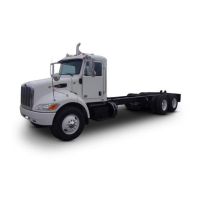
AXLE
4
General Calibration Guidelines
These instructions
are general in
nature. For more specic instructions,
review the pusher or tag suspension
manufacturers maintenance manual or
contact the nearest authorized dealer.
NOTE
Perform this procedure at or near a
weight scale. Procedure can be per
-
formed while parked on the weight
scale if scale is available.
1. Park loaded vehicle on level
surface with wheels blocked.
2. Release vehicles
spring
brakes. (Do not release for
Liftable/Non-Steerable pusher or
tag axles).
3. Lower the
pusher/tag axles with
the axle lift control ip valve. (For
some non-liftable axles, inate air
suspension).
4. Adjust the
amount of load on
each axle by turning the pressure
regulator clockwise to increase
the load or counterclockwise
to decrease the load. (The
suspension manufacturer
may publish pre-established
Pressure-to-Load Ratio Pressure
Settings to assist you in achieving
an estimated ground load).
5. After setting
the pressure to obtain
the desired axle load, verify proper
ground loading with the weight
scale.
NOTE
Exceeding local,
state or federal
weight limits may result in citations.
Contact your local commercial weight
enforcement ofce for limits in your
area.
Operation guidelines
NOTE
Steerable-pusher and/or tag axle(s)
will raise when the transmission is
shifted into reverse or when the park
-
ing brakes are applied.
Maximizing Drive Axle Traction
Adjust the
pressure regulator control
knob to a lower pressure until desired
traction is obtained. By reducing air
pressure at pusher or tag axle, load
will be transferred to drive axles. Do
not overload drive axles.
Coupling to
a Loaded Trailer
Inate air
springs of the auxiliary axles
to the desired pressure after coupling
to a loaded trailer while still maintaining
proper traction of the drive axles.
4-46
Y53-6047–2C (04/13)



 To Next Page