WHAT TO DO IF...
CAUTION
CAUTION
CAUTION
Before replacing a fuse, turn OFF all
lights and accessories and remove
the ignition key to avoid damaging the
electrical system.
Never patch fuses with tin foil or wire.
This may cause serious damage else
-
where in the electrical circuit, and it
may cause a re.
If a circuit keeps blowing fuses, have
the electrical system inspected for a
short circuit or overload by an autho
-
rized dealer as soon as possible. Fail-
ure to do so could cause serious dam-
age to the electrical system and/or ve-
hicle.
Fuse Inspection and Replacement
All the
electrical circuits have fuses
to protect them from a short circuit or
overload. If something electrical on
your chassis stops working, the rst
thing you should check for is a blown
fuse.
1. Turn
OFF all lights and accessories
and remove the ignition key to
avoid damaging the electrical
system.
2. Determine from
the chart on the
fuse panel which fuse controls that
component.
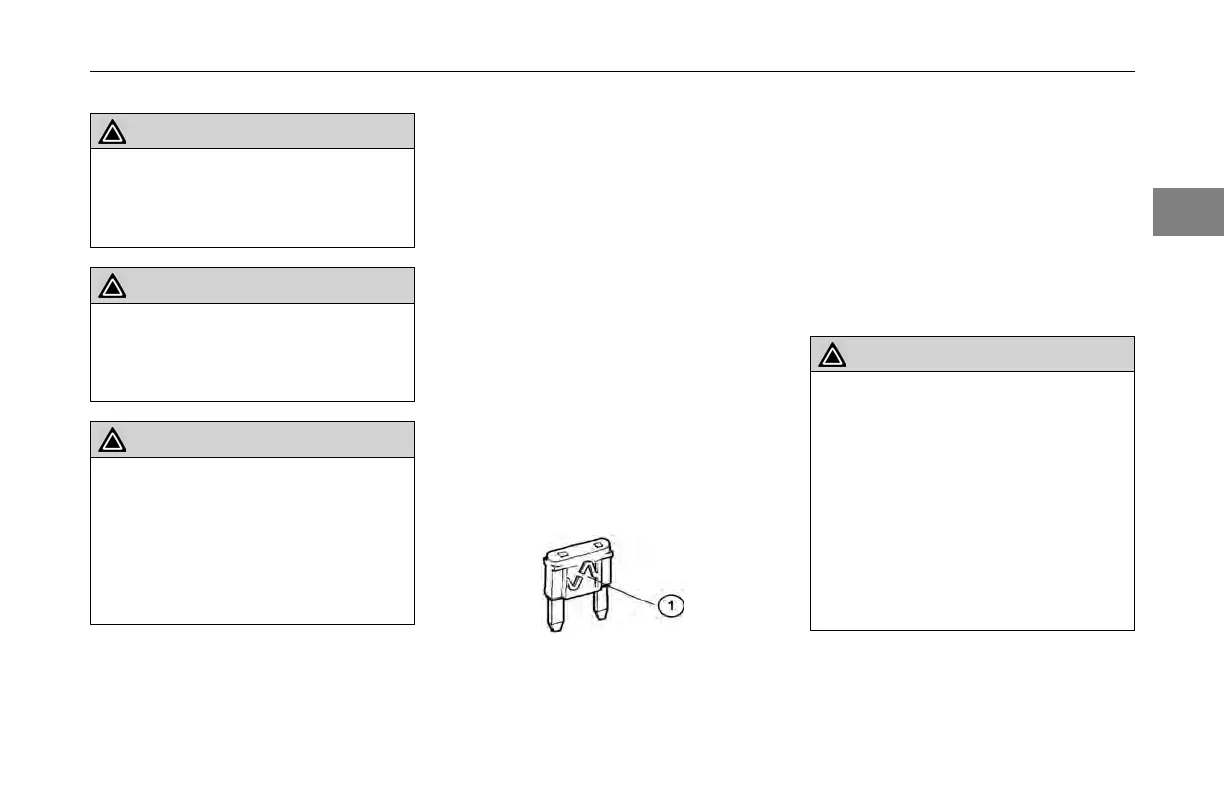
3. Remove that
fuse and see if it is
blown.
1 Blown
If it
is blown, replace it with a fuse of
the same rating.
If a
fuse of the same rating is not
available, a fuse of a lower rating may
be temporarily substituted. You can
also use a fuse from a circuit you can
do temporarily without (for example an
accessory circuit or radio).
When replacing a failed circuit
breaker, always use an approved cir
-
cuit breaker with a current rating equal
to or less than the circuit breaker be
-
ing replaced. Only use the approved
Type II modied reset circuit breakers.
NEVER use a Type I (automatic re
-
set) or Type III (manual reset) circuit
breaker. A fuse with a current rating
equal to or less than the circuit breaker
being replaced can also be used.
CAUTION
2
(04/13) Y53-6047–2C 2-7



 To Next Page