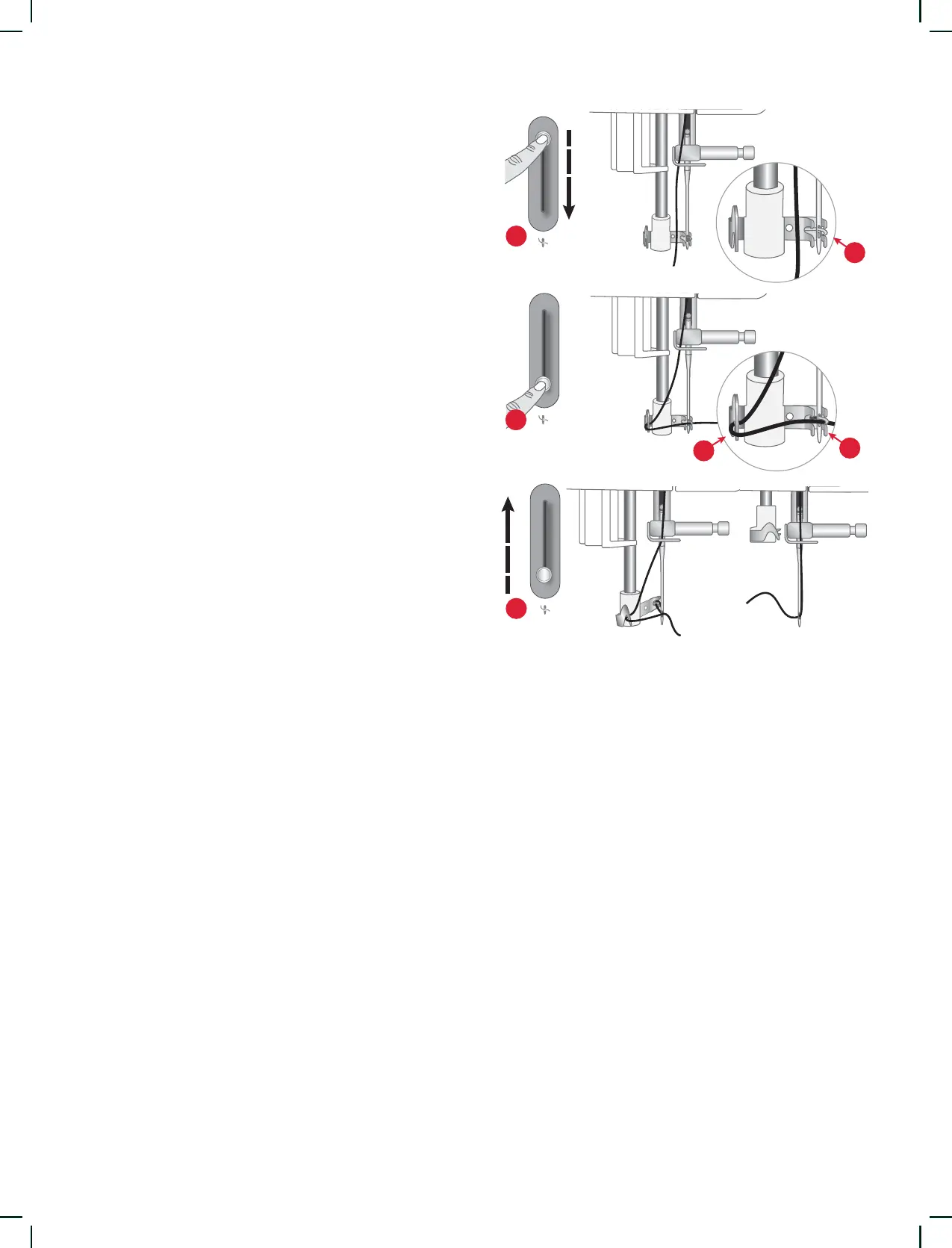
A
B
E
D
F
C
Preparations – 19
There are many threads on the market today de-
veloped for different purposes. The quality and
structure of the thread as well as the shape and size
of the thread spool can affect the behavior of the
thread. Threads can also behave differently if the
spool is full or nearly empty.
If experiencing problems, try the tips and hints
below.
Note: Always test sew on a scrap piece of fabric to check
the sewing result.
If the Thread Spool is Pulled up on the Spool
Pin
When the thread on the spool is running low, the
thread can snag on the edge of the spool and pull
the spool up on the spool pin. Place a spool cap on
top of the thread spool to keep it in place. Always
use a spool cap slightly larger than the thread spool
Threading Tips and Hints
Using the Needle Threader
The built-in needle threader allows you to thread
the needle quickly and easily.
The needle must be in its highest position to use the
built-in needle threader. Turn the hand wheel to-
wards you until the needle is in its highest position.
It is also recommended that you lower the presser
foot.
1. Use the lever (A) on the left side of the sewing
head to pull the needle threader all the way
down. The metal anges cover the needle. A
small hook will pass through the needle eye (B).
2. Keep the needle threader lever down (C).
3. Place the thread from the right over the thread
guide (D) and under the small hook (E).
4. Gently release the needle threader lever (F). The
hook pulls the thread through the needle eye and
forms a loop behind the needle. Pull the thread
loop out behind the needle.
5. Raise the presser foot and place the thread under
it.
6. Pull out about 4” (10cm) of thread beyond the
needle eye. This will prevent the machine from
coming unthreaded when you start to sew.
Note: The needle threader is designed to be used for size
70-110 needles. You cannot use the needle threader for
size 60 needles or smaller, or twin needles. There are also
some optional accessories that require manual threading
of the needle. When threading the needle manually, make
sure that the needle is threaded from front to back.
to prevent the thread from snagging. The at side of
the spool cap should be pressed rmly against the
spool. There should be no space between the spool
cap and the thread spool.
If the Thread Slides Down on the Standing
Thread Spool
If the thread is of a quality that unwinds easily and
slides down on the standing thread spool it can get
caught under the thread spool around the spool pin
and break. Place the large spool cap on the spool pin
with the at side up before placing the thread spool.
If the thread spool has the same diameter as the
large spool cap, place a thread net from below over
the spool before placing it on the spool pin.



 To Next Page