A
B
C
Preparations – 15
Needles
The sewing machine needle plays an important role in successful sewing. Use only quality needles. We recom-
mend needles of system 130/705H. The needle package included with your machine contains needles of the
most frequently used sizes.
Be sure to match the needle to the thread you are using. Heavier threads require a needle with a larger needle eye.
If the needle eye is too small for the thread the needle threader may not work properly.
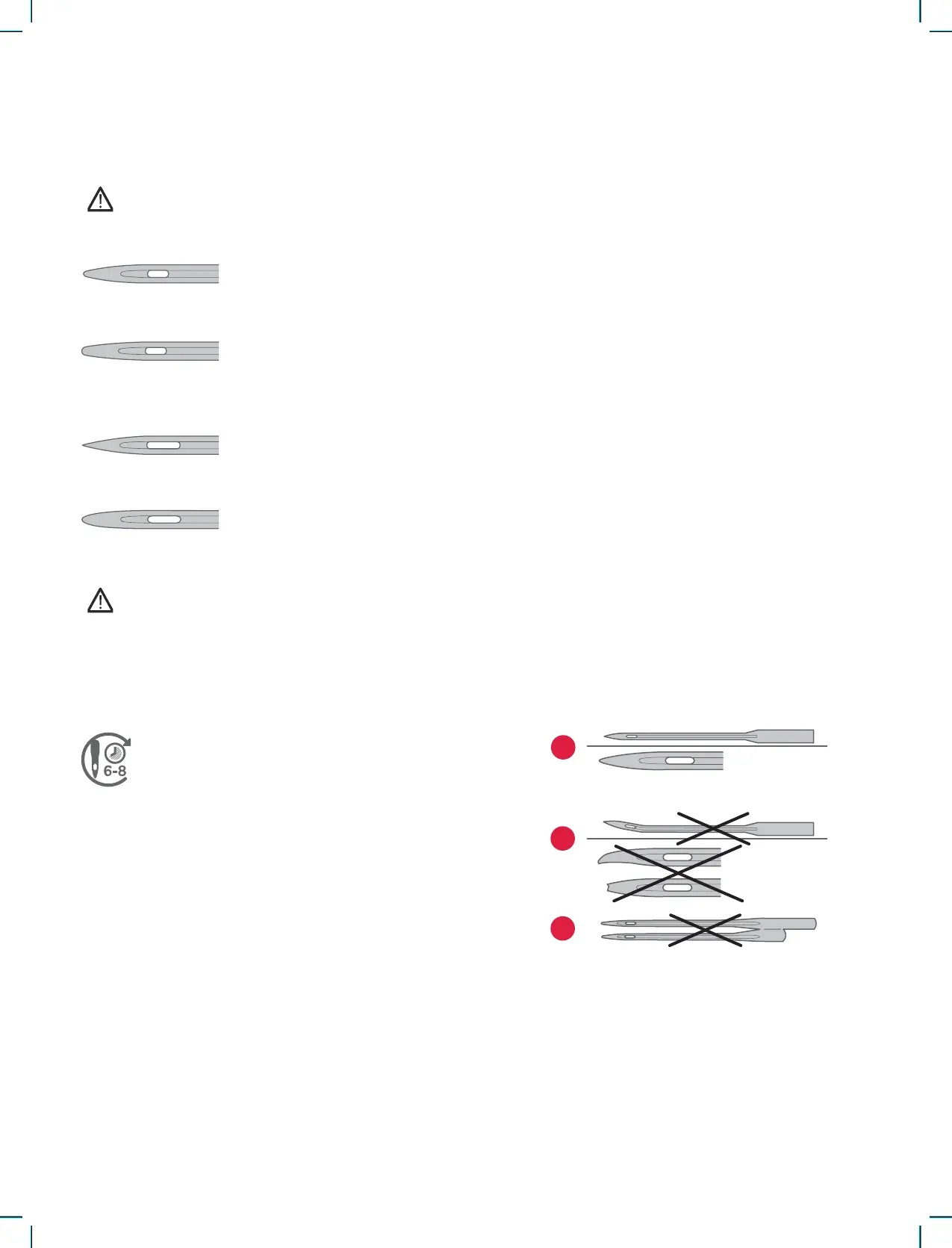
Universal Needle
Universal needles have a slightly rounded point and come in a variety of sizes. For gen-
eral sewing in a variety of fabric types and weights.
Stretch Needle
Stretch needles have a ball point and a special scarf to eliminate skipped stitches when
there is a ex in the fabric. For knits, swimwear, eece, synthetic suedes and synthetic
leathers.
Denim Needle
Denim needles have a sharp point to penetrate tightly woven fabrics without deecting
the needle. For canvas, denim, microbers.
Embroidery Needle
Embroidery needles have a special scarf, a slightly rounded point and a slightly larg-
er eye to avoid damage to thread and materials. Use with metallic and other specialty
threads for free-motion embroidery and decorative sewing.
To help prevent needle breakage, use only medium/low sewing speed and the recommended needle for sewing thick
fabrics.
Change the needle often. As a general
rule, needles should be changed every 6-8
hours of actual stitching time.
Important Needle Information
Always use a straight needle with a sharp point and
make sure the point is not bent or damaged (A).
A damaged needle (B) can cause skipped stitches,
breakage or snapping of the thread. It can also dam-
age the needle plate.
Do not use asymmetrical twin needles (C), they can
damage your sewing machine.



 To Next Page