Circuit Descriptions, Abbreviation List, and IC Data Sheets
EN 210 JL2.1E AA9.
using a special error reduction coding to produce the 10-bit
word that is transmitted.
Basic audio functionality consists of a single IEC 60958 audio
stream at sample rates of 32 kHz, 44.1 kHz, or 48 kHz. This can
accommodate any normal stereo stream. Optionally, HDMI can
carry a single such stream at sample rates up to 192 kHz or
from two to four such streams (3 to 8 audio channels) at sample
rates up to 96 kHz. HDMI can also carry IEC 61937
compressed (e.g. surround-sound) stream at sample rates up
to 192 kHz.
The DDC is used by the source to read the sink’s Enhanced
Extended Display Identification Data (E-EDID) in order to
discover the sink’s configuration and/or capabilities.
HDMI is backward compatible with DVI (1.0). Compared with
DVI, HDMI offers extra:
• YUV 4:4:4 (3 x 8-bit) or 4:2:2 (up to 2 x 12-bit), where DVI
offers only RGB 4:4:4 (3 x 8 bit).
• Digital audio in CD quality (16-bit, 32/44.1/48 kHz), higher
quality available (8 channels, 192 kHz).
• Remote control via CEC bus (Consumer Electronics
Control): allows user to control all HDMI devices with the
TV's remote control and menus.
• Smaller connector (SCART successor).
• Less cables: e.g. from 10 audio/9 video cables to 3 HDMI
cables.
Implementation
The IC used is the TDA9975 (triple 10-bit video converter
interface), item 7B11 on the SSB.
• Power supply: 3V3 and 1V8.
• Inputs:
– HDMI connectors (Video, Audio, HDCP, Control).
– Analogue (YPbPr, RGB, and H/V).
• Control signals:
–I
2
C coming from TDA9975 (MM-BUS1).
– 13.5 MHz clock for analog format detection.
–JTAG.
• Output to PNX2015: Video (DV4 and DV5):
– YUV 4:2:2 20 bit (10 bit Y, 10 bit UV multiplexed) +
clock + sync.
– ITU-656 (compressed DVD video) encoded in data
stream.
• Output to VIPER:
– Audio: S/PDIF.
– Interrupt signal.
Data Content
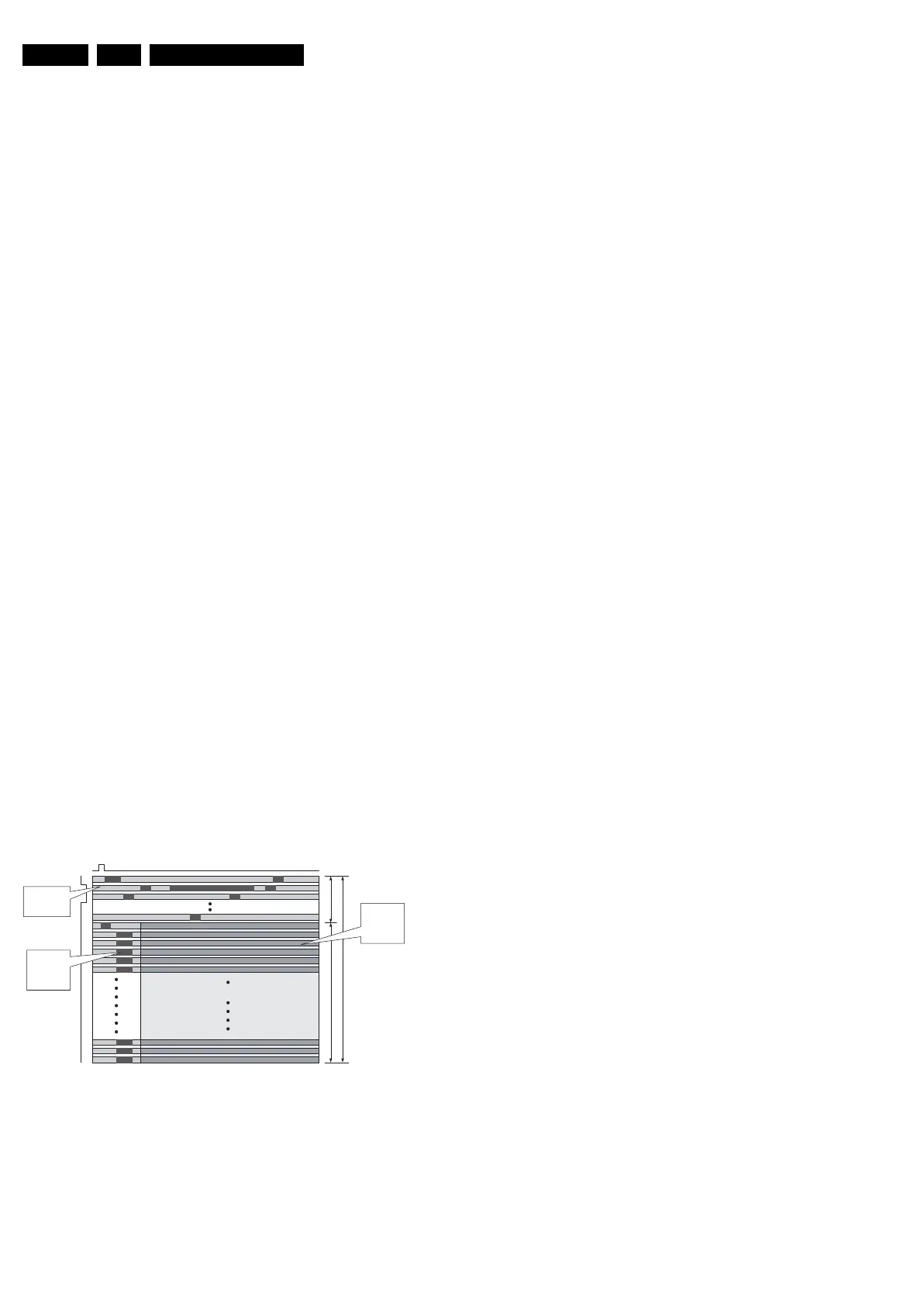
Figure 9-16 Typical video frame
A typical video frame is built up with the following info blocks:
• Control Period.
– Transmission of the pre-amble.
– Character synchronization.
• Data Island Period.
– Audio and auxiliary information are carried in packets
within a Data Island.
– HSYNC, VSYNC are also carried during Data Island
Period.
– Packet Types:
– Audio Sample.
– Audio Clock Recovery.
– InfoFrame: Aux. Video IF, Audio IF, MPEG IF,
vendor-defined IF.
• Video Data Period.
– Carries the pixels of an active video line.
– TMDS encoding.
Data Islands: Audio Formats
• All current CE audio formats can be transmitted.
• Supports compressed formats like:
– Dolby Digital.
– Dolby Digital EX (THX-EX).
–DTS.
–Etc.
• Supports uncompressed formats (“discrete” PCM audio):
– Up to 8 channels, up to 192 kHz, up to 24 bits.
• CD-quality audio is always available, so the user will
always hear sound.
– 2 channel, 16 bit at 32 kHz (STB), 44.1kHz (CD), or 48
kHz (DVD)
Data Islands: InfoFrames (EIA/CEA-861B)
• Auxiliary Video Information (AVI):
– Specifies active aspect ratio, colorimetric info, pixel
encoding, etc.
• Audio InfoFrame:
– Describes audio stream, speaker/channel allocation,
etc.
• Source Product Info:
– Contains manufacturer name, product name, type, etc.
(replaced by CEC).
• MPEG Source:
– Contains flags that permit optimized display of de-
compressed video.
• Vendor unique info.
Content Protection: HDCP
• HDCP (High-bandwidth Digital Content Protection) for
HDMI encrypts and protects video, audio, and other
auxiliary data.
• If a source device is HDCP coded and is connected to a
HDTV display or projector via DVI/HDMI without the proper
HDCP decoding mechanism, the picture is relegated to
"snow" or in some cases, a very low (480p) resolution. In
order to see HDTV with HDCP compliance, both the source
and display devices must be equipped with DVI/HDMI
connections that can enable HDCP using "software key"
decoding.
• HDCP requires that decoding takes place in the display
device (no external converters).
CEC Bus (Consumer Electronics Control)
• This is the successor of the P50 protocol.
• It allows the user to control all HDMI devices with the TV's
remote control and menus.
• High-level functions such as “One-touch play”.
• Optional for device to implement protocol.
• Mandatory to implement wire pass-through.
Active Video
480 active lines
525 total lines
45 lines
vertical blanking
HSYNC
V
S
Y
N
C
Control
Period
Data
Island
Period
Video
Data
Period
F_15400_011.eps
210405







 To Next Page