Circuit Descriptions, Abbreviation List, and IC Data Sheets
EN 217JL2.1E AA 9.
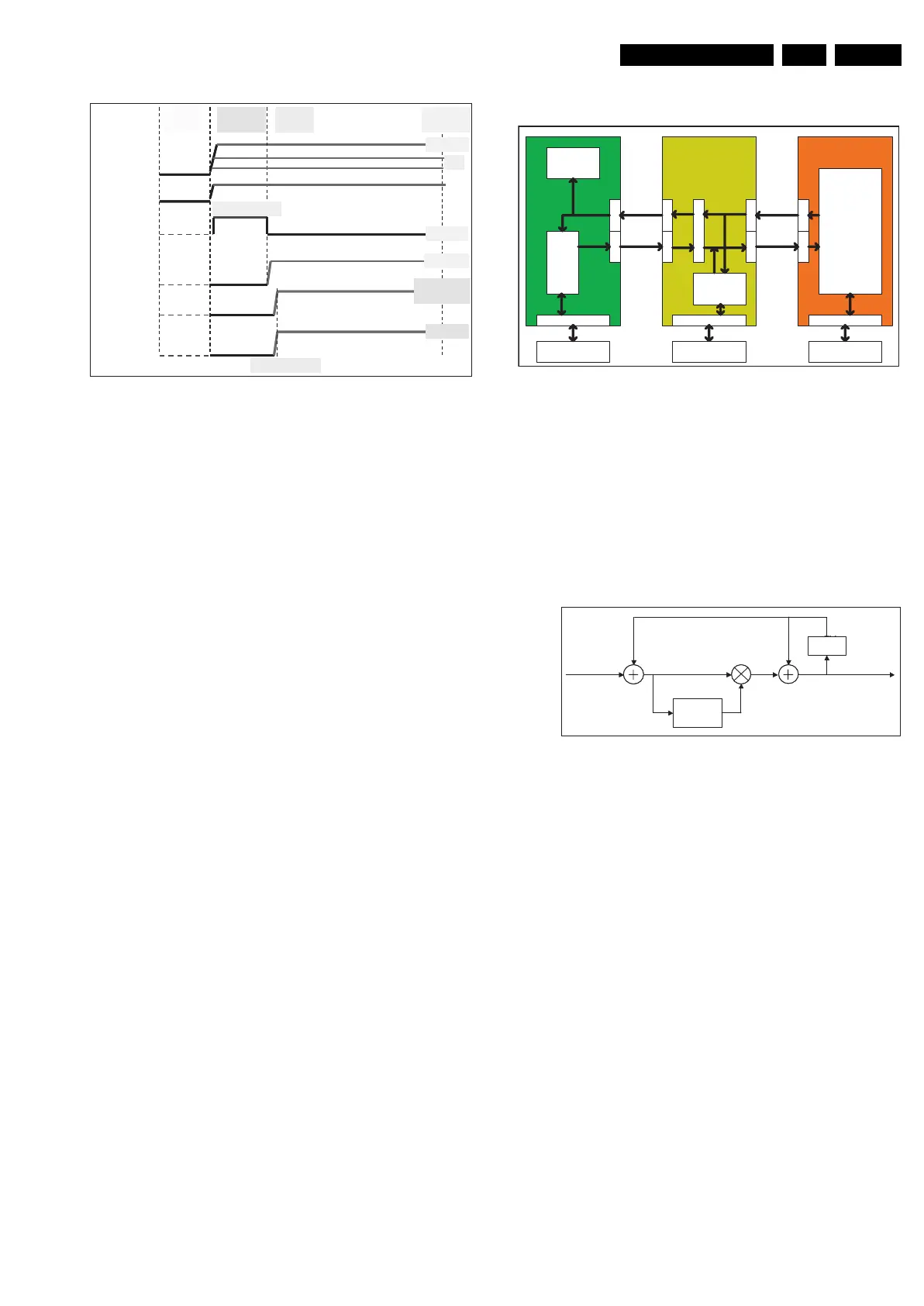
Figure 9-30 Timing chart power supplies
The Stand-by Microprocessor is responsible for the start-up of
the VIPER, by providing the correct timing for the DC/DC
converted voltages (for timing of DC/DC converter voltages see
description in paragraph "Power Supply").
The DC/DC converters (via ENABLE) are switched "on" (active
"low"). Once these voltages are switched "on", the Stand-by
Controller is monitoring these voltages via a voltage detector
circuit connected to port P2.x. When one of the voltages is
missing, the fault detection will be active "low" on port P2.x. An
error code will be written in the error buffer.
There is a common SUPPLY_FAULT line; connected to port
P1.3 (INT5) that is active "low" when there is a problem
detected on one of the DC/DC power supplies driver circuits.
One input (P2.6) is used for the Audio Supply protection from
the audio amplifier.
The RESET_SYSTEM line (P4.0) is "low" in Stand-by and at
Start-up to keep the VIPER in reset state. Once the VIPER core
supply is available, the RESET_SYSTEM line will become
"high". The VIPER is starting up and will provide a RESET-
MIPS active "high" to the Stand-by Processor P3.3, AVIP, and
COLUMBUS.
9.11.3 Inputs/Outputs Stand-by Processor
The inputs on the Stand-by Microprocessor are used to detect
the AV status from the front inputs (see also the control block
diagram in chapter 6 "Block diagrams,...").
An UART communication line via an electronic switch is
available on a connector and will be used for Service to
communicate with ComPair. The UART line is switched to the
Stand-by Processor when the UART_SWITCH line (P0.7) is
"high". Otherwise it is switched to the VIPER.
9.12 SPIDER (T6TE0TBG)
9.12.1 Introduction
The SPIDER is a video co-processor and responsible for:
• Temporal Noise reduction.
• De-interlacing for HD signals.
• Temporal upconversion for SD signals.
• Vertical and Horizontal scaling.
• Pixel plus 2 processing.
9.12.2 Block Diagram
Figure 9-31 Tunnel bus block diagram
The most important connections:
• Tunnel bus to/from PNX2015.
• DDR interface to/from SPIDER DDR.
• Reset signal SPIDER (from VIPER).
• Clock input SPIDER (33MHz) (from PCI clock VIPER).
• IRQ SPIDER connects to VIPER.
• I²C connection with VIPER.
9.12.3 Temporal Noise Reduction
Figure 9-32 Temporal noise reduction
• For both luminance and colour difference signals.
• Motion compensated.
The previous field is subtracted from the current field, which will
result in the difference between the two fields. With a static
picture, the difference will be noise, with a dynamic picture it is
not. That is why the delta is weighted by looking if there is
movement or not. When there is a lot of movement, the output
“k “ will be “1”, when there is little movement, “k” will be almost
“0”. If no movement is detected, the difference signal will be
noise, and the output is not affected. When a lot of movement
is detected, the difference signal will be added to the former
field, because it is no noise.
9.12.4 De-interlacing For HD Signals
This function is calculating the missing lines of the interlaced
input signal. There are different options for de-interlacing:
• Line repetition.
• Field insertion.
• Median filtering.
• Motion compensated de-interlacing.
Note: For SD signals, de-interlacing is done in the VIPER.
F_15710_185.eps
280905
Mains not
connected
Mains
connected
Out of
standby
Connector
SSB
1M46 P7
1M03 p7
1M46 P5
1M46 P3
+12V
1M46 P4, P9
-
B8A
+2V5D Stabiliser
Standby Supply
Standby
+5V SW
Main Supply +24V, +12V, Vs+, Vs-
Mains not
connected
5V2
Mains
connected
Out of
standby
Connector
SSB
1M46 P7
1M03 p7
1M46 P5
1M46 P3
+8V6
Main Supply
Main Supply
+12V
1M46 P4, P9
+5V SW
On-mode P0.0
Relay is closed
+3V3 Standby
+1V2 Standby
B8A
Standby
F_15710_180.eps
270905
Viper PNX2015 Spider
QVCP
DDR Viper
PMAN
T
U
N
N
E
L
T
U
N
N
E
L
T
U
N
N
E
L
T
U
N
N
E
L
DDR-controllerDDR-controller
DDR PNX2015
PMAN
1
P
M
A
N
2
DDR-controller
DDR Spider
Processing
F_15710_182.eps
270905
k
FM
k
FM
-
+
Cur (Y/C)
Motion
detector
Out (n)
Diff







 To Next Page