Function description
Operating Manual PITreader, PITreader Firmware V1.5.x
1004806-EN-08
| 21
NOTICE
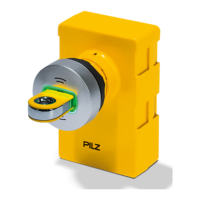
When inserting the transponder key in the PITreader, make sure you can
feel the transponder key lock in position.
5.4.1 Serial number of the transponder key
The serial number of the transponder key is composed of a prefix (2 digits) and a consecut-
ive number (7 digits). When evaluating the serial number in an external system, make sure
that the prefix and consecutive number are stored and communicated separately within the
4-byte serial number field (e.g. in the Modbus/TCP interface). The top byte contains the
prefix, the lower 3 bytes contain the consecutive number.
5.4.2 Transponder key's security ID (SID)
All transponder keys are factory pre-programmed with a Security-ID (SID). A transponder
key’s security ID cannot be changed. A transponder key’s security ID is a unique identifier,
which is only valid for this one transponder key.
The security ID is used to uniquely identify a transponder key on the PITreader; i.e. a
transponder key is authenticated on the PITreader with the help of the security ID. The per-
missions that are configured for a transponder key are linked to the security ID.
The security ID is displayed in the web application. In an application created by the user
(e.g. evaluation and activation of the selected operating mode via HMI, web application,
user software), the security ID can be read via Modbus/TCP, REST API or OPI UA. In such
applications, the security ID should also be evaluated by the user and used for authentica-
tion.
Authentication can be blocked by entering a transponder key’s security ID in a block list
(see Use block list [ 41]).
5.5 User data
A free data area is available on the transponder keys. Customer-specific data (e.g. lan-
guage, user name, ...) can be stored in this free data area. The user data can also be used
to extend the number of device groups to more than 32.
User data is organised in parameters. There are parameters whose function is determined
by the user (user parameters) and there are system parameters. System parameters have
a pre-defined function. See System parameters [ 23].
Each parameter has an ID, a name and a data type:
} Parameter-ID
The ID is a number in the range 1 ... 65535. It uniquely identifies a parameter.
Users can freely assign the ID.
Note: Users should not use IDs 1 ... 9999 because they might be used by Pilz for system
parameters.
} Name
Users can freely assign the name.


 To Next Page