Need help?
Do you have a question about the Planet WNRT-627 and is the answer not in the manual?
Lists the items included in the WNRT-627 wireless broadband router package.
Details the WNRT-627 as an integrated 300Mbps 802.11n wireless broadband router for SOHO networks.
Highlights key capabilities like Wireless LAN, Broadband Router functions, and security support.
Provides detailed hardware and wireless interface specifications for the WNRT-627 router.
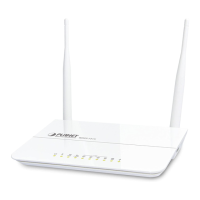
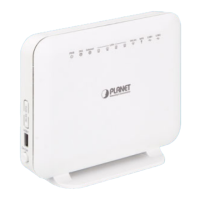
Describes the physical components and indicators of the WNRT-627 router.
Details the LEDs and buttons on the front panel of the WNRT-627 router.
Explains the status and function of each LED on the WNRT-627 router.
Identifies the ports and connectors located on the rear panel of the WNRT-627 router.
Lists the necessary hardware and software for connecting the WNRT-627 router.
Provides step-by-step instructions for physically installing the WNRT-627 wireless broadband router.
Guides users through manually configuring TCP/IP settings for PC network connections.
Explains how to set up a PC to automatically obtain an IP address via DHCP.
Details the process for manually assigning IP addresses and subnet masks to a PC.
Guides users on accessing and performing initial configuration via the router's web-based utility.
Describes how to use the Smart Setup! utility from the CD for quick router configuration.
Instructions on how to log in to the WNRT-627 router's web management interface.
Displays current status information about the router, which is read-only.
Guides users through a simplified setup process for the router's basic functions.
Explains how to use Wi-Fi Protected Setup (WPS) to quickly add wireless devices.
Manages network-related configurations including WAN, LAN, and MAC cloning.
Configures the Wide Area Network (WAN) connection types and parameters.
Manages Local Area Network (LAN) IP address and subnet mask settings.
Allows cloning a MAC address, often required by ISPs for network access.
Manages all wireless network configurations, including security and advanced options.
Configures fundamental wireless parameters like SSID, region, channel, and mode.
Configures security protocols like WEP, WPA, WPA2, and encryption methods.
Controls wireless access by filtering devices based on their MAC addresses.
Adjusts advanced wireless parameters like transmit power and beacon intervals for performance tuning.
Displays statistics for connected wireless stations, such as MAC address and status.
Configures the router's DHCP server for automatic IP address assignment to LAN devices.
Sets up the DHCP server, including IP address range and lease time.
Shows a list of devices currently connected to the network via DHCP.
Assigns static IP addresses to specific devices based on their MAC addresses.
Manages Network Address Translation (NAT) to allow multiple devices to share a single IP address.
Manages network traffic forwarding for specific applications and services.
Configures virtual servers to redirect incoming internet traffic to specific local devices.
Sets up rules to open specific ports when outgoing traffic on another port is detected.
Exposes a specific device on the LAN to the internet for special services, bypassing firewall rules.
Manages Universal Plug and Play (UPnP) for automatic device discovery and port forwarding.
Configures various security features to protect the network from unauthorized access and attacks.
Enables or disables core security functions like SPI Firewall and VPN Passthrough.
Configures advanced security measures against DoS attacks and ping floods.
Controls which local PCs can access the router's web management interface using MAC addresses.
Configures remote access to the router's management interface via the internet.
Configures rules to restrict internet access for specific PCs based on time and websites.
Manages rules to control internet access based on hosts, targets, and schedules.
Defines and manages internet access control rules for the network.
Manages a list of hosts (IP or MAC addresses) for access control rules.
Manages targets (IP addresses, domains, ports) for access control rules.
Defines time schedules for applying access control rules.
Configures static routes and views the system routing table for network traffic management.
Manually adds and manages static routes for network traffic.
Displays the current routing table used by the router for network traffic.
Manages bandwidth allocation for upload and download traffic on the network.
Configures overall egress and ingress bandwidth limits for the network connection.
Creates specific rules to manage bandwidth for different IP ranges or protocols.
Binds IP addresses to MAC addresses to prevent unauthorized devices from connecting.
Configures and manages IP and MAC address binding entries for network security.
Displays the ARP cache, showing IP to MAC address mappings on the LAN.
Configures dynamic DNS services to map a domain name to a dynamic IP address.
Provides essential tools for router maintenance, monitoring, and configuration.
Sets the router's system time and timezone for accurate logging and scheduling.
Offers tools like Ping and Traceroute to test network connectivity.
Guides users on how to update the router's firmware to the latest version.
Restores the router's configuration settings to their original factory defaults.
Allows saving and restoring the router's configuration settings to a file.
Provides the option to restart the router to apply settings or resolve issues.
Explains how to change the default login username and password for router access.
Displays system logs for monitoring router events and troubleshooting.
Shows network traffic statistics, including packet counts and transmission rates.
Steps for connecting to a wireless network using Windows XP's Wireless Zero Configuration.
Steps for connecting to a wireless network using Windows 7's WLAN AutoConfig service.
Instructions for connecting to a wireless network on Mac OS X systems.
Guide for connecting iPhones, iPod Touches, and iPads to the wireless network.
Instructions for installing and configuring the TCP/IP component on a PC for network connectivity.
 General
| Frequency Band | 2.4 GHz |
|---|---|
| Wireless Speed | Up to 300 Mbps |
| WAN Ports | 1 x 10/100 Mbps |
| LAN Ports | 4 x 10/100 Mbps |
| Firewall | NAT, SPI |
| Security | WEP, WPA, WPA2 |
| Operating Modes | Router |
| Wireless Standards | IEEE 802.11b, IEEE 802.11g |
| Antenna Type | Detachable |
| Wireless Standard | IEEE 802.11n |
| Antenna | 2 x 5dBi detachable antennas |


 To Next Page