page 10
Industrial Power Corruptor Manual Rev 1.00
It is a very good idea to prepare a written check-list. Use
it every time you begin a new test.
Prior to connecting your IPC:
1. Verify exit locations.
2. Locate the nearest fire extinguisher.
3. Find the nearest telephone, and identify the emergency
telephone number. Write down your location, and place
the note near the telephone.
4. Determine what safety equipment is required: insulating
mats, insulating gloves, goggles, hard hats, etc.
5. Determine what dangerous gases, liquids, or chemicals
are present.
6. Determine what physical risks are present: falling objects,
pinch points, etc.
7. Determine what alarms may sound during testing, and
find out what the appropriate reaction is to each alarm.
8. Assign responsibilities to each member of the test team.
Never test alone.
9. Make sure there is unobstructed access to an emergency
power off location, upstream from your IPC location. Verify
that each member of the test team knows where it is, and
how to operate it.
10. Make sure there is unobstructed access to a secondary
emergency power off location, upstream from the
emer
gency power off location, and that each member of
the test team knows where it is and how to operate it.
11. Verify the current limiting device ratings (circuit breaker
or fuse), including the speed at which it operates.
12. Inspect the IPC. Do not use it if there is any visible
damage, especially to the high voltage terminals. Do not
use it if there are any rattles or loose connections.
13. Turn off and lock out the power source.
14. First verify that your multimeter works, by testing it on a
live circuit. Then verify that there is no voltage between
each pair of power conductors, and between each power
conductor and earth.
15. Inspect each power conductor that will be used during
the test. Is the power conductor cross-section adequate
for the available current? Look for broken, nicked, cracked,
or damaged insulation.
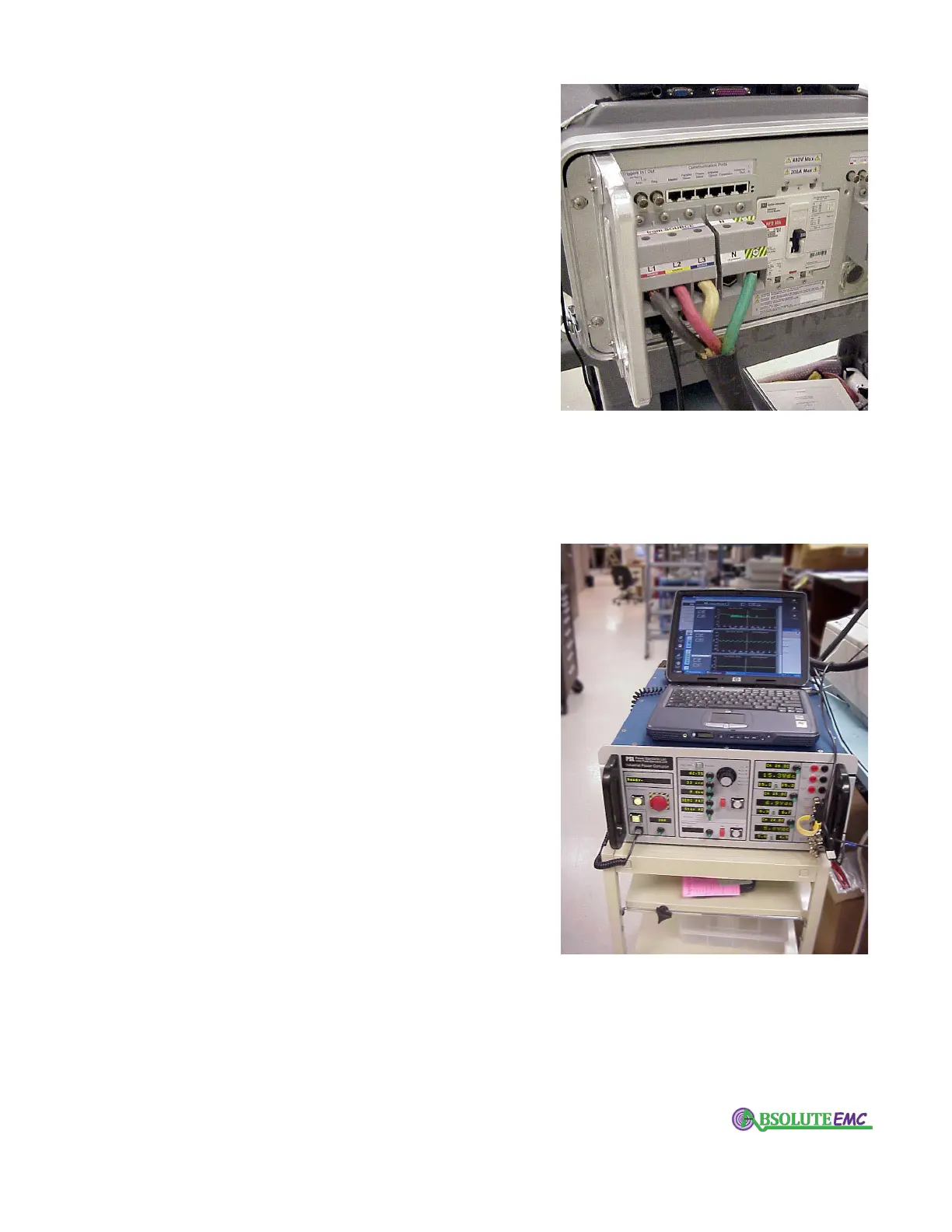
16. Make the power connections. Verify that all connectors
are appropriately tight. Tug on each connection to verify
it is mechanically secure. Mechanically anchor all power
cables so that no physical strain can be placed on the
connections during testing. Block physical access to any
exposed wiring.
17. Have each member of the test team independently verify
that the connections are correct prior to applying power.
The final verification should be made by the individual
responsible for safety
.
absolute-emc.com
Phone:703-774-7505
info@absolute-emc.com



 To Next Page