page 6
Industrial Power Corruptor Manual Rev 1.00
1. Overview
1.1 What is an Industrial Power Corruptor?
An Industrial Power Corruptor produces bad quality electric
power
, reliably and repeatedly.
Power from a clean source, such as your electric company, passes
through your IPC. Your IPC then adds disturbances - sags, swells,
interruptions, etc. - that reproduce disturbances that occur in the
real world. You use this disturbed power to test your equipment, to
verify that your equipment is rugged enough to tolerate power
disturbances.
Because all power for your equipment passes through your IPC,
you can use its optional Power Flow
Analysis package to measure
and record all of your electric power parameters, including inrush
current, kWh, power factor, etc.
Your IPC includes many tools that make it easier to diagnose
power disturbance problems, including a 31-channel digital
oscilloscope, many pre-connected meters, and a waveform display
program that zooms, converts to true-RMS, and has graphs that you
can copy and paste into reports.
The optional Power Flow Analysis package adds a real-time
spectrum analyzer
, harmonics meters, power flow meters, and a
superb power flow recorder for analyzing energy consumption of
your load.
Although your IPC has many safety features, such as ground
current detection, overtemperature sensors, overvoltage sensors, and
overcurrent breaker trips, testing with electric power is always
dangerous. Do not operate your IPC unless you have the training
and skill to do so. Be careful.
1.2 What is a voltage sag?
A voltage sag, or dip, is a brief reduction in RMS voltage on an
AC power circuit.
Typically, a voltage sag duration is between one
cycle and a few seconds; longer events are usually called
“undervoltages”.
Common causes of voltage sags include distant faults, or short
circuits, on a utility power grid; sudden, large increases in current,
typically caused by a motor starting or a large electronic load being
connected; and voltage regulation faults.
Voltage sags can disrupt sensitive electronic equipment in four
dif
ferent ways. First, there may not be enough energy available during
a voltage sag to continue to operate all, or part of, the equipment.
Second, a circuit within the equipment may detect the voltage sag
and consequently decide to shut down the equipment, whether that
action is appropriate or not. Third, a voltage sag on one phase of a
three-phase system can trip phase unbalance or phase rotation relays.
And fourth, the end of the voltage sag often involves a rapid increase
in line voltage, which can inadvertently trip the equipment’s “power-
on-reset” circuits.
These are difficult problems to diagnose, because they happen at
random times, and they are generally very brief.
The symptom is
often simply that the sensitive equipment misbehaves, or malfunctions,
for no apparent reason.
Use your IPC to verify that your sensitive electronic
equipment can tolerate power disturbances.
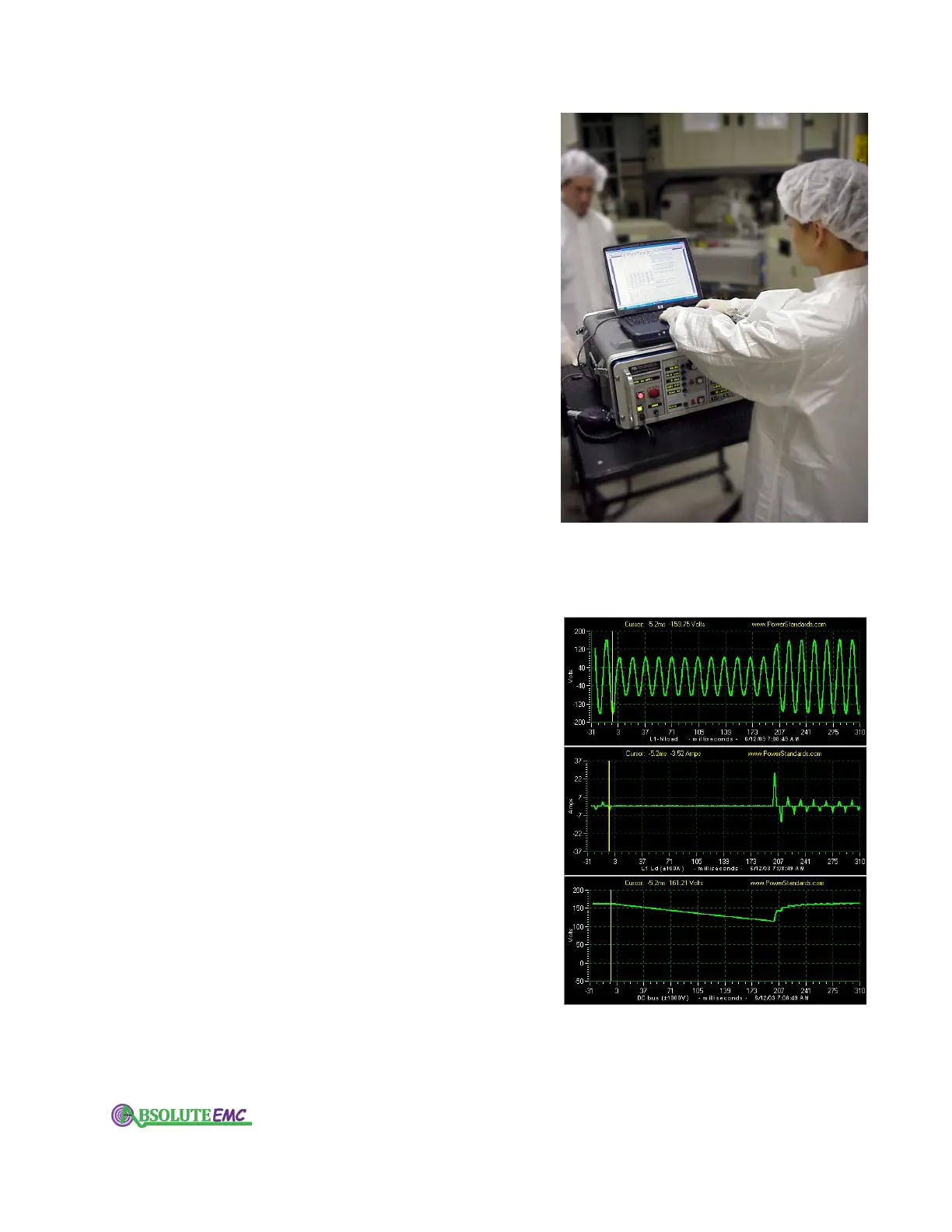
A typical voltage sag, generated by the IPC. The top
graph shows the voltage waveform. The middle graph
shows the current drawn by the load. The bottom
graph shows the load's internal DC bus, which
collapsed during the sag. All of these graphs were
recorded by the IPC’s internal data acquisition system.
absolute-emc.com
Phone:703-774-7505
info@absolute-emc.com


 To Next Page