page 56
Industrial Power Corruptor Manual Rev 1.00
Appendix C - Specifications - Maximum allowable current
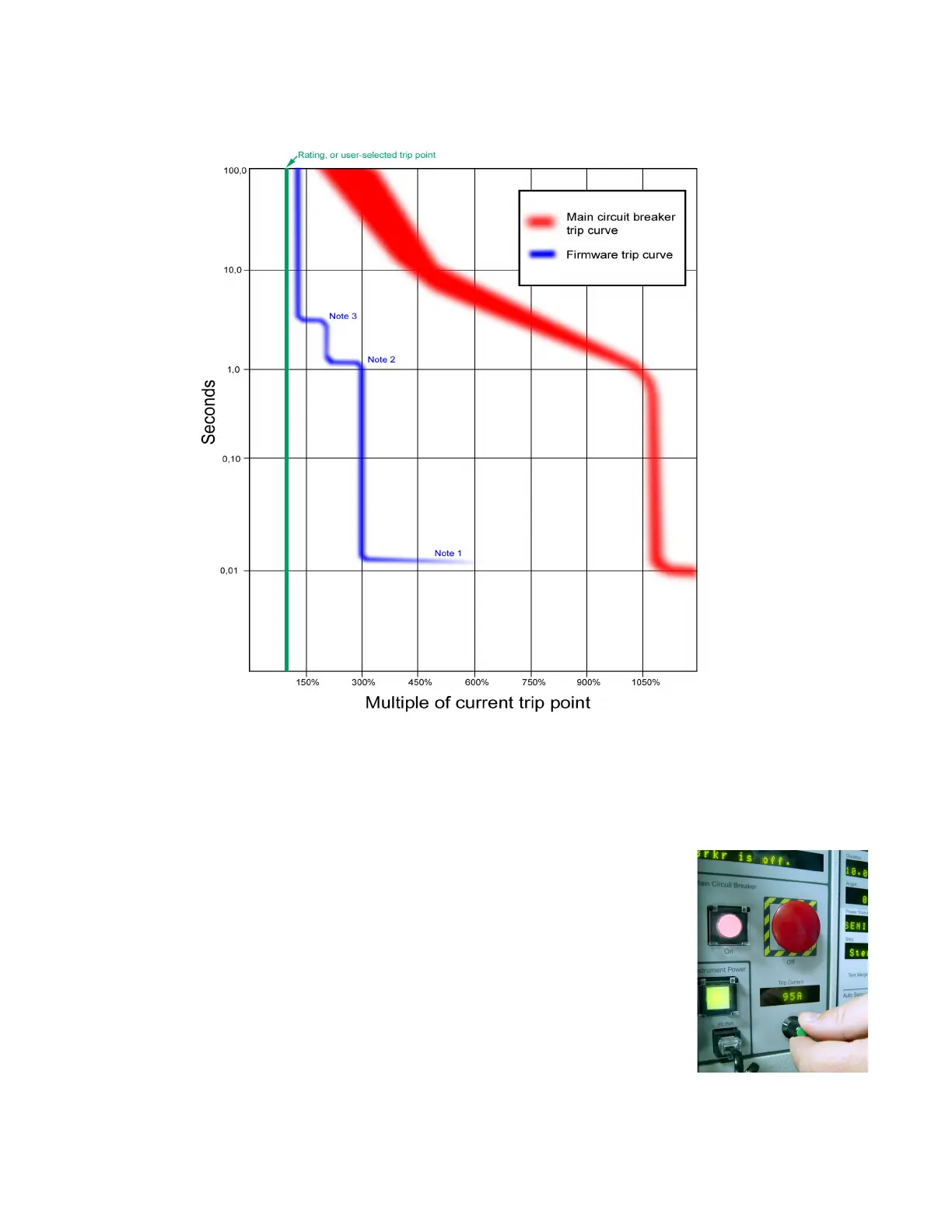
Note 1: During a sag/swell event, there is a 600-amp instantaneous trip point. On IPC’s rated for
200 amps, this trip point can be increased to 700 amps by placing the IPC into Combat Mode.
Note 2: The time for this threshold is frequency-dependent. It is set to 75 consecutive cycles.
Note 3: The time for this threshold is frequency-dependent. It is set to 250 consecutive cycles.
Your IPC’s main circuit breaker has an internal trip curve, shown in red on the graph
above.
The firmware in your IPC watches the current on each of the three source-side phase
terminals, and each of the three load-side phase terminals. It will trip the main breaker if any
of these currents, based on average-sense RMS calibration, exceed the following limits: 300%
of the front-panel current trip point for a single cycle, or 200% of the front-panel current trip
point for 75 consecutive cycles, or 125% of the front-panel current trip point for 250 consecutive
cycles.
In addition, during a sag or swell event, the firmware will trip the main breaker if the
absolute value of any single current sample exceeds 600 amps, regardless of the IPC rating or
the front-panel current trip point. (IPC’
s that are rated for 200 amps have a Combat Mode - in
Combat Mode, this limit is increased to 700 amps.)
In addition, the firmware will trip the main circuit breaker if any phase-to-phase or phase-
to-neutral voltage exceeds 550Vrms (for IPC’s rated at 480V) or 300Vrms (for IPC’s rated at
The blue curve is controlled
by the front-panel Trip
Current setting.


 To Next Page