11. Vehicle Settings
a) Setting the Camber
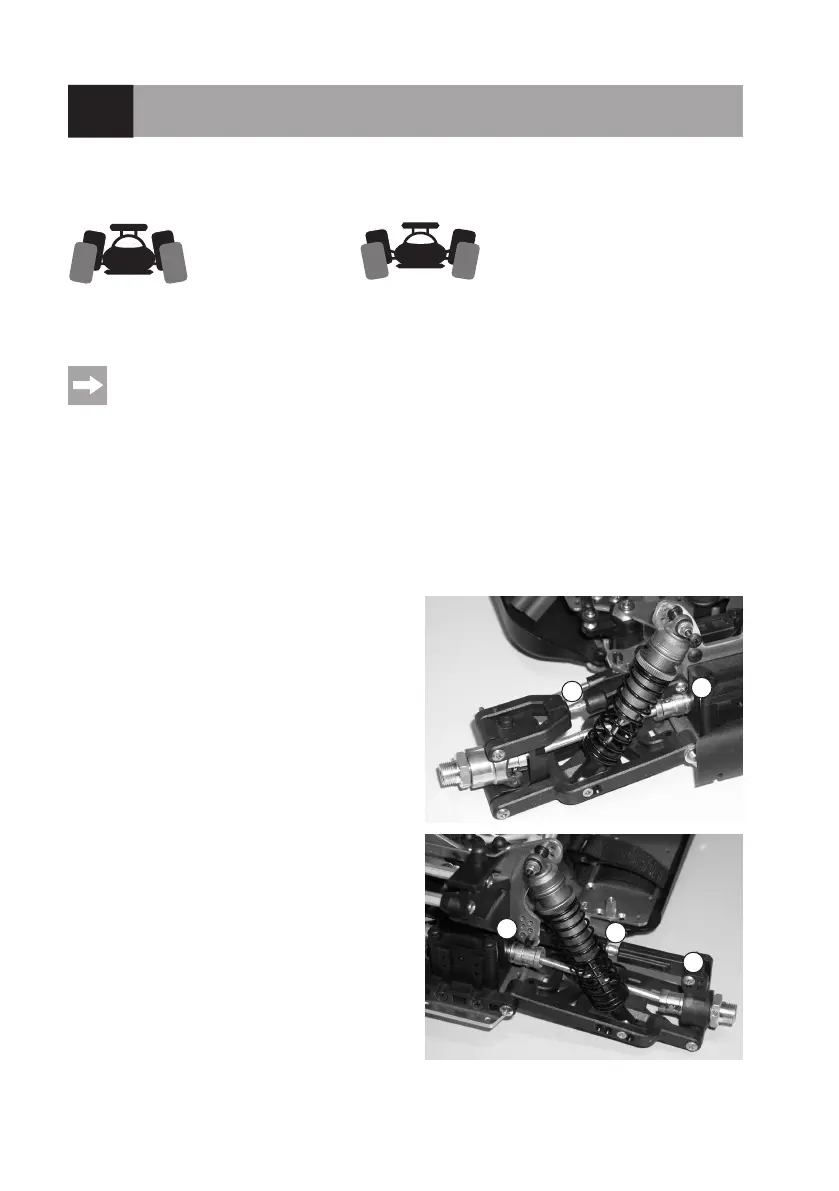
The camber is the inclination of the wheel level as compared to the vertical.
Negative inclination Positive inclination
(Top wheel edge points inwards) (Top wheel edge points outwards)
Thesettingofthewheelisexaggeratedinthetwoguresinordertomakethedifferencebetweennegative
and positive cambers more obvious. The setting on the model vehicle should of course not be as extreme
as shown!
• Anegativeinclinationofthefrontwheelsincreasesthelateralcorneringpowersofthewheelwhendrivingthrough
bends, the steering reacts more directly and steering forces are reduced. At the same time, the wheel is pushed onto
the axle leg in the direction of the axle. This balances out axial bearing clearance, the driving behaviour is calmer.
• Anegativeinclinationoftherearwheelsreducesthetendencyoftherearofthevehicletoswerveinbends.
• Settingapositivecamberontheotherhandreducesthecorneringforceofthewheelsandshouldnotbeused.
Setting Front and Rear Axle Camber:
For setting the camber, turn the screw (A) of the upper trans-
verse link.
Because this screw has a left and right hand thread at either
end, the transverse link does not need to be dismantled for
the camber to be adjusted.
Furthermore, the rear axle spur (B) and the two dampener
bridges (C) have several different suspension points for the
upper transverse link.
If the transverse link was attached in a different location, this
changesthecamberwhenthewheeldeectsandextends.
The manufacturer has already selected the best setting for
the vehicle. Therefore, you should not change the attach-
ment point (B and C).
A
B
C
A
C


 To Next Page