b) Setting the Alignment
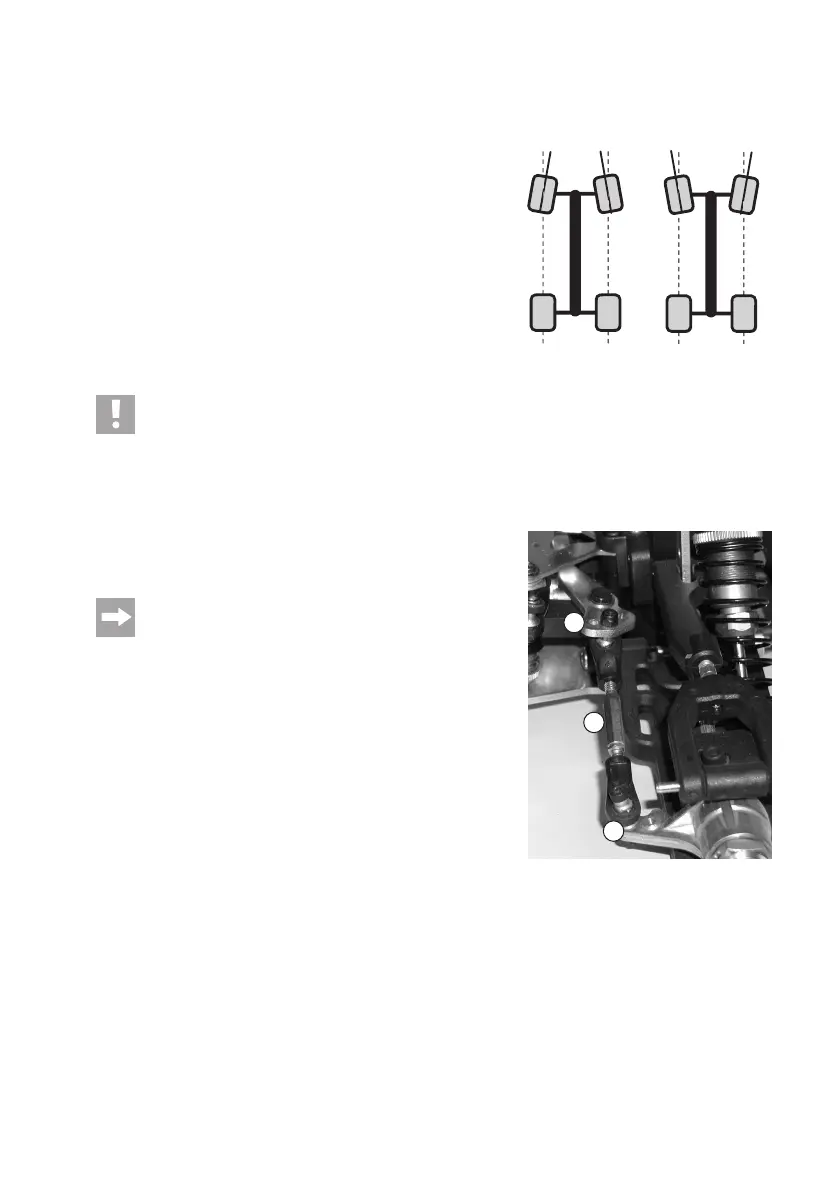
Wheelalignment(toe-in=gure„A“,toe-out=gure„B“)describesthe
relation of the wheel level to the driving direction.
The tyres are pushed apart in the front by rolling friction when driving.
Therefore, they are no longer precisely parallel to the driving direction.
To compensate, the tyres of the stationary vehicle can be adjusted so
that they point slightly inwards. This toe-in improves lateral cornering of
the tyres and leads to a more direct response to steering.
If a milder response to steering is desired, this can be achieved accor-
dingly by adjusting a toe-out, i.e. the wheels of the stationary vehicle
point outward.
An alignment angle of 0° at the front axle ensures the best driveability
on almost any underground.
An alignment angle of more than 3° toe-in (a) or toe-out (b) will lead to handling problems and decreased
speed. It will also increase tyre wear.
Thegureabove showsastronglyover-emphasised setting.Itis onlyusedforshowing thedifference
betweentoe-inandtoe-out.Ifsuchasettingisusedforthevehicle,itwillbeverydifculttocontrol!
Setting front axle alignment:
For the front axle, alignment can be set by twisting the steering knuckle
arm (A). Because it has a left and right hand thread each, it does not
need to be dismantled to be adjusted.
Turn both track rod levers evenly (left and right front wheel).
Otherwise, you need to adjust the trim of the transmitter (or
even change the steering servo control by adjusting the servo
rod).
At the axle leg (B) and in the steering plate (C) there are several attach-
ment points for the steering knuckle arm, which are used for changing
the turning angle of the front wheel (Ackermann angle).
The manufacturer already selected the best setting. Therefore, you
should not change these attachment points (B and C).
B
A
C


 To Next Page