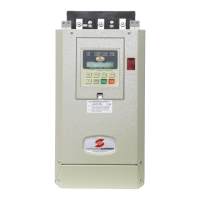
DCREG2 15P0059B3
DCREG4 USER MANUAL
67/200
3.33 SIGNAL TERMINALS
Decisive voltage class A according to EN 61800-5-1 (except for the cases specified below)
+10V: +10V reference voltage output for analog inputs.
-10V: -10V reference voltage output for analog inputs.
n OUT: Speed signal output for tachometer or any other use. Positive
polarity with bridge A running (not in regenerative state).
The value 10V corresponds to the max. speed (voltage) feedback signal, i.e.
parameter M001 (nFdbk) is equal to 100%.
If the drive is in armature feedback mode, this output is not enabled.
REF: Main analog input (5: REF+ / 7: REF-).
If both signal wires are connected, the two terminals represent a differential input
with a high rejection to interferences. Alternatively, with a signal to be reflected to
the drive 0V, the two terminals represent a common mode input. This common
mode input is a non-reversing input if the signal “hot wire” is connected to terminal
5 when terminal 7 is disconnected, whereas it is a reversing input if it is connected
to terminal 7 when terminal 5 is disconnected.
By setting jumper JP407 in the control board on pos. 2-3, the two terminals will
represent an input for a signal expressed in milliAmperes: a positive reference is
generated if the current enters terminal 5 and goes out through terminal 7. See
also the MILLIAMPERE INPUT / OUTPUT SIGNALS chapter.
JP407 on pos. 1-2:
-10 … +10 Vdc
R
in
= 20 k
JP407 on pos. 2-3:
20 mA max
R
in
= 200
I OUT: Current signal output (filtered) for possible ammeter, or different use.
Positive polarity with bridge A in operation. The value is 6.67V according to
the rated current of the drive (i.e. 100A for a DCREG.100).
In case of a DCREG4, the mentioned signal can be set as bipolar or
unipolar by means of the parameter P156 (IOutPol).
OUT 1: Analog output 1 to be configured with parameter P150
(AnOut1Cfg).
By setting jumper JP4010 in the control board on pos. 1-2, the terminal
will represent an output for a voltage signal, while when the jumper is
set on pos. 2-3, the terminal will represent an output for a signal
expressed in milliAmperes. An outgoing current only may be produced
towards 0V potential. See also the MILLIAMPERE INPUT / OUTPUT
SIGNALS chapter.
JP4010 on pos. 1-2:
-10 ... +10 Vdc
5 mA max
JP4010 on pos. 2-3:
0 ... 20 mA
10 V max
OUT 2: Analog output 2 to be configured through parameter P153 (AnOut2Cfg).
By setting jumper JP409 in the control board on pos. 1-2, the terminal will
represent an output for a voltage signal, while when the jumper is set on pos. 2-3,
the terminal will represent an output for a signal expressed in milliAmperes. An
outgoing current only may be produced towards 0V potential. See also the
MILLIAMPERE INPUT / OUTPUT SIGNALS chapter.
JP409 on pos. 1-2:
-10 ... +10 Vdc
5 mA max
JP409 on pos. 2-3:
0 ... 20 mA
10 V max
IN 1: Analog input 1 (11: IN 1+ / 13: IN 1-) to be configured through
parameter C120 (AnIn1Cfg). If both signal wires are connected, the two
terminals represent a differential input with a high rejection to interferences.
Alternatively, with a signal to be reflected to the drive 0V, the two terminals
represent a common mode input. This common mode input is a non-
reversing input if the signal “hot wire” is connected to terminal 11 when
terminal 13 is disconnected, whereas it is a reversing input if it is connected
to terminal 13 when terminal 11 is disconnected.
By setting jumper JP408 in the control board on pos. 2-3, the two terminals
will represent an input for a signal expressed in Milliamperes: a positive
reference is generated if the current enters terminal 11 and goes out
through terminal 13. See also the MILLIAMPERE INPUT / OUTPUT
SIGNALS chapter.
JP408 on pos. 1-2:
-10 … +10 Vdc
R
in
= 20 k
JP408 on pos. 2-3:
20 mA max
R
in
= 200



 To Next Page