SP395 SoundPro Audio Integrator Form7492 Operation Manual
61
RaSTI simplifies the above method by selecting only 9 waveforms total, using the 500Hz and
2kHz octave bands. RaSTI measurements use a transmitter to output a composite signal of all 9
modulation waveforms, and a separate receiver which analyzes the composite waveform, The
SP395 analyzes the results of a standard RASTI test signal, which is supplied on a CD. By using
a separate test signal on a CD, the test signal can be routed to a system that has a number of
speakers such as an emergency evacuation system, and the SP395 can be carried around to
measure each speaker individually.
In operation, an amplifier and speaker are set up at the “speaker” position, and the SP395
microphone is set up at the “listener” position. The RaSTI test waveform is played from a CD or
other source, and the test is performed by the SP395 RASTI analyzing function.
After 10 seconds of analysis, the results are shown on the screen, and the RaSTI value is read
directly. See the table, below the ALCONS function description, for a summary of the results of
these tests.
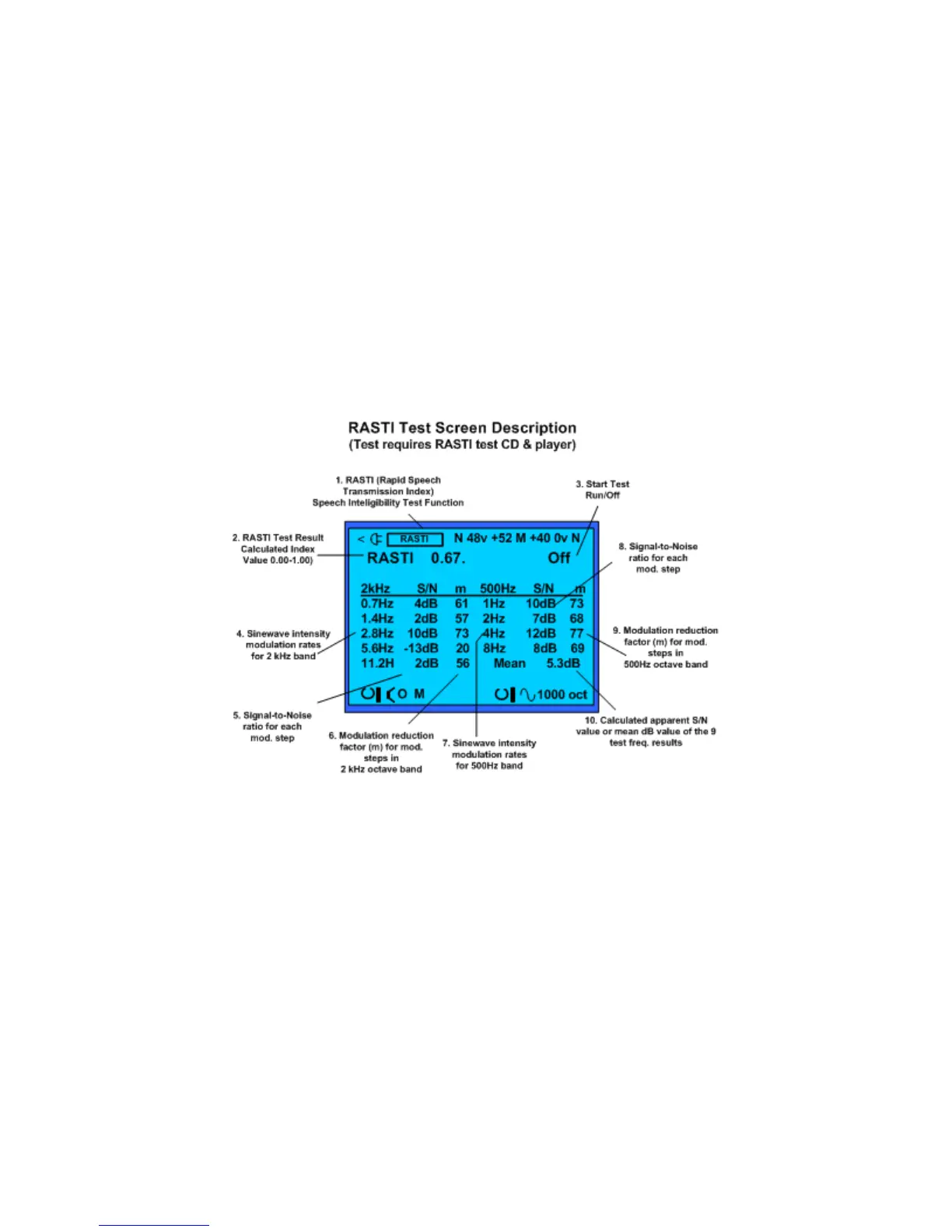
RASTI speech intelligibility test screen and control fields.
RASTI test screen and control fields.
1. Test Function – Identifies RASTI as the selected function and measurement screen.
2. RASTI Test Value – This is the RASTI measurement or index value after a valid test is
performed. The readout range is .00 to 1.
3. Off/Run – This field begins the test by selecting “RUN” and turns the test function off by
selecting “OFF.”
4. Column 2 kHz Intensity Modulation Rates – Five Modulation signals of the 2 kHz test
waveform used by RASTI to measure modulation reduction factor (m) and compute S/N
values.
5. S/N Ratio Measurements – values measured by the RASTI test for each of the
modulation signals.
6. Modulation Reduction Factor (m) – values measured by the RASTI test for each of the
modulation signals.


 To Next Page