SP395 SoundPro Audio Integrator Form7492 Operation Manual
84
7. Observe the display for speaker phase. A plus sign indicates that the speaker output is
the same polarity as the signal that is being applied to the system input.
Note: Some
loudspeakers are intentionally wired with one driver out of phase in the enclosure to
provide a smoother phase response at the crossover point of the crossover network.
Speaker Distortion
Excessive speaker distortion can cause audible problems and may be a sign of speaker damage or
impending speaker failure. The Speaker Distortion test uses FFT analysis to compare the level of
the fundamental test frequency with its harmonics and noise. It generates a sine wave and sums
the energy in the upper harmonics (and residual noise) to calculate the total harmonic distortion
plus noise (THD+N). The range is 0.01% to 50%. The display shows the value numerically and
also has a bar graph using a log-scale from 100% to 0.0001% THD.
Speaker distortion typically runs in the 1-5% range (with low levels of room noise). Use the
Speaker Distortion test to check all speakers, looking for differences between left and right
speakers and differences between speakers in matched sets. If one speaker has appreciably higher
distortion than the others, it is probably defective or damaged. Several test frequencies are
provided to properly test woofers, midrange and tweeter speaker types.
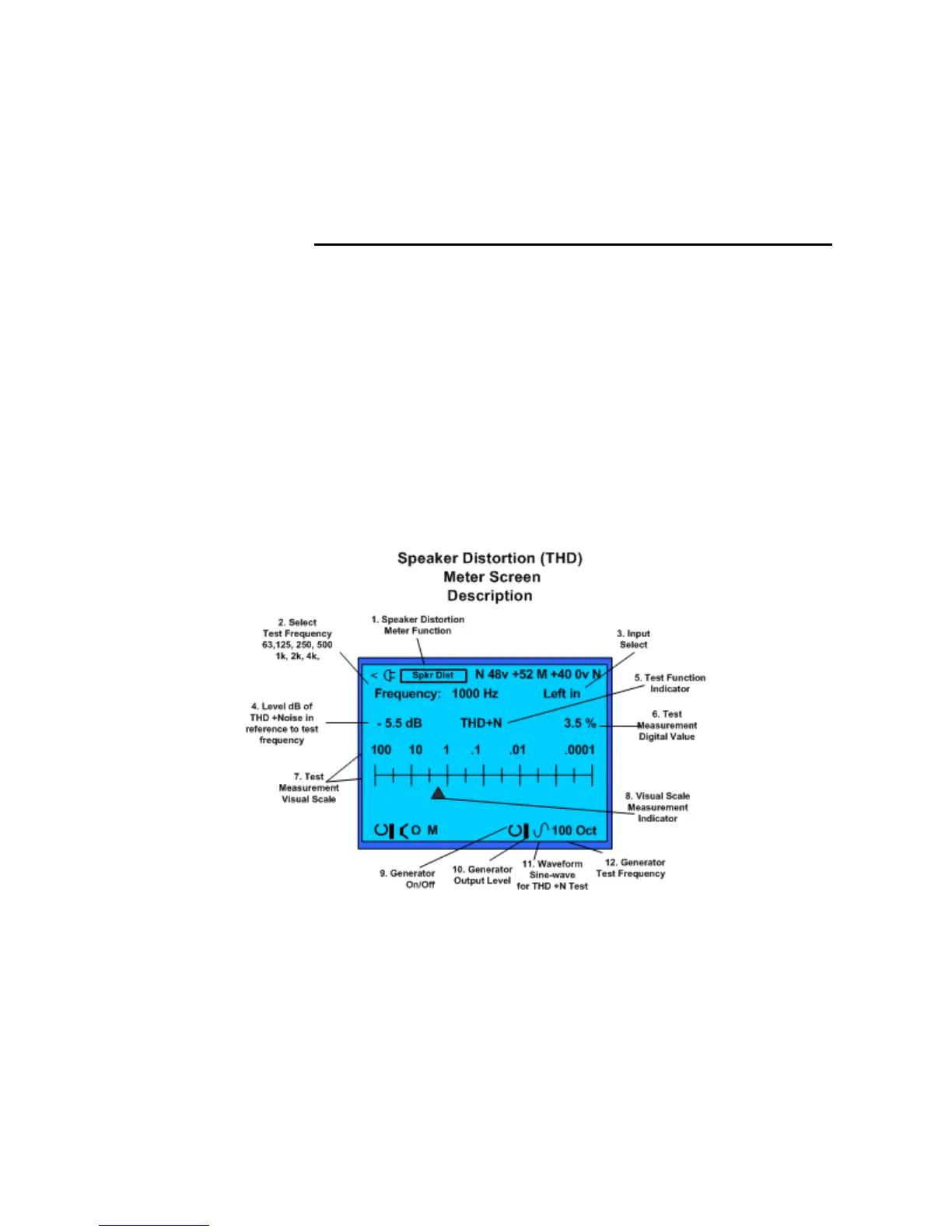
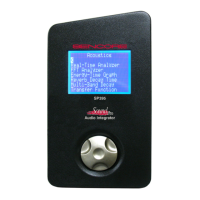
Speaker Distortion display and description of control fields.
Speaker Distortion Display and Control
1. Test Function – Identifies Speaker Distortion (Spkr Dist) as the active test function.
2. Test Frequency or Standard – Selects the frequency of the THD+N distortion test. The
generator low distortion sine-wave test frequency which is output to the audio system
driving the speakers must agree with this frequency selection. Test distortion of full-range
speakers over this full frequency range; test sub-woofers at 63 and 125 Hz; test satellite,
bookshelf, and PA speakers at 125 Hz and above
3. Input Select – Selects either the right or left input for the distortion test. For the Speaker
Distortion test, connect a microphone to the left channel input.


 To Next Page