Need help?
Do you have a question about the SICK LD-LRS and is the answer not in the manual?
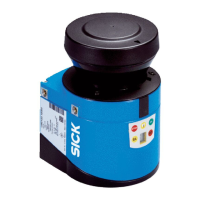
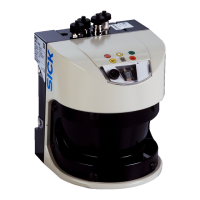
The LD-LRS is a 2D LiDAR sensor designed for use in industrial environments. It operates by contactlessly scanning its surroundings using laser beams and determining the position of objects in two-dimensional polar coordinates based on the reflected light. The device measures distance by calculating the time it takes for a pulsed laser beam to be reflected and received by the sensor. Direction is measured as the scanner head rotates at a selectable frequency (5 to 15 Hz), continuously triggering a distance measurement after each angle increment. In interlaced mode, individual scans are taken with an angular offset to achieve higher overall resolution when combined externally.
The LD-LRS is primarily used for automating ship loading operations with ship-to-shore cranes, where it precisely detects obstacles and determines container stack profiles. It can also measure the filling condition of bulk material stockpiles, converting the data into a 3D model to control loading systems. In conjunction with its field application, the LD-LRS3600 variant is suitable for building safety and security, and for monitoring outdoor access zones.
Possible applications include:
The device features multi-echo analysis, allowing it to evaluate up to three echo signals per measuring beam for reliable results even in adverse ambient conditions. The LD-LRS3600 variant includes an integrated field application that analyzes up to six detection fields within its scan range, enabling systems for collision protection, object protection, or access monitoring.
The device is configured using the SOPAS ET software, which allows interactive parameterization of measuring properties, evaluation behavior, and output properties. The software enables users to create application-specific parameter sets, save them to the device's non-volatile memory, and archive them as project files. Communication with the device can be established via Ethernet TCP/IP or RS-422.
For reliable object detection, the minimum object size must be considered, which is calculated as the beam diameter plus the measuring point distance. Objects need to be hit completely by the laser beam at least once to be reliably detected. For field applications, an object usually needs to be hit multiple times in a row to be recognized as interrupting the field.
Synchronization of the device's internal clock with an external computer is crucial for precise control of contour data. This can be achieved via telegrams, Timer Read telegrams, or an index pulse at the hardware output.
Regular maintenance is recommended to ensure optimal performance and safety. The maintenance plan includes:
Cleaning the optics cover should be done with a lint-free lens cloth and plastic cleaning agent. Coarse dirt should be rinsed off with water first. The cleaning interval depends on ambient conditions. If the optics cover is scratched or damaged, it must be replaced by SICK Support.
No specific maintenance is required to ensure compliance with the laser class. Repairs should only be performed by qualified and authorized personnel from SICK AG to maintain warranty claims. For returns, SICK Service should be consulted, and the device should be sent in its original or equivalent padded packaging, including details of the contact person, application description, and fault description. Disposal must be done in an environmentally friendly manner, adhering to country-specific waste disposal regulations.
 General
| Brand | SICK |
|---|---|
| Model | LD-LRS |
| Category | Accessories |
| Language | English |

 To Next Page