3.4.4 Impact of object surfaces on the measurement
Remission value
Remission is the ability of a material to reflect light. The remission correlates with the
amount of laser light emitted by the LiDAR sensor which is reflected by an object (see
Lambert’s law).
Glossy surfaces have different remissions at the same distance with different angles of
impact. In the case of shiny surfaces, maximum remission is achieved when the beam
makes vertical impact.
Matt and dull surfaces have diffuse remission. They therefore exhibit similar relative
remissions with the same angle of impact regardless of the distance from the zero
point.
Table 3: Typical remissions of frequently used materials
Material Typ. relative remission
Rubber tires (vulcanized, black) 2%
Foam rubber (black) 2.4%
Photographic board (black, matte) 10%
Cardboard (gray) 20%
Wood (untreated fir, soiled) 40%
PVC (gray) 50%
Paper (white, matte) 80%
Plaster (white) 100%
Aluminum (black anodized) 110 … 150%
Steel (stainless, shiny) 120 … 150%
Steel (high gloss) 140 … 200%
Reflection
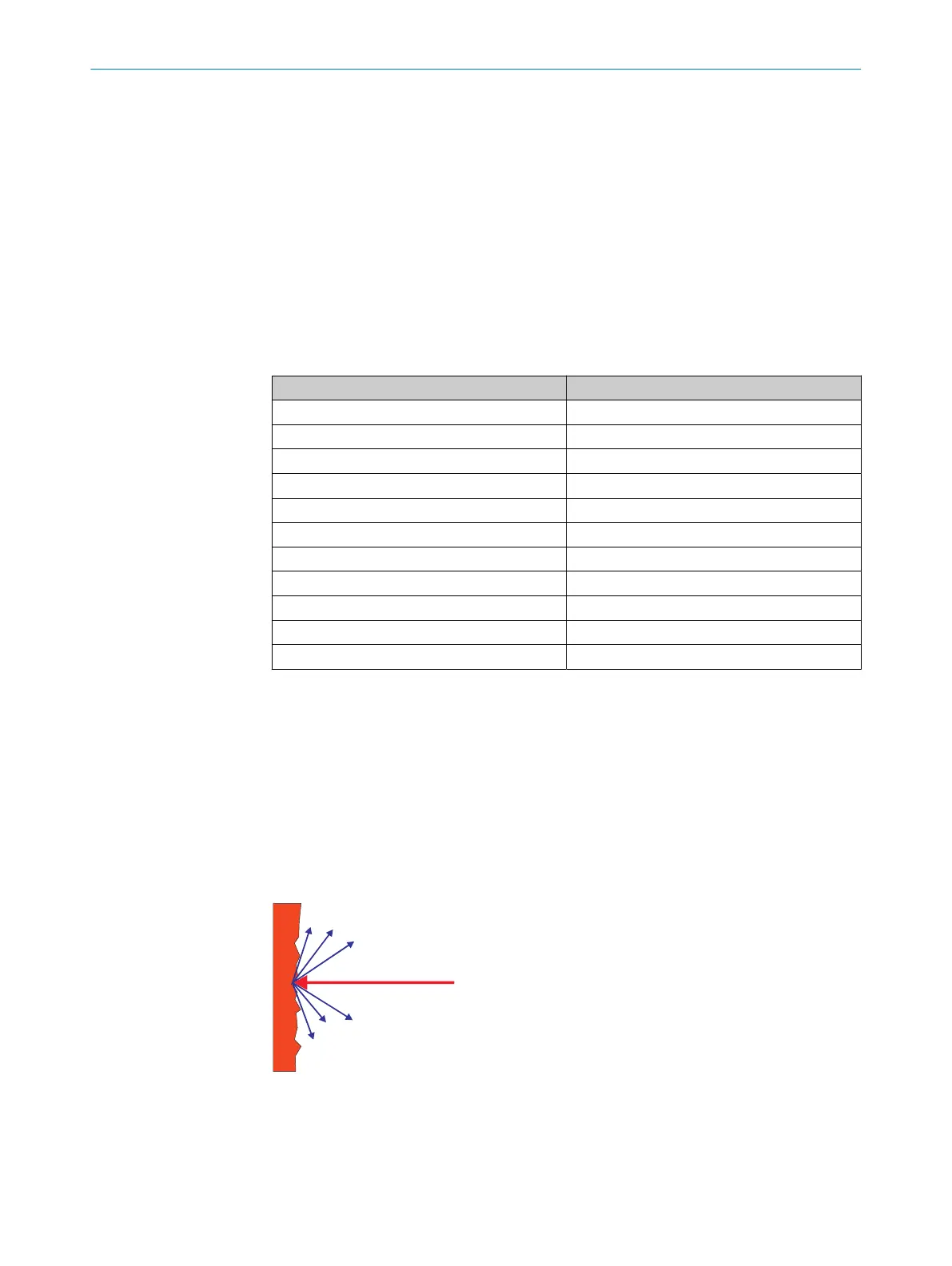
Most surfaces produce a diffuse reflection of the laser beam in all directions. The
structure (smooth or rough), shape (flat or curved), and color (light or dark) of the
surface determine how well the laser beam is reflected.
On very rough surfaces, a large proportion of the energy is lost due to absorption.
Curved surfaces produce a higher diffusion. Dark surfaces reflect the laser beam worse
than light ones (brilliant white plaster reflects approx. 100% of the light, while black
foam rubber reflects approx. 2.4%). The aforementioned surface characteristics can
reduce the scanning range of the device, in particular for surfaces with low remission
values.
Figure 3: Reflection of light on the surface of the object
3 PRODUCT DESCRIPTION
12
O P E R A T I N G I N S T R U C T I O N S | LD-LRS 8016506/1G07/2020-11-08 | SICK
Subject to change without notice


 To Next Page