31
2 Set the cursor to the character to be entered and
push on the MENU SEL knob/ENTER button.
Repeat steps 1 and 2.
By selecting INS on the line below the character list, you
can enter a space at the cursor position.
Selecting DEL deletes the character at the cursor
position.
You can return to step 1 without changing the character
by selecting RET.
If you enter the permitted maximum number of
characters (up to the stop mark at the right end of the
line), the cursor moves to ESC on the line below the
character list.
To register the new string you have set, select END and
push on the MENU SEL knob/ENTER button.
To restore the previous string, select ESC and push on
the MENU SEL knob/ENTER button.
To return a menu item to its standard value
Select the menu item to be returned to its standard value
then hold the MENU SEL knob/ENTER button pressed for 3
seconds while the arrow marker (,) is displayed.
To end menu operations
Set the DISPLAY switch to OFF.
Editing the USER Menu
You can select desired pages and items from the
OPERATION, PAINT, MAINTENANCE, FILE, and DIAGNOSIS
menus and register them to the USER menu.
If you specify pages or items frequently used for the USER
menu, you can easily call and use them.
The following pages are included on the factory-set USER
menu:
For the items on each page, see the corresponding source
menu page in the table in “Menu List” on page 34.
The USER MENU CUSTOMIZE menu allows you to configure
a USER menu that consists only of pages and items that you
need, by your adding, deleting or replacing pages.
Editing by items
The USER MENU CUSTOMIZE menu allows you to add a new
page to the USER menu and add desired items to the page.
While the EDIT page contains factory-preset items, the
USER 1 EDIT to USER 19 EDIT pages are all blank in their initial
state. You can register up to 10 items, including blank lines,
on each of these pages.
To add items to a page
Proceed as follows.
1 Set the DISPLAY switch from the OFF position to the
MENU position while holding the MENU SEL knob/
ENTER button pressed.
The TOP MENU screen appears.
2 Turn the MENU SEL knob/ENTER button to move the
arrow marker (
,) to “USER MENU CUSTOMIZE” then
push on the MENU SEL knob/ENTER button.
If this is the first time the USER MENU CUSTOMIZE menu
has been displayed, the CONTENTS page of the menu
appears.
If the USER MENU CUSTOMIZE menu has been used
before, the page last accessed appears.
3 If the CONTENTS page is displayed, turn the MENU
SEL knob/ENTER button to move the arrow marker
(,) to any of USER 1 EDIT to USER 19 EDIT then push
on the MENU SEL knob/ENTER button to display the
page.
If a different page is displayed, turn the MENU SEL
knob/ENTER button until the desired page appears,
then push on the MENU SEL knob/ENTER button to
select the page.
Example: When you select the USER 2 EDIT page
4 Move the arrow marker (,) to the item to be added
(this operation is unnecessary if no item exists on the
page, as shown in the figure for step 3) then push on
the MENU SEL knob/ENTER button.
The EDIT FUNCTION screen appears.
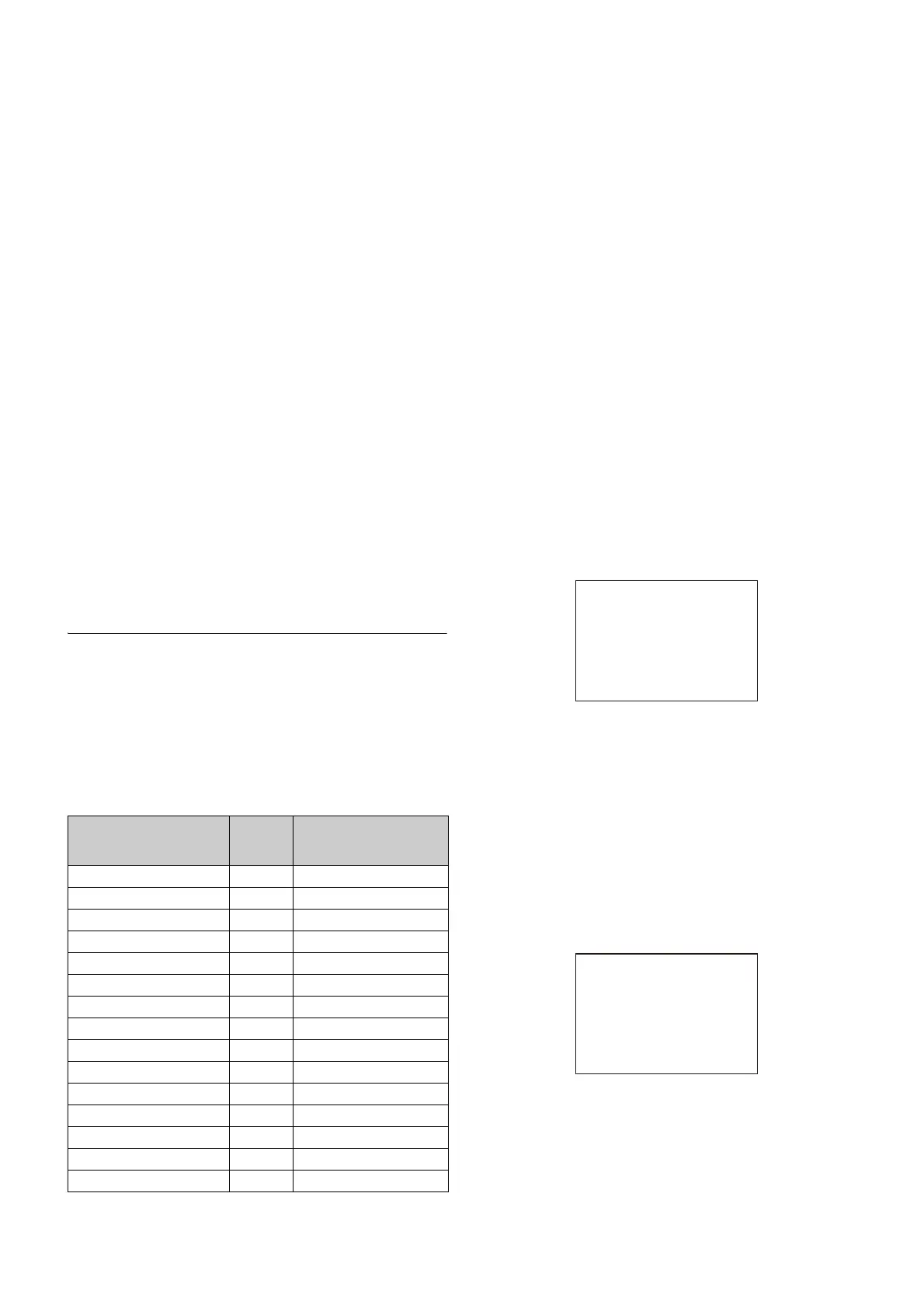
Menu page title USER
menu
No.
Source menu / page No.
<VF OUT> U01 OPERATION 14
<VF DETAIL> U02 OPERATION 04
<FOCUS ASSIST> U03 OPERATION 08
<VF DISPLAY> U04 OPERATION 01
<‘!’ IND> U05 OPERATION 02
<VF MARKER> U06 OPERATION 03
<CURSOR> U07 OPERATION 10
<ZEBRA> U08 OPERATION 09
<SWITCH ASSIGN1> U09 OPERATION 15
<SWITCH ASSIGN2> U10 OPERATION 16
<HEADSET MIC> U11 OPERATION 20
<OUTPUT FORMAT> U12 MAINTENANCE M11
<TEST OUT> U13 MAINTENANCE M12
<SDI OUT> U14 MAINTENANCE M13
<ROM VERSION> U15 DIAGNOSIS D03
CONTENTS E00
xx
01.EDIT PAGE
02.USER 1 EDIT
c
03.USER 2 EDIT
04.USER 3 EDIT
05.USER 4 EDIT
06.USER 5 EDIT
07.USER 6 EDIT
08.USER 7 EDIT
09.USER 8 EDIT
10.USER 9 EDIT
TOP
USER 2 EDIT E03
c
TOP



 To Next Page