STEMCELL TECHNOLOGIES INC.’S QUALITY MANAGEMENT SYSTEM IS CERTIFIED TO ISO 13485 MEDICAL DEVICE STANDARDS.
FOR RESEARCH USE ONLY. NOT INTENDED FOR HUMAN OR ANIMAL DIAGNOSTIC OR THERAPEUTIC USES.
TOLL-FREE PHONE 1 800 667 0322
PHONE +1 604 877 0713 VERSION 02
INFO@STEMCELL.COM
TECHSUPPORT@STEMCELL.COM
FOR GLOBAL CONTACT DETAILS VISIT WWW.STEMCELL.COM DOCUMENT #10000005578
7
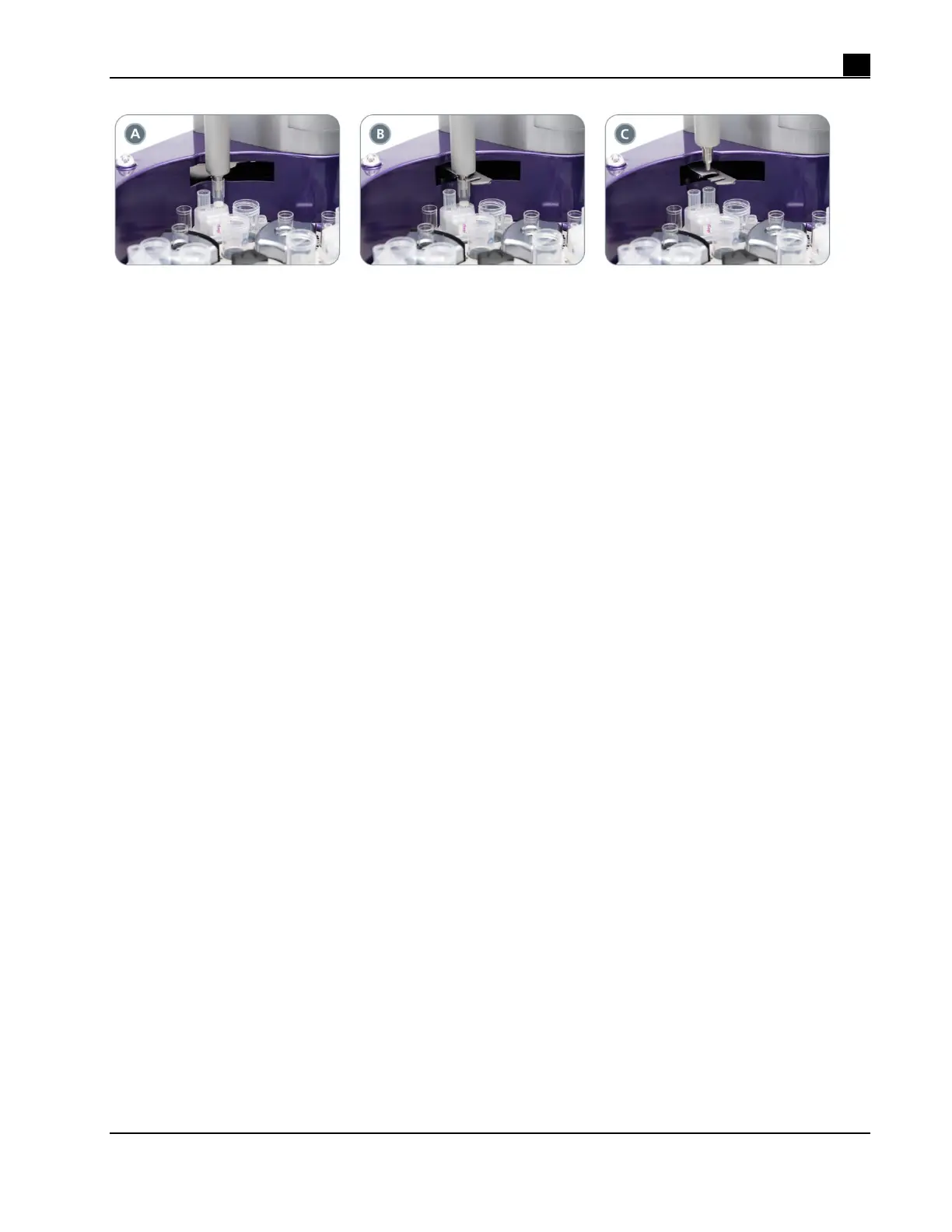
Figure 8. Tip Strip Process. (A) The robotic arm places the used 5 mL tip partly back into the tip rack. (B)
The tip stripping arm swings out to engage the tip head just above the 5 mL tip. (C) The robotic arm moves up
and the tip fully falls into the tip rack.
Tip Strip Failures
In some cases RoboSep™-S may be unable to strip a pipette tip from the tip head. If RoboSep™-S detects a
tip strip failure, a dialog box will appear and the instrument will beep and the LED light (Figure 2) will flash.
Selecting the Resume button will prompt RoboSep™-S to try stripping the tip again. If RoboSep™-S cannot
successfully strip the tip, this step should be done manually.
Note: If a tip strip failure occurs, the tip head may need to be cleaned as described in section 6.1.
2.1.3 Hydraulic System
The hydraulic system uses sterile deionized water driven by a positive displacement piston pump. The pipette
handling tip head is connected to a hydraulic fluid bottle containing sterile deionized water located behind the
front access panel of RoboSep™-S (Figure 1). The only visible part of this system is the tubing running from
the console to the robotic arm.
The hydraulic fluid does not make contact with samples or reagents, and because it is deionized water, it is
less damaging to the piston seal than salt solutions or buffers. Therefore the RoboSep™-S pump has a
substantially longer operating life than the seals on syringe pumps used in other instruments and does not
require any user maintenance. The use of water as a hydraulic fluid instead of air allows for accurate high-
speed dispensing: the water effectively acts as an incompressible extension of the pump piston, allowing the
system to operate with a dead air volume similar to that of a manual pipette.
The hydraulic fluid bottle should be refilled periodically (section 3.5). To reduce the chance of the hydraulic
tubing becoming clogged with microbial growth, sterile deionized water should be used.
Note: RoboSep™-S will automatically monitor the volume of deionized water in the hydraulic fluid bottle and a
dialog box will notify you if priming is required (section 3.5).



 To Next Page