STEMCELL TECHNOLOGIES INC.’S QUALITY MANAGEMENT SYSTEM IS CERTIFIED TO ISO 13485 MEDICAL DEVICE STANDARDS.
FOR RESEARCH USE ONLY. NOT INTENDED FOR HUMAN OR ANIMAL DIAGNOSTIC OR THERAPEUTIC USES.
TOLL-FREE PHONE 1 800 667 0322
PHONE +1 604 877 0713 VERSION 02
INFO@STEMCELL.COM
TECHSUPPORT@STEMCELL.COM
FOR GLOBAL CONTACT DETAILS VISIT WWW.STEMCELL.COM DOCUMENT #10000005578
13
3.5 Priming the Hydraulic System
RoboSep™-S performs a priming sequence at the beginning of every cell separation protocol to minimize the
effect of air bubbles that naturally accumulate in the hydraulic system. When RoboSep™-S is used for the
first time, or if the hydraulic fluid bottle needs to be refilled, use the priming protocol below.
Note: RoboSep™-S will automatically monitor the volume of deionized water in the hydraulic fluid bottle and
notify you if priming is required.
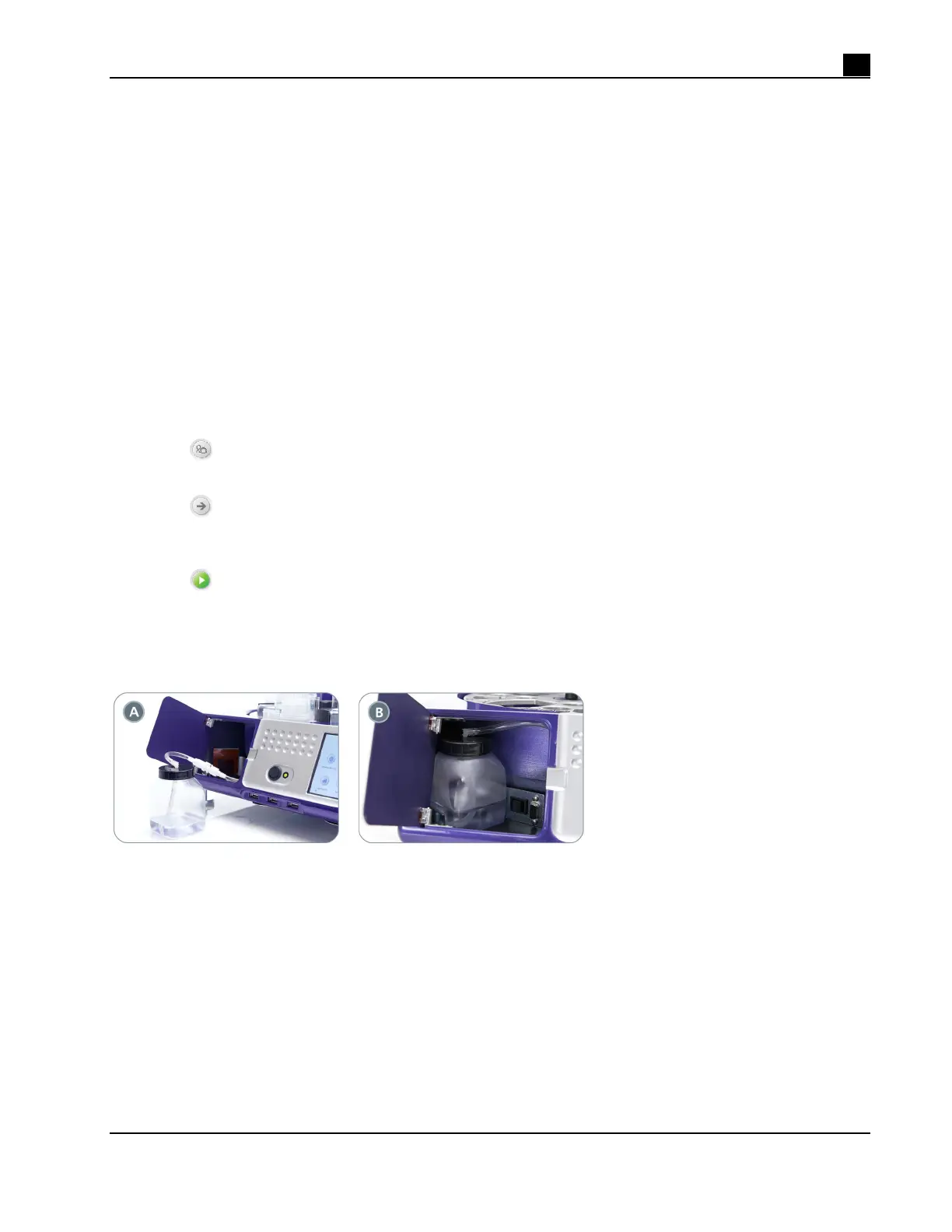
1. Open the access panel located at the front of the instrument and remove the hydraulic fluid bottle using
the white quick connect (Figure 14A).
Note: Do NOT touch the black switch behind the access panel. This is to be used only by a STEMCELL
Technologies representative for servicing purposes.
2. Unscrew the cap and fill the bottle with 250 mL of sterile deionized water.
3. Screw the cap back on, reconnect the bottle to the hydraulic system tubing, and place back into the
instrument (Figure 14B).
4. If necessary, start up the instrument (section 3.3).
5. Select
[Maintenance] on the Home screen. Select Basic Prime under System Protocols.
Note: The Basic Prime protocol will appear in quadrant #1 of the Run Samples screen.
6. Select
[Next] and then OK in the Confirm Run dialog box.
7. Place an empty 50 mL waste tube in the slot highlighted in purple in quadrant #1 of the Carousel Loading
screen.
8. Select
[Run] to initiate the Basic Prime protocol.
9. Wait approximately 2 minutes for the protocol to run. RoboSep™-S will expel water and any air bubbles
contained in the hydraulic system into the waste tube.
Note: If no water is expelled into the waste tube by the end of the protocol, refer to section 8.0.
Figure 14. Hydraulic System. The hydraulic bottle and quick release (A) outside and (B) inside of the
instrument.
Note: The hydraulic bottle may discolor over time with exposure to UV light. Discoloring of the bottle does not
affect instrument performance.



 To Next Page