© STULZ GmbH, Hamburg DE / 06-2016 / 1000687
-
15
-
STULZ UltraSonic -System for duct humidication ENS 14 A - 18 A- Product description
4.4. Operating principle of ultrasonic humidication
Ultrasonic humidiers from the STULZ UltraSonic model series work on the principle of ultrasonic atom-
ization. A 48 V alternating voltage is rectied on an nebulizer print plate and converted into a high-fre-
quency signal of 1.65 MHz. This signal is transferred to an transducer installed in the water bath, which
converts it into a high-frequency mechanical oscillation. The integrated transducers are referred to as
thickness transducers, which change their thickness 1.65 million times a second in line with the applied
signal of 1.65 MHz.
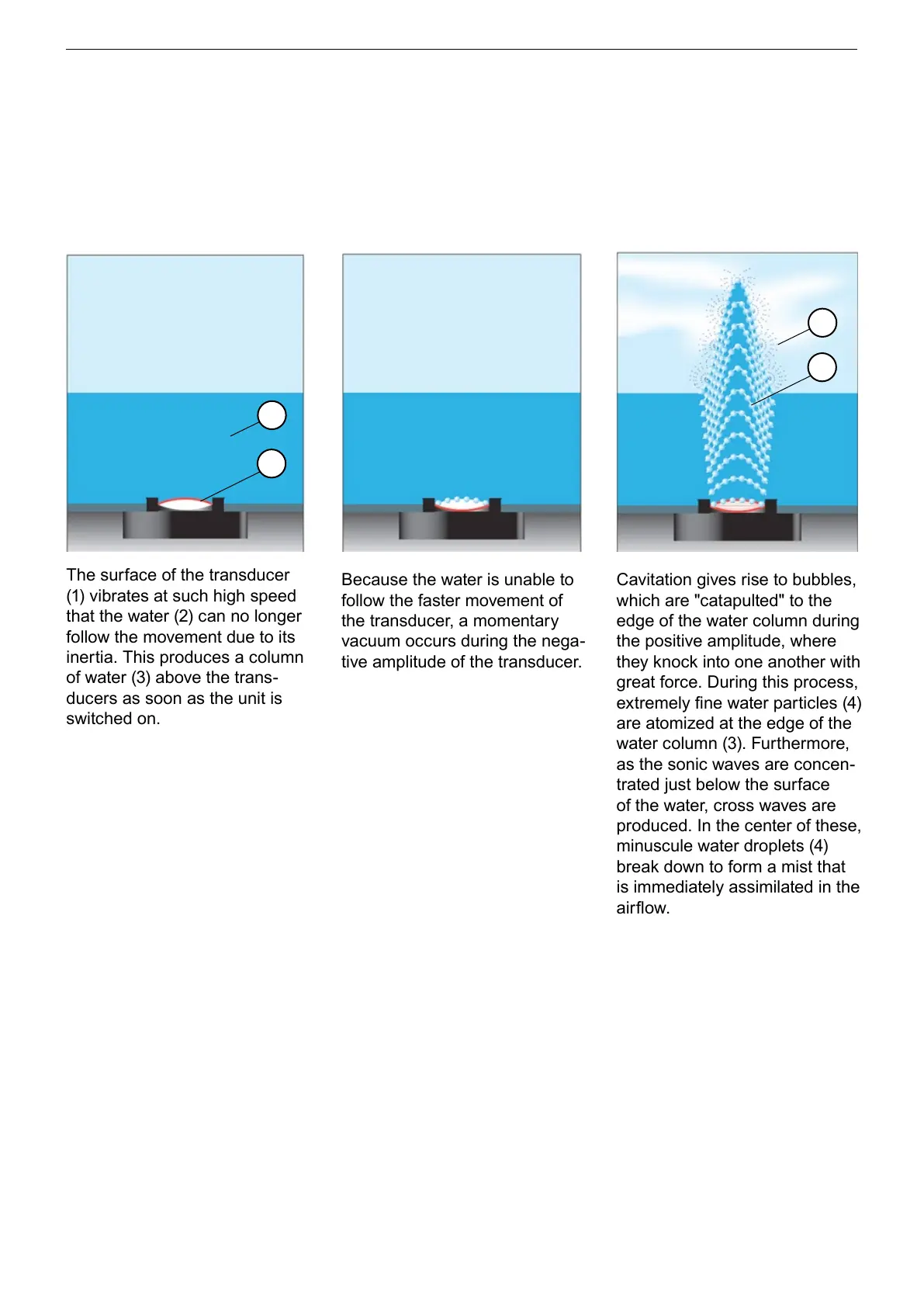
The surface of the transducer
(1) vibrates at such high speed
that the water (2) can no longer
follow the movement due to its
inertia. This produces a column
of water (3) above the trans-
ducers as soon as the unit is
switched on.
Because the water is unable to
follow the faster movement of
the transducer, a momentary
vacuum occurs during the nega-
tive amplitude of the transducer.
Cavitation gives rise to bubbles,
which are "catapulted" to the
edge of the water column during
the positive amplitude, where
they knock into one another with
great force. During this process,
extremely ne water particles (4)
are atomized at the edge of the
water column (3). Furthermore,
as the sonic waves are concen-
trated just below the surface
of the water, cross waves are
produced. In the center of these,
minuscule water droplets (4)
break down to form a mist that
is immediately assimilated in the
airow.
1
2
3
4



 To Next Page