GB.GOLDSK509.091101
We reserve the right to alter specifications without notice.
www.swegon.com 47
16 MAINTENANCE
Warning
Before carrying out any work, make sure that the
power supply to the unit has been isolated.
16.1 Filter Change
The filters should be changed when the filter alarm has been
activated.
Order new filters from Swegon or its representative!
State the size of the GOLD unit and whether the change involves
one or two air directions.
16.1.1 To remove the Filters
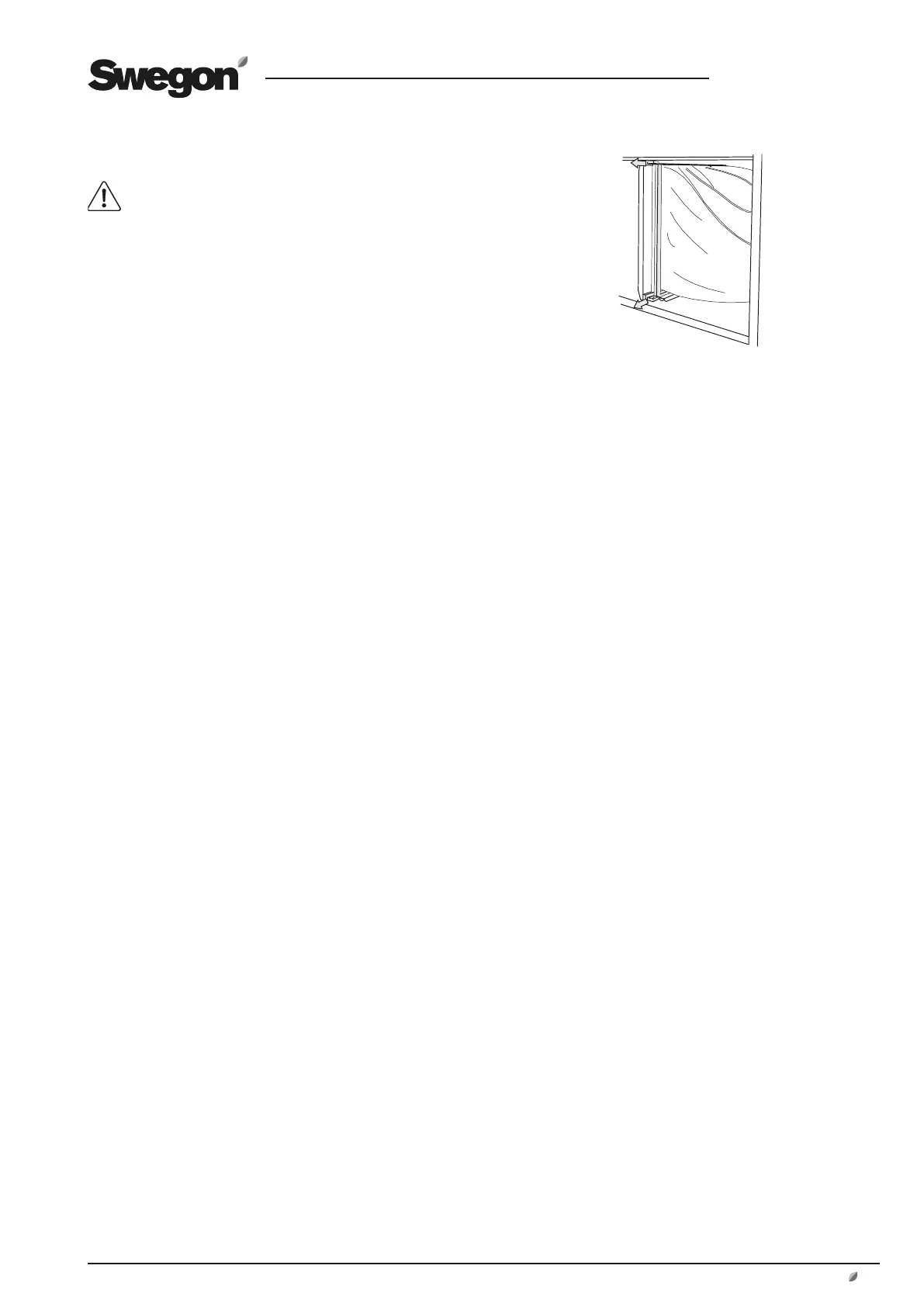
Pull out the handles (A) to free the filters from the filter holder.
Withdraw the filters.
It is advisable to clean inside the filter space while the filters are
gone.
16.1.2 To fit new filters
Insert the filters into the filter holder. At the same time, stretch
out the filter bags, so that they will not get caught, hurt or
become folded.
Insert the filters as far as possible into the unit and press lightly
on the filter frames, so that they will fit tightly.
Push in the handles (A) so that the filters are clamped in place in
the filter holder.
Carry out a filter calibration as described in Section 6.4.2.
16.2 Cleaning and Inspection
16.2.1 General
Clean the interior of the air handling unit as the need arises.
Inspect the air handling unit thoroughly at the same time that
you replace the filters or at least twice a year.
16.2.2 Filter Space
Cleaning is most appropriate when you change the filters.
16.2.3 Heat exchangers
Check at least twice a year whether cleaning is necessary.
The cleaning work is carried out from the filter space.
Rotary heat exchanger
The heat exchanger should preferably be cleaned by vacuum
cleaning with a soft nozzle to prevent damaging the air passages
in the rotor.
Turn the rotor by hand to enable you to vacuum clean its entire
surface.
If the heat exchanger is substantially fouled, it can be blown
clean with compressed air.
If necessary, the heat exchanger can be withdrawn from the unit
casing and washed with degreasing solvent. Only service person-
nel trained by Swegon shall be permitted to use this cleaning
method.
FABRIC SEAL
Lift up the fabric seal and inspect its underside. Clean if needed
by brushing or vacuum cleaning.
If the fabric seal is worn or substantially fouled, it should be
replaced. Do not lubricate it!
BELT TENSION
Replace the drive belt if it feels loose or worn and slightly slips
if it meets resistance. Contact service personnel trained by
Swegon!
Plate heat exchanger
Always clean against the regular direction of airflow.
Cleaning shall only be done by blowing with compressed air,
vacuum cleaning with a soft nozzle or wet cleaning with water
and/or solvent. Before you begin cleaning, cover adjacent func-
tional sections to protect them.
If cleaning solvent is used, do not use solvent that will corrode
aluminium or copper. Swegon’s cleaning agent is recommended.
This cleaning agent is sold by Swegon Service.
Inspect the condensate drain to make sure that it isn’t clogged.
The by-pass and shut-off dampers do not require maintenance.
Coil heat exchanger
Make sure that the coils are purged of air. If a droplet eliminator
is fitted, remove it and flush it clean with water.
Always clean against the regular direction of airflow.
Cleaning shall only be done by blowing with compressed air,
vacuum cleaning with a soft nozzle or wet cleaning with water
and/or solvent. Before you begin cleaning, cover adjacent func-
tional sections to protect them.
If cleaning solvent is used, do not use solvent that will corrode
aluminium or copper. Swegon’s cleaning agent is recommended.
This cleaning agent is sold by Swegon Service.
While cleaning, check the content of glycol in the water and the
condition of the coil for tightness. Also check that the conden-
sate drain is not clogged.
16.2.4 Fans and Fan Space
Inspect and clean the fan impellers to remove possible dirt
deposits.
Check the impeller to make sure that it is not out of balance.
Clean or brush off the fan motor. It can also be cleaned by
carefully wiping it with a damp cloth that has been dipped in a
solution of water and dishwashing detergent.
Clean the fan space, if needed.
16.3 Performance Checks
General performance checks should be carried out in conjunc-
tion with filter change or at least once a year.
It is then appropriate to compare the current performance values
of the unit with the Commissioning Record. Eventual deviations
should be remedied.




 To Next Page