The measurement conditions M0, M1, M2, M3 according to
ISO 13655-2009
Many types of paper contain optical brighteners or pigments to improve the visual
performance of the paper. The brighteners and pigments are used to make the paper
look brighter and whiter. But for the accurate color adjustment they are quite a chal-
lenge, because the type of ambient light inuences the color perception in most cases
to a large extent. To be able to evaluate these printing substrates precisely when mea-
suring, new standards have been dened concerning the measurement conditions.
The following measurement conditions are selectable in the measurement parameter
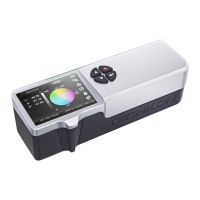
menu of the SpectroDens color measurement device.
Measurement condition M0 is used when the printing substrate contains no or only
little optical brighteners. The measurement light corresponds to the standard illumina-
tion type A and the UV component of the source, which activates the optical brighten-
ers, is not specied. Almost every color measurement device in the graphic industries
works so far with this measurement condition. This measurement condition should
also be used, when measurement values have to be compliant to older devices.
Measurement condition M1 was dened to activate optical brighteners with a speci-
ed component of UV light, to be able to evaluate the eect of the brighteners more
precisely. The measurement light conforms to the illumination type D 50 with a speci-
ed UV component.
Measurement condition M2 describes the measurement without UV light. In older
devices this measurement condition was realized using an UV-Cut lter. The compari-
son of the measurement value M1 to M2 shows clearly how strong the eect of optical
brighteners is.
Measurement condition M3 is mainly used for densitometric measurements and only
to a less extent for colorimetric measurements. It describes the use of polarization
lters which reduce surface reections to minimize measurement deviations between
wet and dry printing sheets.


 To Next Page