User's Manual
MH3D
©2004 TESA Switzerland All Rights Reserved.
Page 3-15
Probe Compensation
“What is probe compensation?” When a point is measured with a probe, the
point recorded is at the center of the probe, not on the surface of the probe.
Probe compensation is the process of calculations that corrects the measured
feature for the probe radius error. The approach vector for the first point of a
feature is used in these calculations and is thus of critical importance.
The approach vector determines:
• The direction of probe radius compensation during measurement
calculations
• A plane’s vector direction
• Which bonus tolerance calculation to use when true position tolerancing
circular features
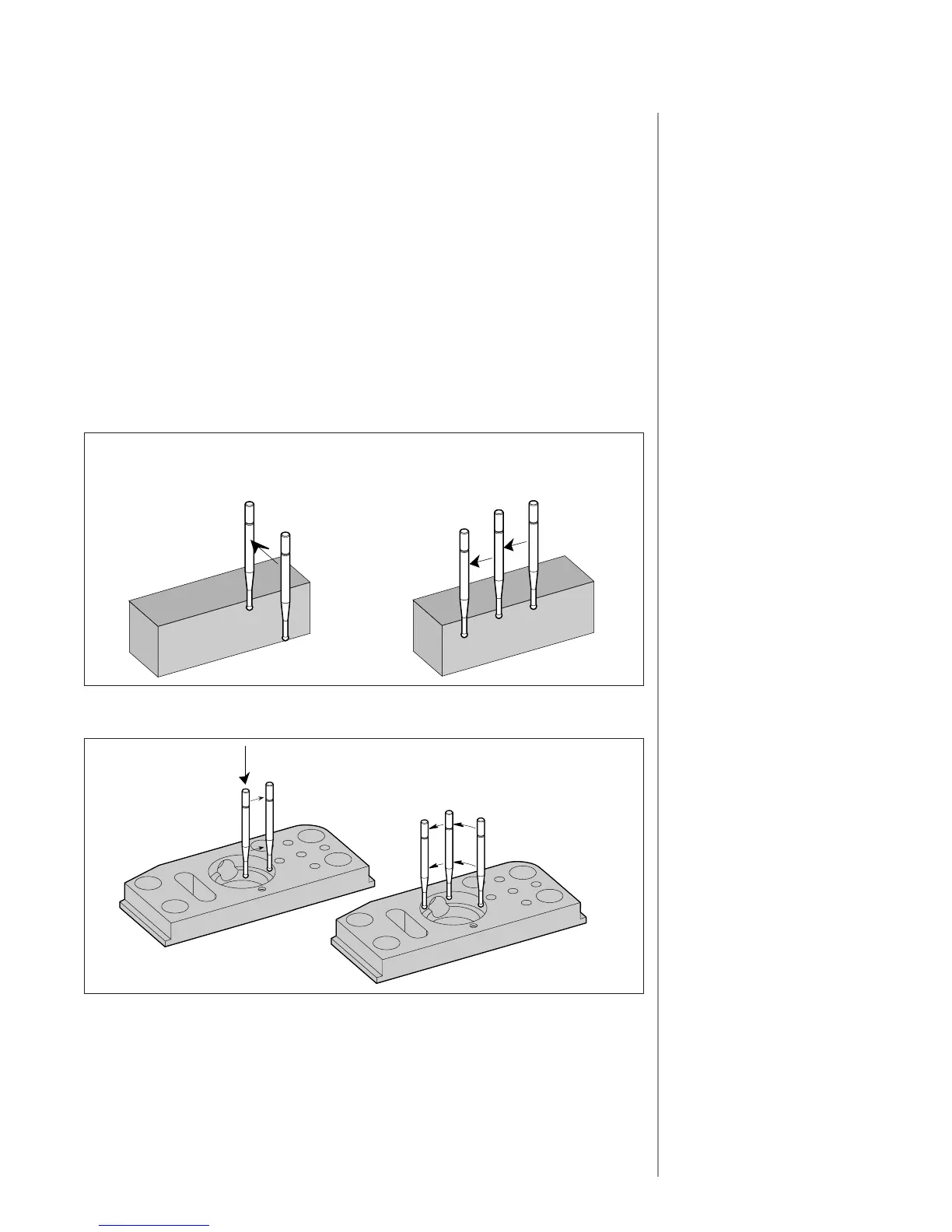
Taking Points With a Hard Probe Against a Planar Surface
Taking Points With a Hard Probe on a Round Surface
The approach of the
probe to the first point
should be as
perpendicular to
the planar surface
as possible.
The probe can be slid
against the planar surface
from point to point
only after the first point
has been taken.
The approach vector
for the first point
for a round surface
should be radial.
Points taken after
the intial point can
be tangential to the
round surface.




 To Next Page