Chapter 1. Device description
1. Device description
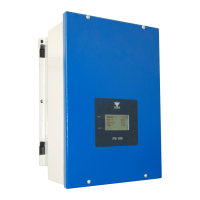
The family of single-phase, high efficiency and transformerless PS100 inverters is designed for work with
small wind turbines (equipped with permanent magnet synchronous generators) and PV installations, with an
electric power of up to 5.5 kW. These inverters converts the energy obtained from the wind and/or solar
power plant to a single-phase power grid (so-called "on-grid" systems). They operate fully autonomously.
After being installed by an authorized person, the user's role is limited to systematic monitoring of the
device's condition (failure, flooding, etc.).
Presented PS100 products family includes the following types of inverters:
• PS100-WT/1kW, PS100-WT/3kW, PS100-WT/5.5kW - inverters with WT synchronous generators
input (AC voltage input): designed for a small wind or water turbines.
• PS100-PV/1kW, PS100-PV/3kW, PS100-PV/5.5kW - inverters with PV input(s) (DC voltage
input(s)): designed for a photovoltaic panels (PV).
• PS100-H/3kW, PS100-H/5.5kW - hybrid inverters with one WT input and one PV input enabling
simultaneous connection of PV panels and a synchronous generator.
Note: the inverter power determines the total input power obtained from both sources – PV panels
and synchronous generator. Currents and voltages cannot exceed individual input values given in
Table 3.1 on page 8.
• PS100-x-BAT - each of the above types of inverters (WT, PV, H) can be equipped with a battery
charging module in the 48V DC voltage system. It enables building off-grid island systems and
intelligent energy management in "on-grid" systems. See chapter 12. Battery charger module on
page 49 for more information.
Photovoltaic panels are loaded on the basis of the following MPPT (Maximum Power Point Tracking)
algorithm, while for synchronous generators a 16-point characteristic of the generator's input current should
be introduced as a function of its frequency. In addition, load control of a synchronous generator can be done
by directly setting the load current using the MODBUS communication protocol (RTU, TCP / IP). Each of
these algorithms is designed to optimally use a renewable energy source (RES).
Using the MODBUS or Json communication protocol, you can read from the system information about:
• current inverter input and output voltages and currents,
• current output power (home appliances or electrical network),
• energy delivered in the last 24 hours,
• information on occurring failures.
The system is equipped with an extensive diagnostic and protection tools for the inverter and user. The
device is secured:
• from the mains side:
◦ protection against improper mains parameters: voltage, frequency,
◦ protection against off-grid island operation (disconnection by relays from the network in the
event of its loss);
• from the generator side: overvoltage, overcurrent, before the generator runs away;
• from the PV side: overvoltage, overcurrent;
• against too high inverter’s heat sink temperature;
• against too deep discharge of the energy storage (applies to systems with a battery charging
module marked "+ BAT").
Limitation of liability
Despite all efforts and due diligence, the Zakład Energoelektroniki TWERD (TWERD Power Electronics)
does not guarantee that the published data is free of errors. In case of any doubts or the desire to obtain
additional information, please contact us. All trademarks used are the property of their respective owners.
PS100 – User manual 5


 To Next Page