EasyManua.ls Logo

US Robotics COURIER - Page 196

US Robotics COURIER
216 pages
Print Icon
To Next Page IconTo Next Page
To Previous Page IconTo Previous Page
Loading...
-
-
-
-
-
-
-
-
COURIER HIGH SPEED MODEMS
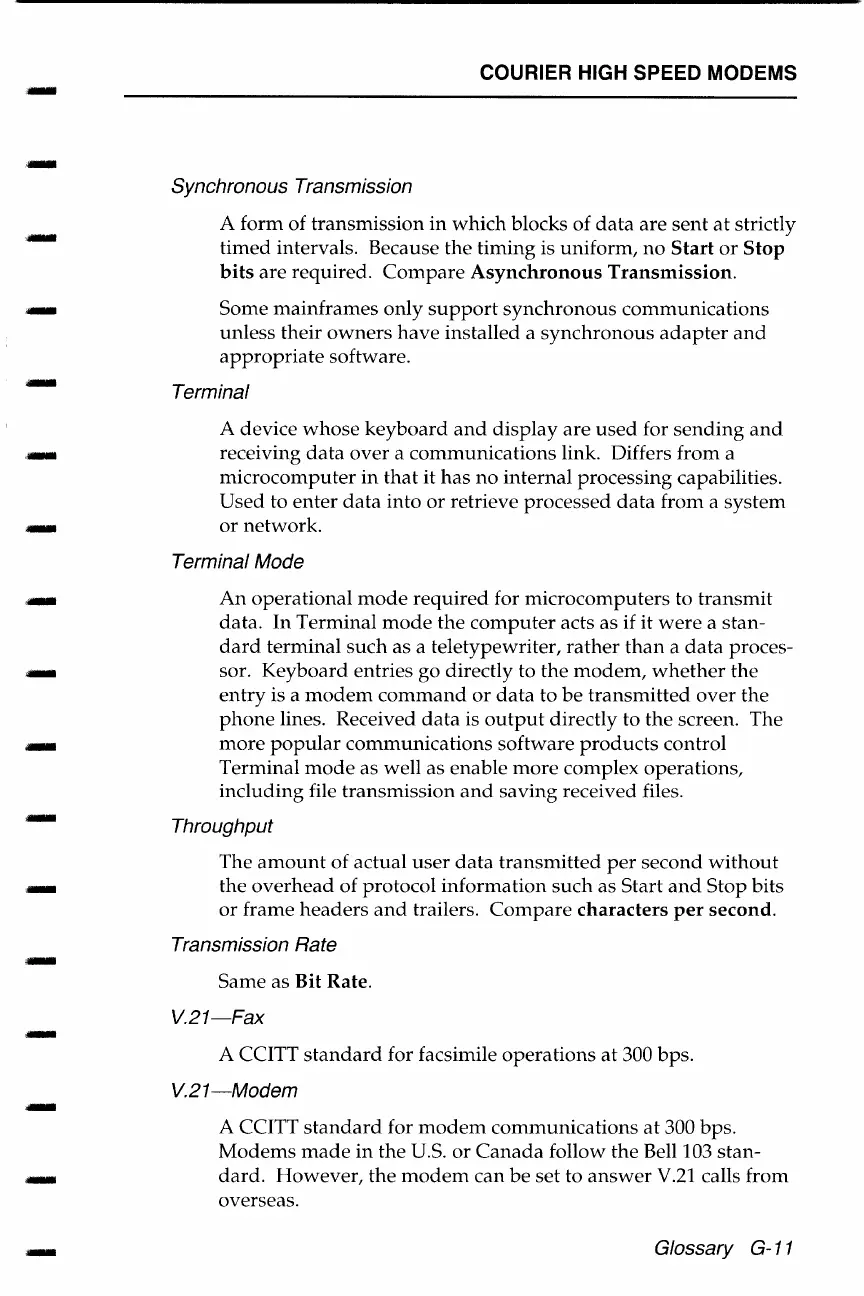
Synchronous Transmission
A
form
of
transmission
in
which
blocks of
data
are
sent
at
strictly
timed
intervals. Because
the
timing
is uniform,
no
Start
or
Stop
bits
are
required.
Compare
Asynchronous
Transmission.
Some
mainframes
only
support
synchronous
communications
unless their
owners
have
installed a
synchronous
adapter
and
appropriate
software.
Terminal
A device
whose
keyboard
and
display
are
used
for
sending
and
receiving
data
over
a
communications
link. Differs
from
a
microcomputer
in
that
it
has
no
internal
processing
capabilities.
Used
to
enter
data
into
or
retrieve processed
data
from a
system
or
network.
Terminal Mode
An
operational
mode
required
for
microcomputers
to
transmit
data.
In
Terminal
mode
the
computer
acts as
if
it
were
a stan-
dard
terminal
such
as a teletypewriter,
rather
than
a
data
proces-
sor. Keyboard entries go directly to the
modem,
whether
the
entry
is a
modem
command
or
data
to
be
transmitted
over
the
phone
lines. Received
data
is
output
directly to
the
screen. The
more
popular
communications
software
products
control
Terminal
mode
as well as enable
more
complex operations,
including
file transmission
and
saving
received files.
Throughput
The
amount
of actual
user
data
transmitted
per
second
without
the
overhead
of protocol
information
such
as Start
and
Stop bits
or
frame
headers
and
trailers.
Compare
characters
per
second.
Transmission Rate
Same as Bit Rate.
V.21-Fax
A CCITT
standard
for facsimile
operations
at
300 bps.
V.21-Modem
A CCITT
standard
for
modem
communications
at
300 bps.
Modems
made
in
the U.S.
or
Canada
follow the Bell 103
stan-
dard.
However,
the
modem
can
be
set
to
answer
V.21
calls from
overseas.
Glossary
G-11

Table of Contents

Related product manuals