EasyManua.ls Logo

US Robotics COURIER - CHAPTER 6. ASYNCHRONOUS DIALING AND ANSWERING; Modulation and Signaling Standards

US Robotics COURIER
216 pages
Print Icon
To Next Page IconTo Next Page
To Previous Page IconTo Previous Page
Loading...
-
-
-
COURIER HIGH SPEED MODEMS
CHAPTER 6. ASYNCHRONOUS DIALING AND ANSWERING
The
information
in
this
chapter
applies
to
asynchronous
calls
only.
For
synchronous
operations, refer to
Chapter
7.
BEFORE CONNECTING
For
two
modems
to connect
and
exchange
data,
they
must
use
the
same
modulation
standard
and,
for
error
control to
be
successful,
the
same
error
control protocol.
The
end-to-end
devices (the
computers,
or
DTEs)
must
use
the
same
word
length,
parity,
and
number
of
stop
bit
settings.
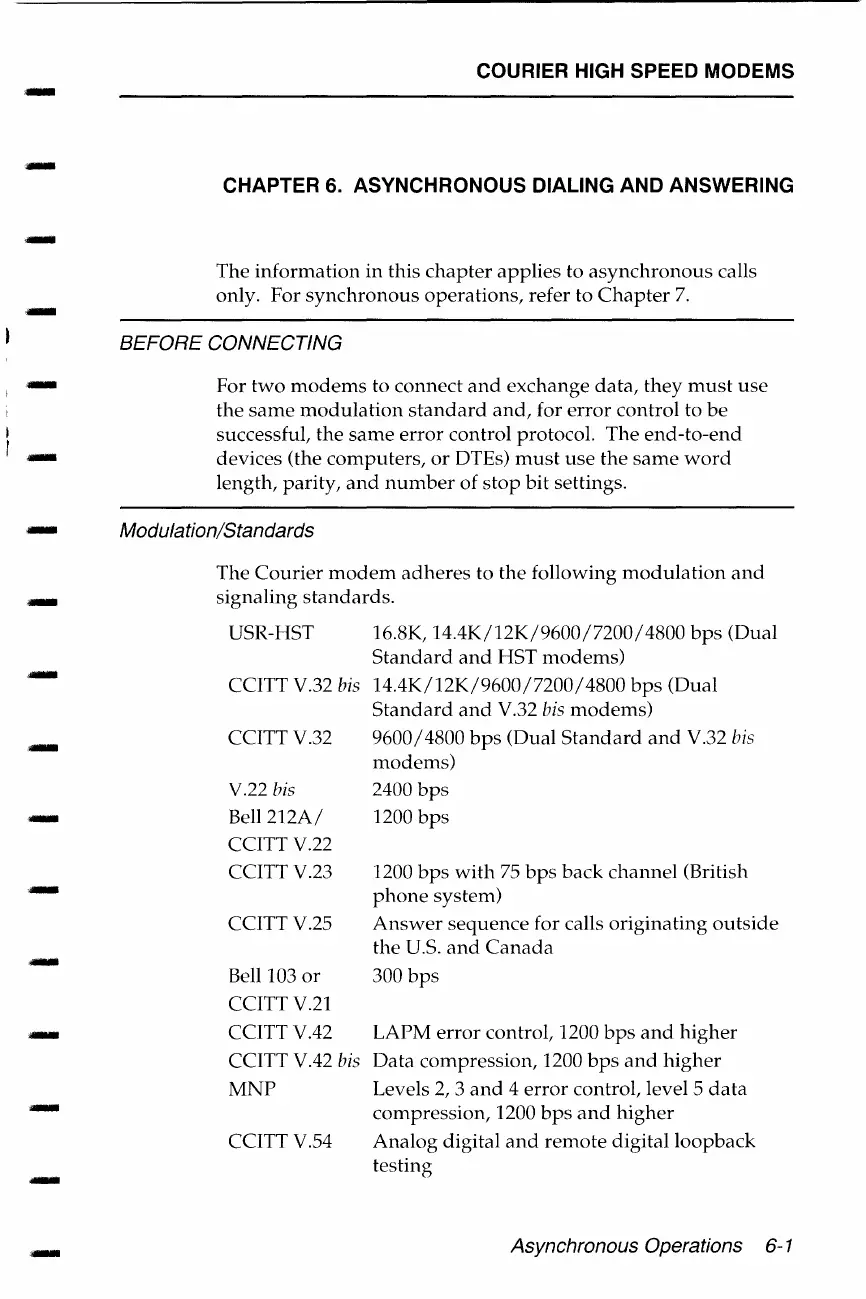
Modulation/Standards
The
Courier
modem
adheres
to
the
following
modulation
and
signaling
standards.
USR-HST
CCITT V.32
bis
CCITTV.32
V.22
bis
Bell
212A/
CCITTV.22
CCITTV.23
CCITTV.25
Bell 103
or
CCITTV.21
CCITT V.42
CCITT V.42
bis
MNP
CCITTV.54
16.8K,
14.4K/12K/9600/7200/
4800
bps
(Dual
Standard
and
HST
modems)
14.4K/12K/9600/7200/4800
bps
(Dual
Standard
and
V.32
bis
modems)
9600 I 4800
bps
(Dual
Standard
and
V .32
bis
modems)
2400
bps
1200
bps
1200
bps
with
75
bps
back
channel
(British
phone
system)
Answer
sequence
for calls
originating
outside
the
U.S.
and
Canada
300
bps
LAPM
error
control, 1200
bps
and
higher
Data
compression,
1200
bps
and
higher
Levels
2,
3
and
4
error
control, level 5
data
compression,
1200
bps
and
higher
Analog
digital
and
remote
digital
loopback
testing
Asynchronous Operations
6-1

Table of Contents

Related product manuals