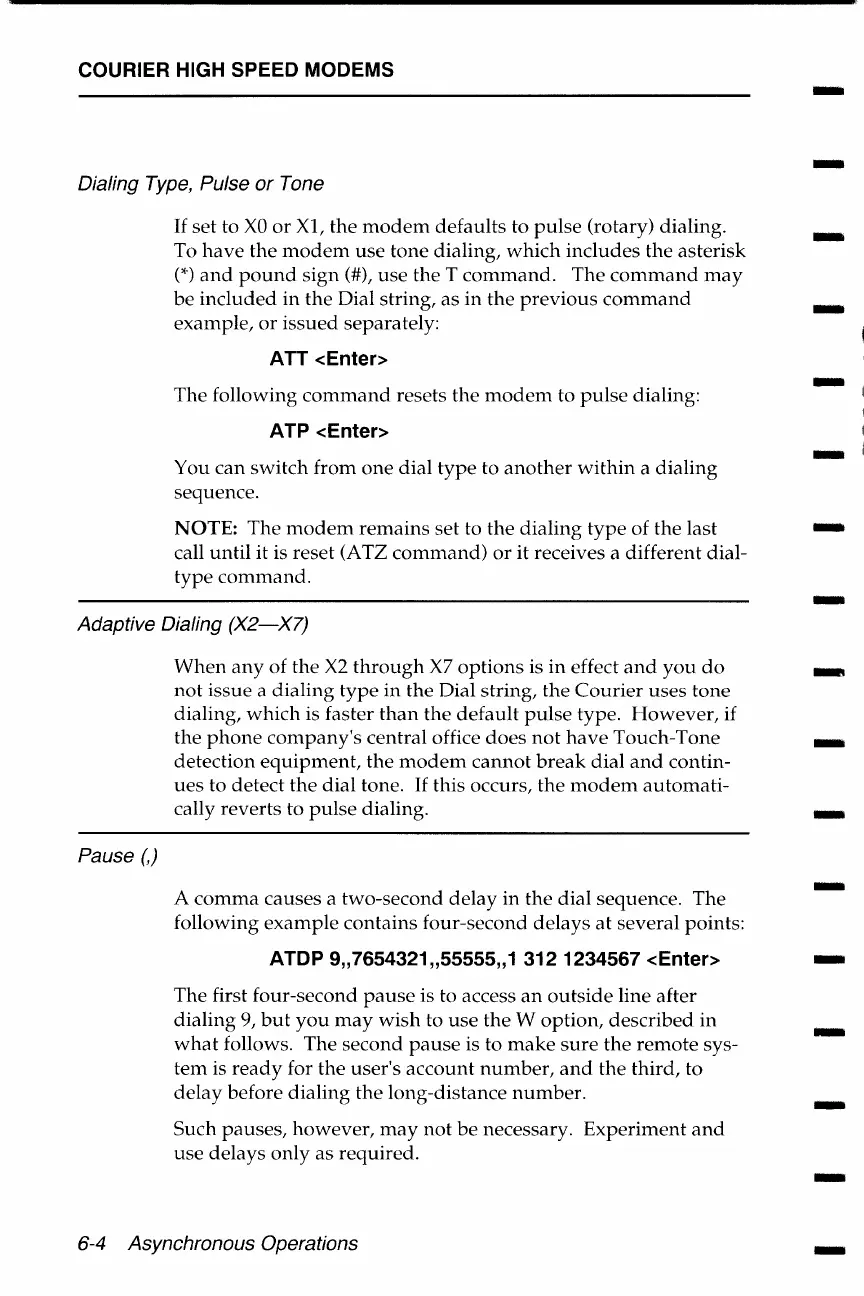
COURIER HIGH SPEED MODEMS
Dialing
Type,
Pulse or Tone
If
set
to
XO
or
Xl,
the
modem
defaults
to
pulse
(rotary) dialing.
To
have
the
modem
use
tone
dialing,
which
includes
the
asterisk
(*)
and
pound
sign(#),
use
the
T
command.
The
command
may
be
included
in
the
Dial string,
as
in
the
previous
command
example,
or
issued
separately:
ATT <Enter>
The following
command
resets
the
modem
to
pulse
dialing:
ATP <Enter>
You
can
switch
from
one
dial
type
to
another
within
a
dialing
sequence.
-
-
-
-
-
-
NOTE: The
modem
remains
set to
the
dialing
type
of
the
last -
call
until
it is reset (ATZ
command)
or
it
receives a different dial-
type
command.
Adaptive Dialing
(X2-X7)
When
any
of
the
X2
through
X7
options
is
in
effect
and
you
do
not
issue a
dialing
type
in
the Dial string,
the
Courier
uses
tone
dialing,
which
is faster
than
the
default
pulse
type.
However,
if
-
the
phone
company's
central office
does
not
have
Touch-Tone _
detection
equipment,
the
modem
cannot
break
dial
and
contin-
ues
to detect
the
dial
tone.
If
this occurs,
the
modem
automati-
cally
reverts
to
pulse
dialing. _
Pause(,)
A
comma
causes a
two-second
delay
in
the
dial sequence. The
following
example
contains four-second
delays
at
several points:
ATOP 9,,7654321,,55555,,13121234567 <Enter>
The first four-second
pause
is to access
an
outside
line after
dialing
9,
but
you
may
wish
to
use
the
W
option,
described
in
what
follows. The
second
pause
is to
make
sure
the
remote
sys-
tem
is
ready
for
the
user's
account
number,
and
the
third, to
delay
before
dialing
the
long-distance
number.
Such
pauses,
however,
may
not
be
necessary.
Experiment
and
use
delays
only
as
required.
6-4 Asynchronous Operations
-
-
-
-
-
-




 To Next Page