~ 18 ~
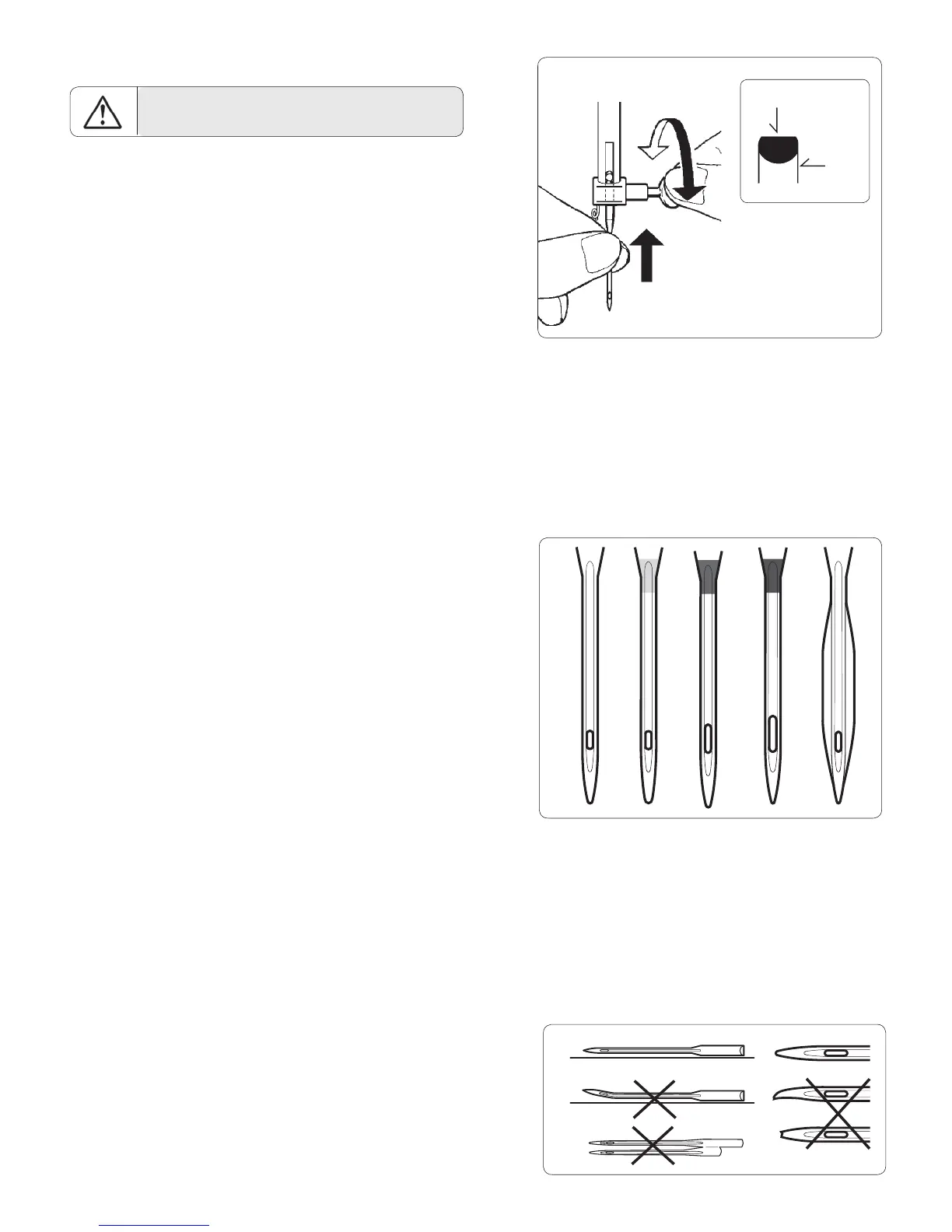
CHANGE THE NEEDLE
1. Raise the needle to its highest position by turning the hand
wheel.
2. Loosen the needle clamp screw by turning it toward you.
3. Remove the needle by pulling it downward.
4. Insert the new needle into the needle clamp with the Á at side
toward the back.
5. Push the needle up as far as it will go.
6. Tighten the needle clamp screw À rmly with the screw driver.
Always disconnect the machine from power supply by
removing the plug from the wall-outlet.
Flat side toward
the back
Flat side
Needle
1
2
A
E
B
D
NEEDLES
The sewing machine needle plays an important role in successful
sewing. To ensure you will get a quality needle, we recommend
INSPIRA™ needles of system 130/705H. Below, À nd a
description of the most frequently used needles for sewing on
woven and stretch fabrics.
Universal needle (A)
Universal needles have a slightly rounded point and come in a
variety of sizes. For general sewing in a variety of fabric types and
weights.
Stretch needle (B)
Stretch needles have a special scarf to eliminate skipped stitches
when there is a Á ex in the fabric. For knits, swimwear, Á eece,
synthetic suedes and leathers. Marked with a yellow band.
Embroidery needle (C)
Embroidery needles have a special scarf, a slightly rounded point
and a slightly larger eye to avoid damage to thread and materials.
Use with metallic and other specailty threads for embroidery and
decorative sewing.
Denim needle (D)
Denim needles have a sharp point to penetrate tightly woven fabrics
without deÁ ecting the needle. For canvas, denim, microÀ bers.
Marked with a blue band.
Wing needle (E)
The Wing needle has wide wings on the side of the needle to poke
holes in the fabric when sewing entredeux and other hemstitches
on natural À ber fabrics.
Note: Change the needle often. Always use a straight needle with a sharp point
(1). A damaged needle (2) can cause skipped stitches, breakage of needles or
snapping of thread. A damaged needle can also damage the stitch plate.
Do not use asymmetrical twin needles (3) since they may damage your sewing
machine.
C
3



 To Next Page