DIESEL
FUEL,
ENGINE
OIL
AND
ENGINE
COOLANT
DIESEL
FUEL
Use
a
diesel
fuel
that
meets
the
requirements
of
No.
2-D
SAE
J
313
and
has
a
Cetane
rating
of
#45
or
higher
grade
of
diesel
fuel
according
to
ASTM
D975
Care
Of
The
Fuel
Supply
Use
only
clean
diesel
fuel!
The clearance of
the
components
in
your
engines
fuel
injection
pump
is
very
critical;
invisible
dirt
pruticles
which
might
pass
through
the
primary
and
sec-
ondary
filters
can
damage
these
finely
machined
pm1s.
It
is
important
to
buy
clean
fuel,
and
keep
it
clean.
The
best
fuel
can
be
rendered
unsatisfactory
by
careless
handling
or
improper storage
facilities.
To
ensure
that
the
fuel
going
into
the
tank
for
your
engine's daily
use
is
clean
and
pure,
the
following
practice
is
advisable:
Purchase a
well-known
brand
of
fuel.
The
use
of
additives
to
combat
BACTERIAL
gro\Yth
in
the
fuel
tank
is
recommended
such
as
Bio-Bor
and
an
additive such
as
Diesel
Kleen
+ ·
Cetane
Boost.
to
help
restore lubricity
back
into
the
diesel
fuel
when
an
Ultra
Low
Sulfur
diesel
is
being
used.
Install and
regulru·Iy
service
a
good,
visual-type
fuel
filter/water separator
between
the
fuel
tank
and
the
engine.
The
Raycor
500
MA
or 230
RMAM
are
good
examples
of
such
filters.
A
10
micron
filter
element
is
recommended.
ENGINE
OIL
Use
a
heavy
duty
diesel
oil
with
an
API
classification
of
CF,
CG-4,
CH-4
or
Cl-4.
Change
the
engine
oil
and
filter
after
an
initial 50
itours
of break-in operation. Then
follow
the
oil
and
filter
change
intervals
as
specified
in
the
MAINTENANCE
SCHEDULE
in
this
manual.
Westerbeke
Corporation
does
not approve or
disapprove
the
use of synthetic oils. If
synthetic
oils
are
used,
engine break-in must
be
performed
using
conventional
oil.
Oil
change intervals
must
be
as
listed
in
the
MAINTENANCE
SCHEDULE
section of
this
manual
and
not
be
extended
if synthetic oils
are
used.
NOTE:
The
information
above
supersedes
all
previous
statements
regarding
synthetic
oil.
SAE
OIL
VISCOSITY
For
all
temperature ranges: SAE lSW-40 or
SAE
lOW-40.
ENGINE
COOLANT
WESTERBEKE
recommends
a
mixture
of 50% antifreeze
and
50%
distilled
water.
Distilled
water
is
free
from
the
chemicals
that
can
corrode
internal
engine
surfaces.
The
antifreeze
performs
double
duty.
It
allows
the
engine
to
run
at
proper
temperatures
by
transferring
heat
away
from
the
engine
to
the
coolant,
and
lubricates
and
protects the
cooling
circuit
from
rust
and
corrosion.
Look
for
a good
quality
antifreeze
that
contains
Supplemental
Cooling
Additives
(SCAs)
that
keep
the
antifreeze chemically
balanced,
crucial
to
long
term
protection.
The
distilled water
and
antifreeze
should
be
premixed
before
being
poured
into
the
cooling
circuit.
NOTE:
Look
for
the
new
environmentally-friendly
long
lasting
antifreeze
that
is
now
available.
.
PURCHASING
ANTIFREEZE
.
Select
a brand of antifreeze specified for diesel
engines.
Antifreeze
specified
for diesel engines contains a special
additive
to
protect against cavitation erosion of
the
engine's
cylinder
walls.
Prestone andZerex
are
two
nationally
known
brands
that
offer
antifreeze specifically for
use
in diesel
engines.
Select
the
pre-mixed variety so that
the
correct
mixture
will
always
be added to the cooling system
when
needed.
Change
the
antifreeze mixture according
to
the
MAINTENANCE
SCHEJ?ULE
in
this
manual.
MAINTENANCE
Change
the
engine coolant
every
five
years
regardless of
the
number
of operating
hours
as
the
chemical
additives
that
protect
and
lubricate
the
engine
have
a
limited
iife.
COOLANT
RECOVERY
TANK
The
coolant
recovery
tank
allows
for
the
expansion
and
contraction
of
the
engines
coolant
during
engine
operation
without
introducing air
into
the
system.
This
recovery
tank
is
provided
with
fresh
water
cooled
models
and
with
the
fresh
water
coolant conversion kit
and
must
be
installed
before
operating
the
engine.
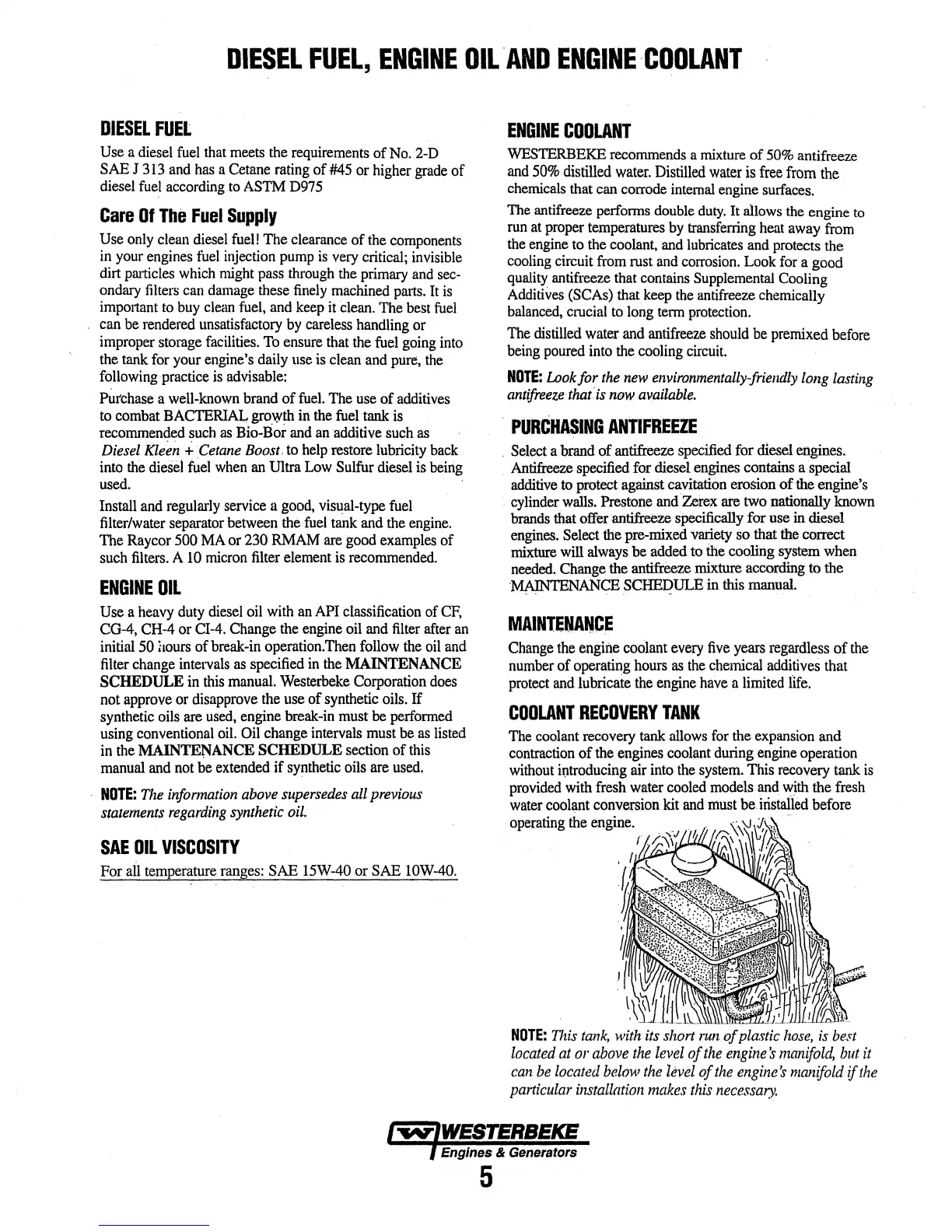
r
NOTE:
771is
tank,
•vith
its
short
run
of
plastic
hose,
is
best
located
at
or
above
the
level
of
the
engines
manifold,
but
it
can
be
located
below
the
level
of
the
engines
manifold
if
the
particular
installation
makes
this
necessary.
Engines & Generators
5


 To Next Page