EasyManua.ls Logo

Westerbeke 20.0 BEDA - Fuel Injector Testing and Pattern

Westerbeke 20.0 BEDA
72 pages
Print Icon
To Next Page IconTo Next Page
To Previous Page IconTo Previous Page
Loading...
ENGINE
ADJUSTMENTS
If the pressure
is
different
from
the
standard value,
adjust
to
the
specified pressure
by
increasing or decreasing
the
thick-
ness of
the
adjusting shim.
The shim
has
10
different thicknesses for
every
0.05 mm
(0.0020
in)
from
1.0
mm
(0.0393
in)
to
1.95
mm
(0.0768
in).
As
0.05
mm
(0.0020 in)
is
increased,
approx.
5.0
kg/cm
2
(71.1lb/in
2
)
of injection pressure increases.
When replacing
the
shim,
grip the retaining
nut
in
a vise
and
remove
the
body
with
a wrench. Tighten
the
retaining
nut
to
the specified torque.
INSPECTING
THE
SPRAY
PAnERN
1.
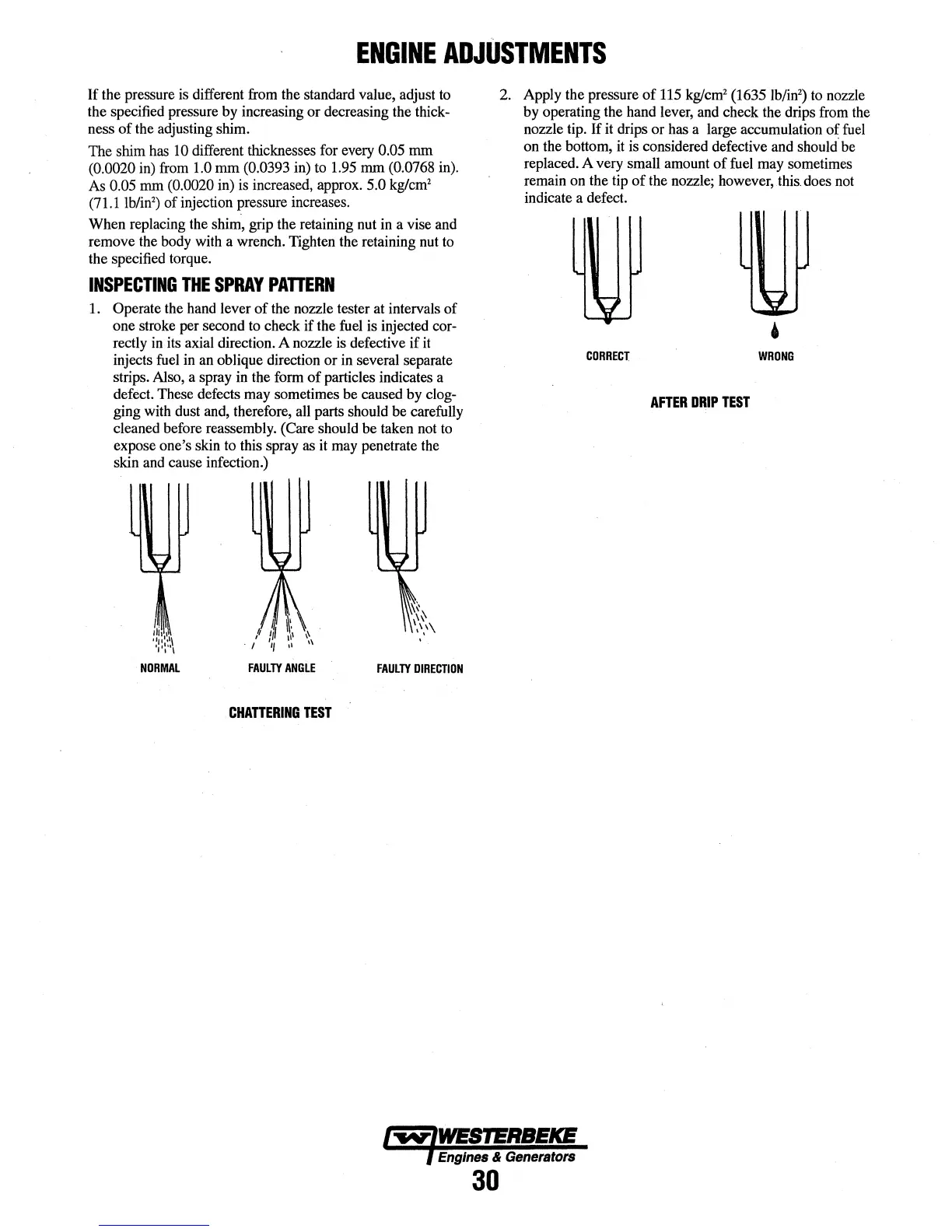
Operate the
hand
lever of the
nozzle
tester at intervals of
one
stroke
per
second
to
check if the
fuel
is
injected cor-
rectly
in
its axial direction. A nozzle
is
defective if
it
injects
fuel
in
an
oblique direction or
in
several separate
strips.
Also,
a
spmy
in
the
form
of particles indicates a
defect. These defects
may
sometimes
be
caused by
clog-
ging with
dust
and,
therefore,
all
parts should
be
carefully
cleaned
before
reassembly.
(Care should
be
taken
not
to
expose one's skin
to
this
spray
as
it
may
penetrate
the
skin
and
cause infection.)
NORMAL
FAULTY
ANGLE
FAULTY
DIRECTION
CHATTERING
TEST
2.
Apply
the
pressure of
115
kglcm
2
(1635lb/in
2
)
to
nozzle
by
operating the
hand
lever,
and
check
the
drips
from
the
nozzle
tip.
If
it
drips or has a
large
accumulation of
fuel
on
the
bottom,
it
is
considered defective
and
should.
be
replaced. A
very
small
amount
of
fuel
may
sometimes
remain
on
the
tip
of
the
nozzle;
however,
this.
does
not
indicate a defect.
CORRECT
WRONG
AFTER
DRIP
TEST
Engines
&
Generators
30

Table of Contents

Related product manuals