STARTING/STOPPING
PROCEDURE
THE
STARTING
SYSTEM
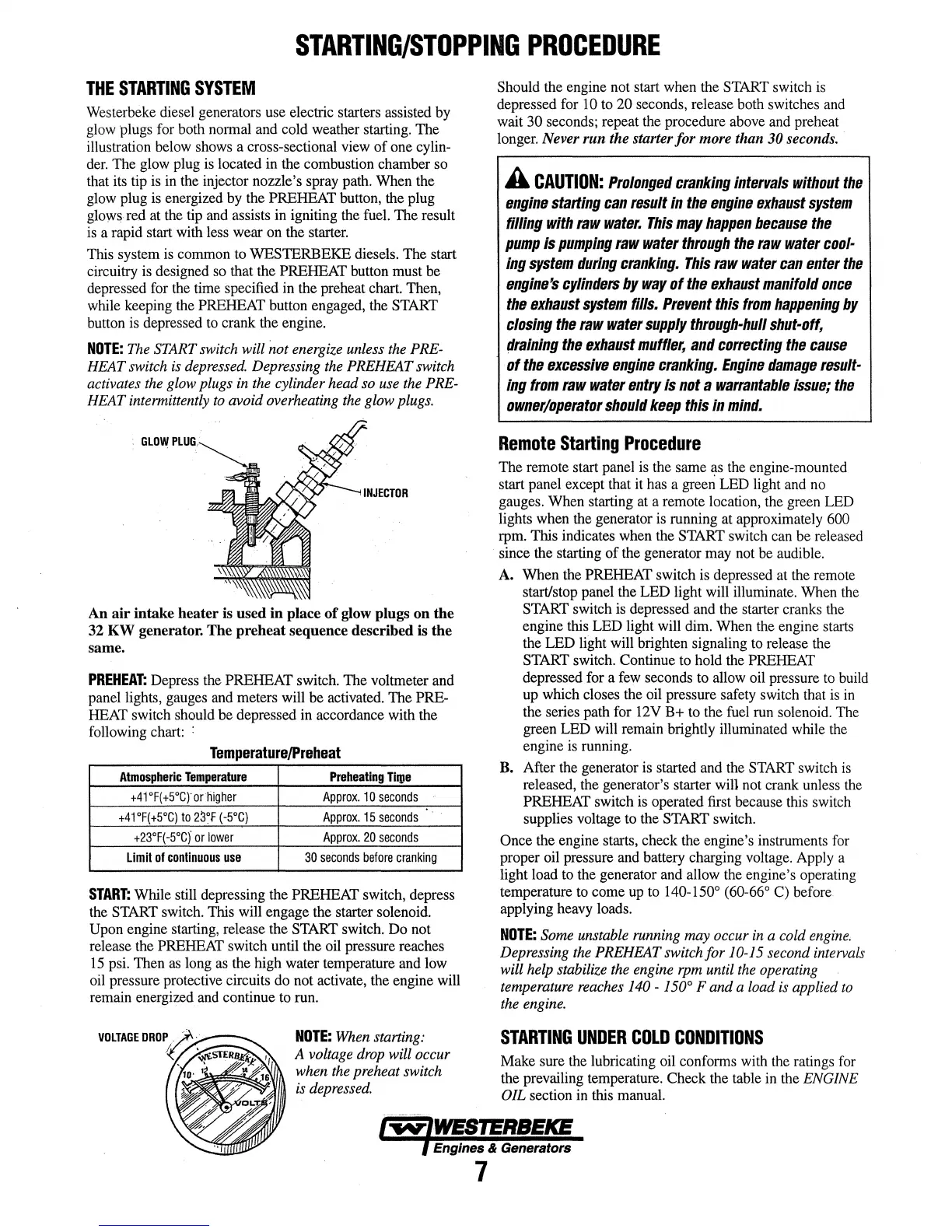
Westerbeke
diesel
generators
use
electric starters assisted
by
glow
plugs
for
both nonnal
and
cold weather starting. The
illustration
below
shows
a cross-sectional
view
of one cylin-
der.
The
glow
plug
is
located
in
the combustion chamber
so
that
its
tip
is
in
the
injector nozzle's spray
path.
When
the
glow
plug
is
energized
by
the
PREHEAT
button,
the
plug
glows
red
at
the
tip
and
assists in igniting the
fuel.
The result
is
a rapid start
with
less
wear
on
the
starter.
This
system
is
common
to
WES1ERBEKE diesels. The start
circuitry
is
designed
so
that the
PREHEAT
button must
be
depressed
for
the
time
specified in the preheat
chart.
Then,
while
keeping
the
PREHEAT
button engaged, the
START
button
is
depressed
to
crank the engine.
NOTE:
The
START switch will not
energize
unless
the
PRE-
HEAT
switch
is
depressed.
Depressing
the
PREHEAT switch
activates
the
glow
plugs
in
the
cylinder head
so
use
the
PRE-
HEAT intermittently
to
avoid overheating
the
glow
plugs.
•
GLOW
An
air
intake
heater
is
used
in
place
of
glow pings
on
the
32
KW
generator.
The
preheat
sequence described is
the
same.
PREHEAT:
Depress the
PREHEAT
switch. The voltmeter and
panel lights,
gauges
and
meters
will
be activated. The
PRE-
HEAT
switch should be depressed
in
accordance with the
following
chart:
:
Temperature/Preheat
Atmospheric
Temperature
Preheating
Tillie
+41
•f(
+5"C).
or
higher
Approx.
10
seconds
+41"F(
+5.C)
to
23~f
(
-s·c)
Approx.
15
seconds
+23.F(-5"Cf
or
lower
Approx.
20
seconds
Limit
of
continuous
use
30
seconds
before
cranking
START:
While still depressing the
PREHEAT
switch, depress
the
START
switch.
This
will
engage the starter solenoid.
Upon
engine starting, release the
START
switch.
Do
not
release the
PREHEAT
switch until the oil pressure reaches
15
psi.
Then
as
long
as
the high water temperature
and
low
oil
pressure protective circuits
do
not
activate,
the engine
will
remain energized
and
continue
to
run.
NOTE:
When
starting:
A voltage
drop
will occur
when
the
preheat switch
is
depressed.
Should the engine
not
start
when
the
START
switch
is
depressed
for
10
to
20 seconds, release both switches
and
wait 30 seconds; repeat
the
procedure
above
and
preheat
longer.
Never run the starter for more than 30 seconds.
A
CAUTION:
Prolonged
cranking
Intervals
without
the
engine
starting
can
result
In
the
engine
exhaust
system
filling
with
raw
water.
This
may
happen
because
the
pump
Is
pumping
raw
water
through
the
raw
water
cool-
Ing
system
during
cranking.
This
raw
water
can
enter
the
engine's
cylinders
by
way
of
the
exhaust
manifold
once
the
exhaust
system
fills.
Prevent
this
from
happening
by
closing
the
raw
water
supply
through-hull
shut-off,
f/ralnlng
the
exhaust
muffler,
and
correcting
the
cause
of
the
excessive
engine
cranking.
Engine
damage
result-
Ing
from
raw
water
entry
Is
not
a
warrantable
Issue;
the
owner/operator
should
keep
this
In
mind.
Remote
Starting
Procedure
The remote start
panel
is
the same
~s
the
engine-mounted
start panel except that
it
has
a green
LED
light
and
no
gauges.
When
starting
at
a remote location, the green
LED
lights
when
the
generator
is
running
at
approximately
600
rpm.
This indicates
when
the
START
switch
can
be released
since
the
starting of the generator
may
not
be
audible.
A. When
the
PREHEAT
switch
is
depressed at
the
remote
start/stop panel the LED light
will
illuminate.
When
the
START
switch
is
depressed
and
the
starter cranks the
engine this LED light will
dim.
When
the engine
starts
the LED light will brighten signaling
to
release
the
START
switch.
Continue
to
hold the
PREHEAT
depressed for a
few
seconds to
allow
oil pressure
to
build
up which closes
the
oil
pressure safety switch that
is
in
the series path for
12V
B+
to
the
fuel
run
solenoid. The
green
LED
will
remain brightly illuminated
while
the
engine
is
running.
B.
After
the
generator
is
started and
the
START
switch
is
released, the generator's starter
will
not
crank
unless
the
PREHEAT switch is operated
first
because
this
switch
supplies voltage
to
the
START
switch.
Once the engine starts, check the engine's instruments
for
proper
oil
pressure
and
battery charging
voltage.
Apply
a
light load
to
the
generator
and
allow
the
engine's operating
temperature
to
come
up
to
140-150°
(60-66°
C)
before
applying
heavy
loads.
NOTE:
Some
unstable
running
may occur
in
a cold
engine.
Depressing
the
PREHEAT switch for 10-15 second
intervals
will help stabilize
the
engine
rpm
until
the
operating
temperature
reaches
140-
150° F
and
a
load
is
applied
to
the
engine.
STARTING
UNDER
COLD
CONDITIONS
Make sure
the
lubricating oil confonns with
the
ratings
for
the
prevailing temperature. Check
the
table
in
the
ENGINE
OIL section
in
this manual.
Engines & Generators
7



 To Next Page