ENGINE
COOLING
CIRCUIT
Refilling
the
Coolant
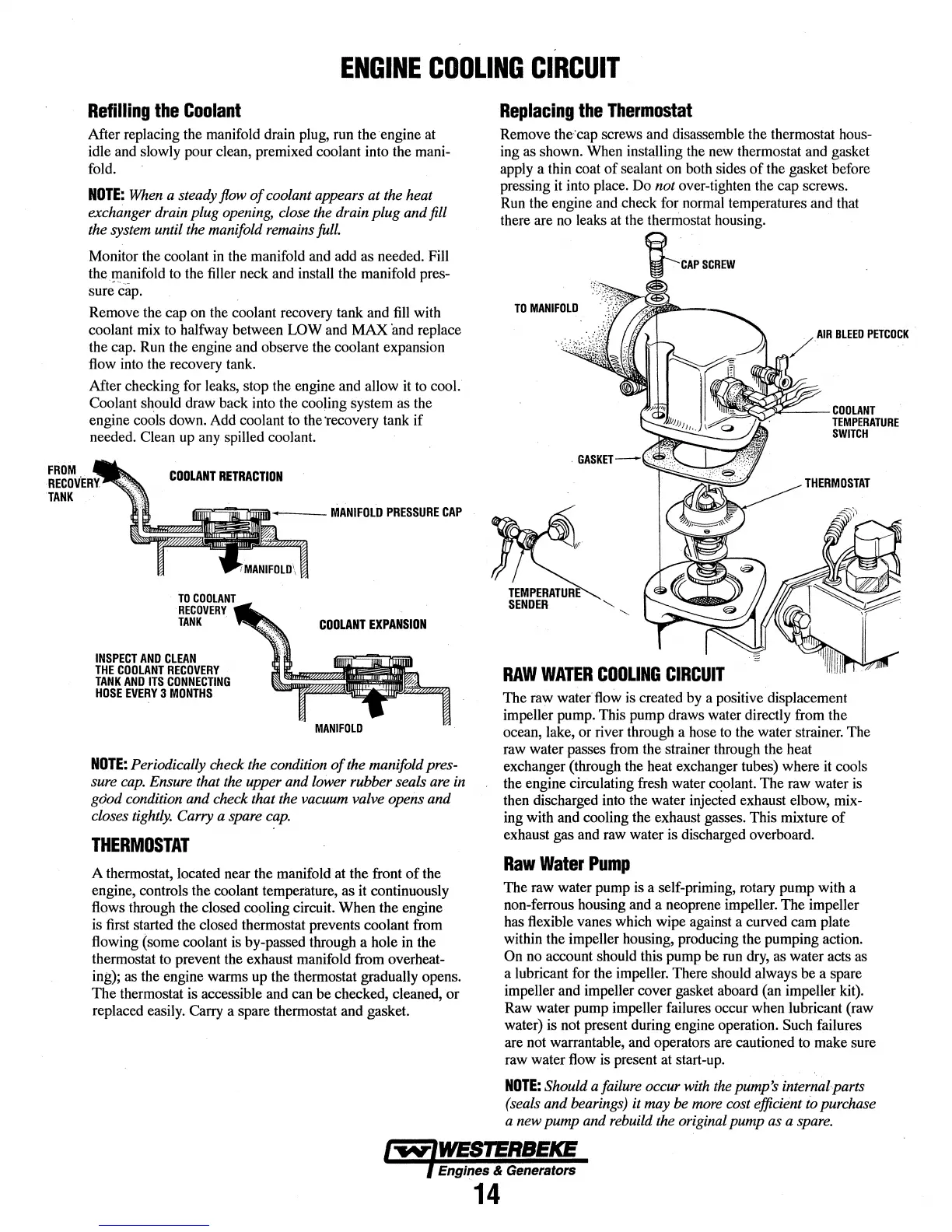
After replacing the manifold drain plug, run the engine at
idle and slowly pour clean, premixed coolant into the mani-
fold.
NOTE:
When a steady flow
of
coolant appears at the heat
exchanger drain plug opening, close the drain
plug
and fill
the system until the manifold remains full.
Monitor the coolant
in
the manifold and add as needed. Fill
the
!llanifold to the filler neck and install the manifold pres-
sure cap.
Remove the cap on the coolant recovery tank and
fill
with
coolant mix to halfway between
LOW and MAX imd replace
the cap. Run the engine and observe the coolant expansion
flow into the recovery tank.
After checking for leaks, stop the engine and allow it to cool.
Coolant should draw back into the cooling system as the
engine cools down. Add coolant to the
·recovery tank if
needed. Clean up any spilled coolant.
COOLANT
RETRACTION
TO
COOLANT
RECOVERY
TANK
INSPECT
AND
CLEAN
THE
COOLANT
RECOVERY
TANK
AND
ITS
CONNECTING
HOSE
EVERY
3
MONTHS
-----
MANIFOLD
PRESSURE
CAP
COOLANT
EXPANSION
NOTE:
Periodically check the condition
of
the manifold pres-
sure cap. Ensure that the upper and lower rubber seals are in
good condition and check that the vacuum valve opens and
closes tightly. Carry a spare cap.
THERMOSTAT
A thermostat, located near the manifold at the front
of
the
engine, controls the coolant temperature, as it continuously
flows through the closed cooling circuit. When the engine
is first started the closed thermostat prevents coolant from
flowing (some coolant is by-passed through a hole in the
thermostat to prevent the exhaust manifold from overheat-
ing); as the engine warms up the thermostat gradually opens.
The thermostat is accessible and can be checked, cleaned, or
replaced easily.
Carry
a spare thermostat and gasket.
Replacing
the
Thermostat
Remove the·cap screws and disassemble the thermostat hous-
ing as shown. When installing the new thermostat and gasket
apply a thin coat
of
sealant on both sides
of
the gasket before
pressing it into place. Do not over-tighten the cap screws.
Run the engine and check for normal temperatures and that
there are no leaks at the thermostat housing.
TO
MANIFOLD
RAW
WATER
COOLING
CIRCUIT
/
AIR
BLEED
PETCOCK
\~'----COOLANT
TEMPERATURE
SWITCH
The raw water flow is created by a positive displacement
impeller pump. This pump draws water directly from the
ocean, lake, or river through a hose to the water strainer. The
raw water passes from the strainer through the heat
exchanger (through the heat exchanger tubes) where
it
cools
the engine circulating fresh water
cqolant. The raw water
is
then discharged into the water injected exhaust elbow, mix-
ing with and cooling the exhaust gasses. This mixture
of
exhaust gas and raw water is discharged overboard.
Raw
Water
Pump
The raw water pump is a self-priming, rotary pump with a
non-ferrous housing and a neoprene impeller.
The
impeller
has flexible vanes which wipe against a curved cam plate
within the impeller housing, producing the pumping action.
On no account should this pump be run dry, as water acts as
a lubricant for the impeller. There should always be a spare
impeller and impeller cover gasket aboard (an impeller kit).
Raw water pump impeller failures occur when lubricant (raw
water) is not present during engine operation. Such failures
are not warrantable, and operators are cautioned to make sure
raw water flow is present at start-up.
NOTE:
Should a failure occur with the pump's internalparts
(seals and bearings) it may be more cost efficient to purchase
a new
pump
and rebuild the original
pump
as a spare.
Engines & Generators
14



 To Next Page